A 160-meter asteroid could threaten a city, yet stopping one may not require hitting it directly. New simulations suggest a nuclear explosion several meters away could fracture such an object through an intense burst of X-rays.
Astrophysicist Isaiah Santistevan and colleagues at Lawrence Livermore National Laboratory modeled a 1-megaton nuclear explosive device against a rocky asteroid based on the shape of Bennu. Their findings point to nuclear standoff explosions as a possible last-resort defense when warning time is short.
The idea differs from the familiar image of planting a bomb on an asteroid. In these scenarios, the device never touches the surface. Instead, it detonates nearby, allowing radiation from the blast to strike the asteroid across a broad area.
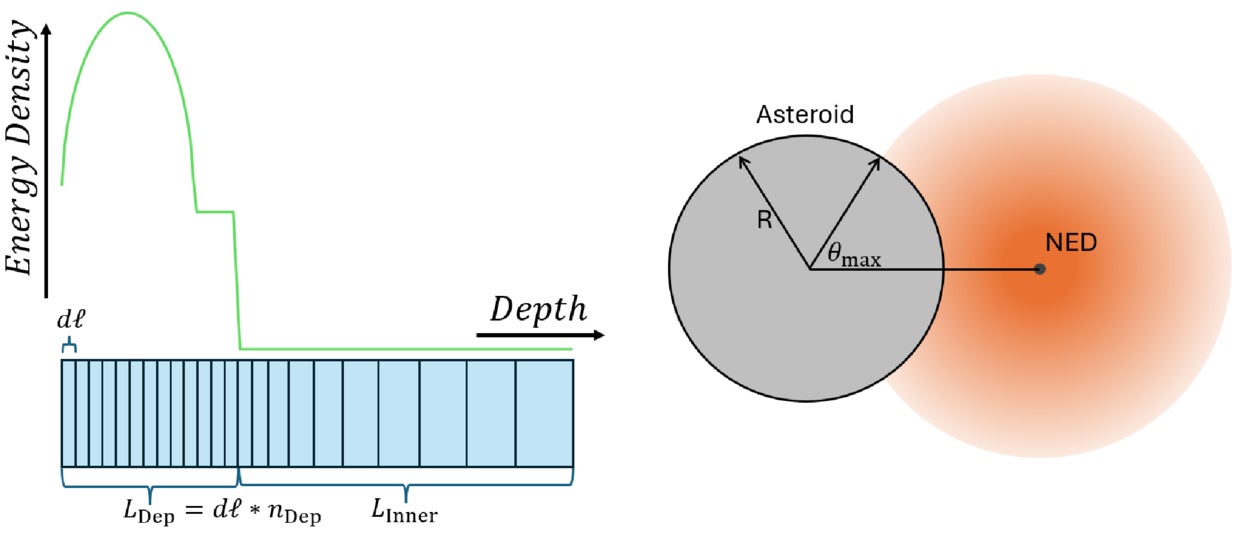
A conventional shock wave cannot travel through the vacuum of space the way it does through air. But a nuclear detonation can release roughly 70% to 80% of its energy as X-rays.
Those X-rays deposit energy in a thin layer near the asteroid’s surface. The heated material vaporizes and blows away. If that material escapes the asteroid’s gravity, the ejection transfers momentum to the remaining body and changes its velocity.
The energy also drives a shock into the asteroid. With enough force, that shock can crack the interior, spread damage and help pull the object apart.
“These X-rays deposit energy in a thin surface layer of the asteroid, driving vaporization and ablation,” the researchers explain. “The vaporized material expands, and if it can overcome the local gravitational field, it is ejected, which imparts a change in momentum that alters the asteroid’s velocity.”
The team first checked whether its Spheral simulation code could reproduce earlier nuclear-deflection calculations. In 1,555 one-dimensional comparisons with the Ares code, the results had a standard deviation of 0.8% in blow-off momentum. Nearly 88% of the cases differed by no more than 1%.
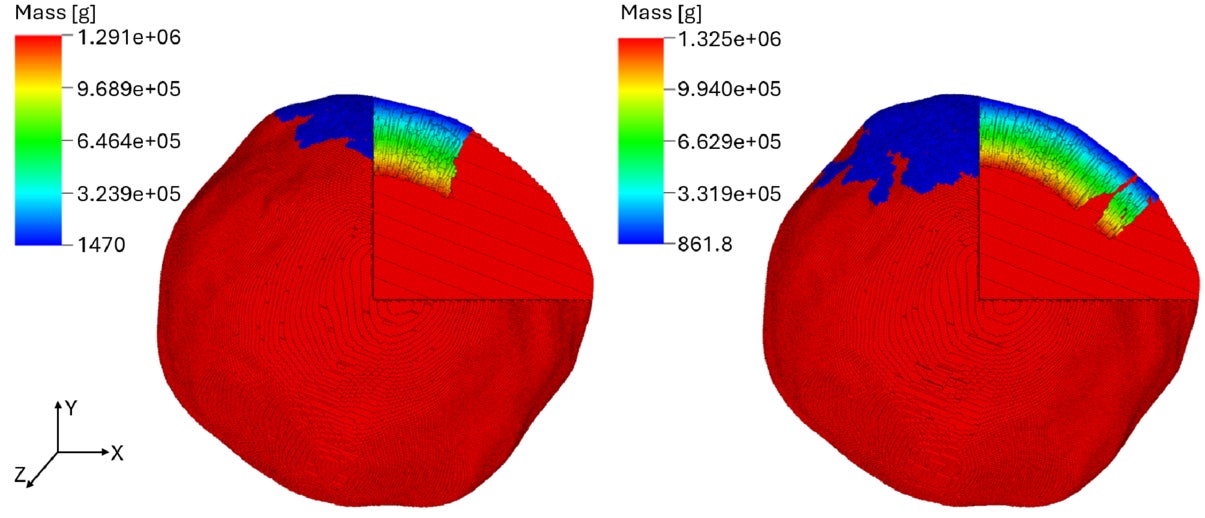
The main tests used an irregular asteroid about 160 meters wide with the shape of Bennu. The modeled body had about 30.8% porosity and a mass of roughly 3.6 billion kilograms.
The researchers ran three simulations. Two used fracture parameters based on the Chelyabinsk meteorite, with detonations 10 meters and 25 meters above the surface. A third used parameters based on the Aba Panu meteorite at 25 meters.
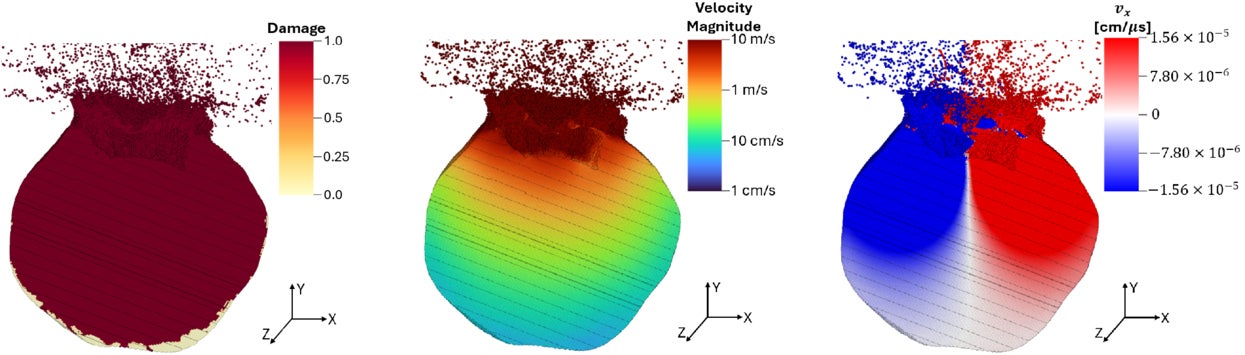
The 10-meter Chelyabinsk case ran the longest. After 145 milliseconds, 98.2% of the asteroid’s material was fully damaged. About 97% was moving faster than escape velocity, while 27% exceeded 10 times that speed.
Large regions were also moving sideways in opposite directions. About 22% of the asteroid moved one way faster than twice escape velocity, while 23% moved just as quickly the other way. The pattern suggested the body was pulling itself apart.
The calculated velocity change reached 66.05 centimeters per second, or 8.37 times the asteroid’s escape velocity. That passed the threshold associated with fragmentation, but remained below the 10-times-escape-velocity benchmark for robust disruption.
The 25-meter Chelyabinsk simulation produced a surprising result. Although the asteroid absorbed only 30 kilotons of energy, compared with 55.4 kilotons in the 10-meter case, damage spread more widely.
After 68 milliseconds, 92.6% of the asteroid was fully damaged in the 25-meter case. At the same point, the 10-meter simulation had reached 78.1%.
Moving the explosion farther away reduced the peak energy reaching the surface, but spread the X-rays across more of the asteroid.
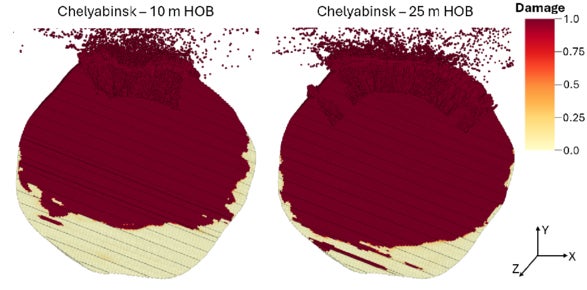
That case also produced a velocity change of 66.73 centimeters per second by 68 milliseconds, or 8.46 times escape velocity. The damage and internal motion both pointed toward likely disruption.
The Aba Panu case showed why material properties matter. At 34 milliseconds, only 34.2% of the asteroid was fully damaged, compared with 60.2% in the Chelyabinsk model under the same geometry. Both had similar velocity changes near 53 centimeters per second, but the Aba Panu parameters made damage harder to spread.
The biggest uncertainty is what happens later. The researchers could not run the models long enough to see the final field of fragments.
The longest simulation used 1,680 processors for 59 days and reached only 145 milliseconds. Robust disruption would require following the broken asteroid much longer to determine whether dangerous fragments remained or later reassembled under gravity.
That distinction matters because the goal is not simply to shatter an asteroid. Robust disruption means breaking and dispersing the body so that no coherent remnant larger than about 10 meters remains a threat.
The models also had resolution limits. Earlier comparisons showed Spheral missed some of the fastest ejecta, making the reported velocity changes likely conservative. Limited resolution can also overestimate how much material becomes damaged, so better calculations are still needed.
“These results are a step toward the immensely difficult problem of doing comprehensive nuclear mitigation modeling for planetary defense scenarios,” the researchers write. “High-fidelity simulations such as the ones presented here allow us to continue pushing the limits of what is possible.”
The work gives planetary-defense planners a more detailed way to evaluate nuclear standoff explosions for large asteroids or short-warning scenarios. It also shows that blast distance cannot be chosen only to maximize the energy striking one spot.
A larger standoff distance may spread X-rays across more surface area and produce more widespread cracking, even while depositing less total energy. Future simulations will need higher resolution, longer runtimes, rubble-pile structures, varied compositions and more asteroid shapes.
The team also points to experiments at the National Ignition Facility, OMEGA and Sandia’s Z machine as ways to improve models of X-ray heating and ablation. Those tests could narrow uncertainties before a real planetary-defense emergency forces officials to consider a nuclear option.
These resources explore how nuclear radiation, kinetic impacts, asteroid structure and mission design could shape humanity’s options for preventing a hazardous asteroid impact.
Simulation of asteroid deflection with a megajoule-class X-ray pulse
Sandia National Laboratories experiments used intense X-ray pulses to vaporize the surfaces of free-floating asteroid analogues, producing measurable momentum changes. The work provides laboratory evidence for the same radiation-driven ablation mechanism central to nuclear standoff defense concepts. (Nature Physics, 2024)
NASA analysis of space mission options for the 2025 planetary defense conference hypothetical asteroid impact threat scenario
NASA and partner researchers evaluated reconnaissance, deflection and robust-disruption missions against a hypothetical asteroid threat, including kinetic and nuclear options. The analysis shows how warning time, asteroid size and mission performance determine which strategies remain practical. (Acta Astronautica, 2026)
Physical properties of asteroid Dimorphos as derived from the DART impact
Simulations of NASA’s DART collision indicate Dimorphos is an extremely weak rubble-pile asteroid and may have undergone global deformation rather than forming a conventional crater. The findings show why strength, porosity and internal structure can strongly affect planetary-defense outcomes. (Nature Astronomy, 2024)
Orbital period change of Dimorphos due to the DART kinetic impact
Observations showed that DART shortened Dimorphos’ orbital period around Didymos by 33.0 ± 1.0 minutes, demonstrating that a spacecraft impact can measurably alter an asteroid’s motion. The unexpectedly large change also showed how escaping ejecta can enhance momentum transfer. (Nature, 2023)
Late-time small body disruptions for planetary defense
This modeling study followed fragments after intentional asteroid disruption to examine whether breaking an incoming object shortly before impact could reduce the threat to Earth. It is particularly relevant to the unresolved question of whether nuclear disruption produces safely dispersed debris or dangerous surviving fragments. (Acta Astronautica, 2021)
Research findings are available online in The Planetary Science Journal.
The original story “A 1-megaton nuclear blast could prevent 97% of a city-killer asteroid from hitting Earth” is published in The Brighter Side of News.
Like these kind of feel good stories? Get The Brighter Side of News’ newsletter.
The post A 1-megaton nuclear blast could prevent 97% of a city-killer asteroid from hitting Earth appeared first on The Brighter Side of News.


Leave a comment
You must be logged in to post a comment.