A small star is taking material from a nearby brown dwarf, one stream at a time. The pair circles so closely that an entire orbit takes less than an hour and a half. Yet the companion appears to be losing mass gradually, rather than disappearing in a sudden stellar engulfment.
The system, ZTF J0440+2325, lies a few hundred light-years away in the Milky Way. An MIT-led team describes it in a study published in Nature Astronomy. The observations provide the first direct evidence of stable material transfer from a substellar object onto a main-sequence star.
The distinction matters because close companions need not always meet a rapid end. In this system, the evidence points to a much longer interaction, potentially lasting billions of years. That timescale is an estimate, rather than a duration astronomers have directly measured.
The discovery began with an unusual brightness pattern recorded by the Zwicky Transient Facility. Its camera at California’s Palomar Observatory scans the sky for changing sources. Those changes can flag explosive events or objects whose brightness varies as they orbit.
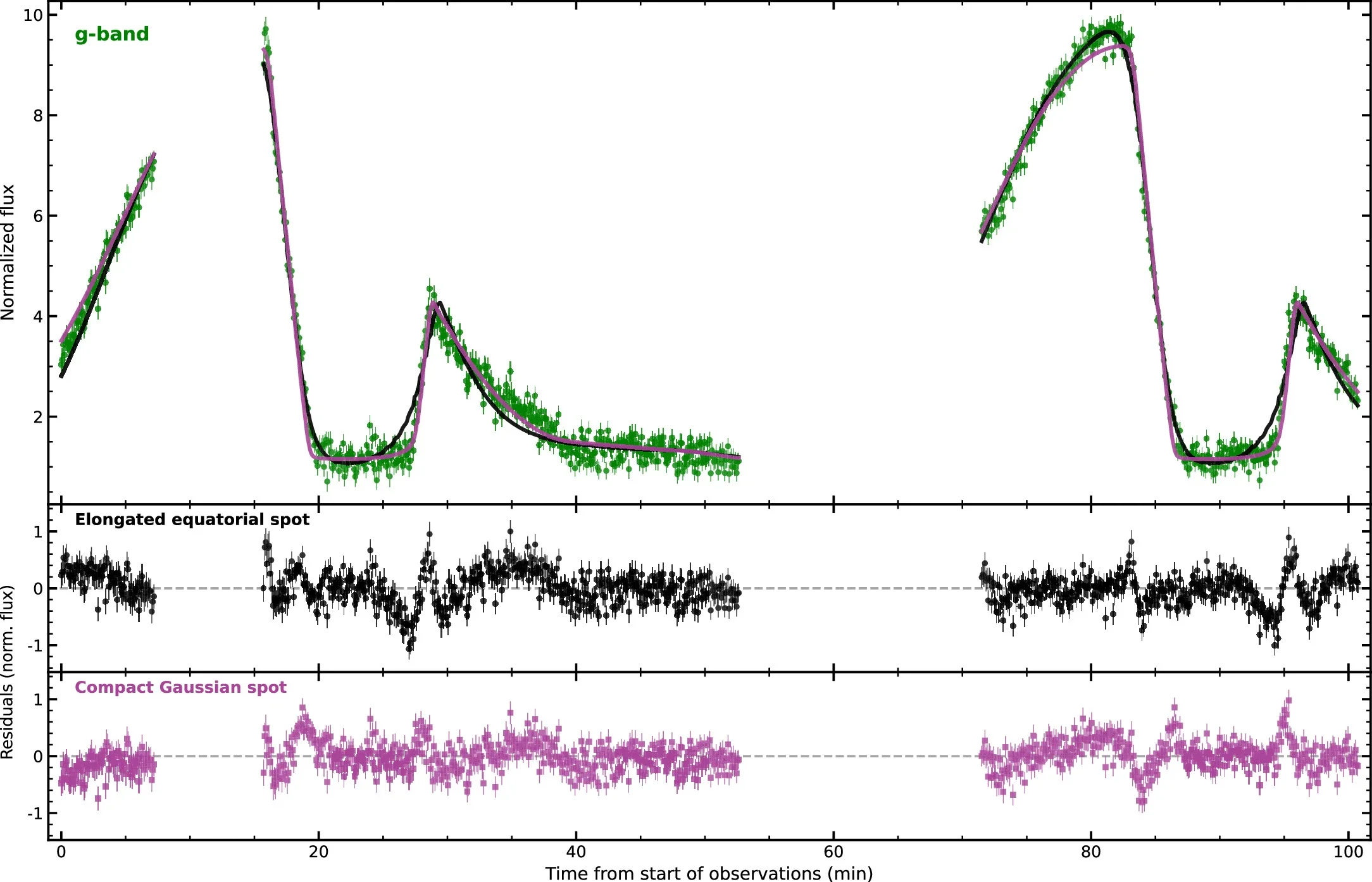
Kevin Burdge, an MIT assistant professor of physics, noticed a signal that repeatedly formed a triangle. It differed from the brightening and fading associated with a supernova. Something was producing the same distinctive pattern over and over.
“I remember first looking at this and thinking, stars don’t make triangular waveforms like this,” Burdge said.
Initially, the signal resembled the optical behavior of a black widow binary. Such systems contain a dense neutron star that irradiates and erodes a lightweight companion. But the motion inferred for this source did not fit that explanation comfortably.
The mystery remained unresolved for years. Burdge and MIT graduate student Aaron Householder eventually returned to it with additional telescope observations. Their task was to determine what the two objects were and what powered the repeating brightness changes.
Follow-up observations included rapid imaging with HiPERCAM on the Gran Telescopio Canarias and spectroscopy at the Keck Observatory. Images measured how brightness changed across five wavelength bands. Spectra revealed the visible star’s characteristics and its motion toward and away from Earth.
The visible object matched an M8 dwarf, a very small, cool star. Its measured velocity variation had a semi-amplitude of 24.7 kilometers per second, with an uncertainty of 2.6. Combined with the orbital period, that motion placed the companion in the substellar mass range.
The brown dwarf completes an orbit in 86.65 minutes, usually rounded to 87. The star has roughly 85 times Jupiter’s mass, while its companion has about 25 times Jupiter’s mass. Their close orbit could fit within the sun’s diameter.
A brown dwarf is more massive than a planet but does not qualify as an ordinary hydrogen-burning star. Here, both objects are lightweight by stellar standards. The measured motion strongly favored this pairing over the much heavier neutron star required by a black widow interpretation.
Brightness alone could not establish the objects’ identities. The spectra and orbital measurements supplied the evidence needed to interpret the triangular signal. Together, they showed a compact pair exchanging material.
The next question concerned the direction of that exchange. Brown dwarfs and small stars can have similar average densities. Identifying both objects therefore did not immediately reveal which one was losing material.
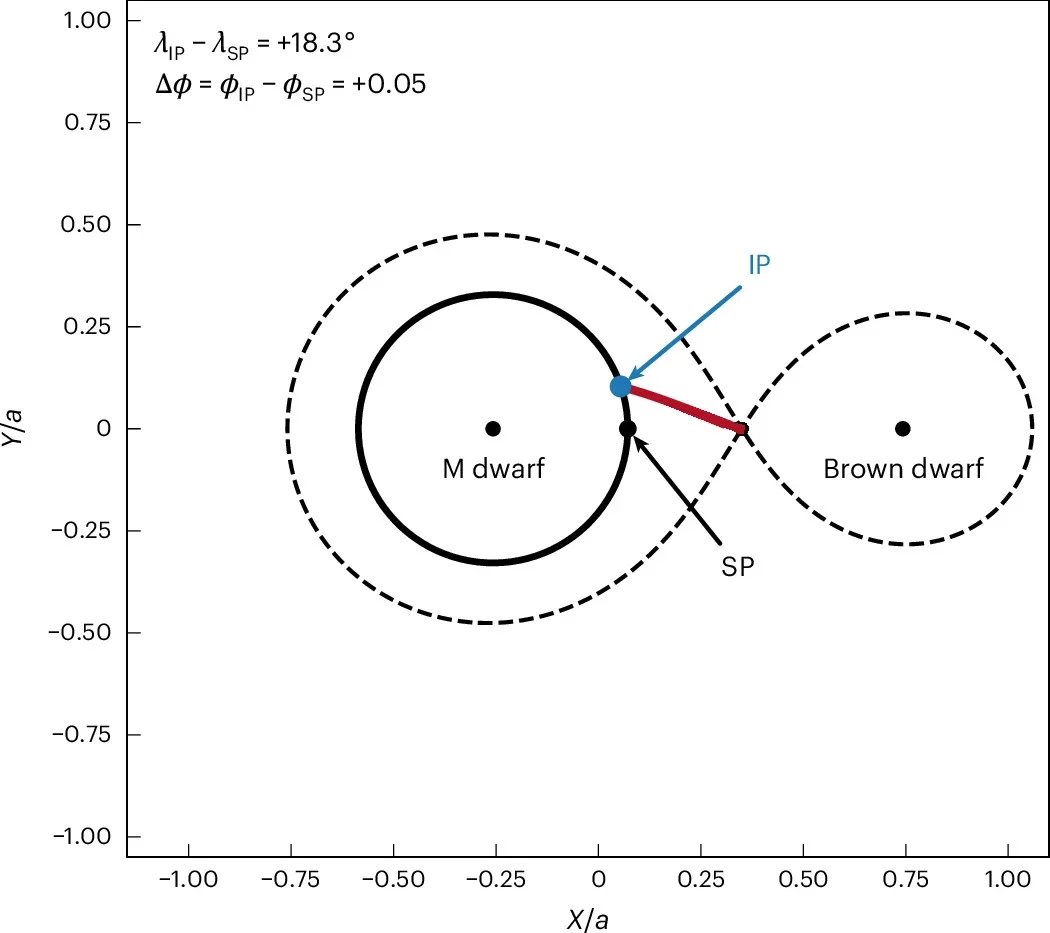
The team combined the timing of peak brightness with simulations of the gas stream’s trajectory. Those calculations followed test particles moving under the system’s gravity. They showed material leaving the brown dwarf and striking the star’s surface directly.
This process is called direct-impact accretion. Instead of first settling into an orbiting disk, the stream hits the receiving object. The impact heats a region of the star, creating a bright spot that moves into and out of view.
The predicted impact location closely matched the observed timing of maximum brightness. The slight offset between the two objects’ alignment and the brightness peak also matched the simulated stream’s deflection. That agreement strengthened the interpretation that the brown dwarf supplies the gas.
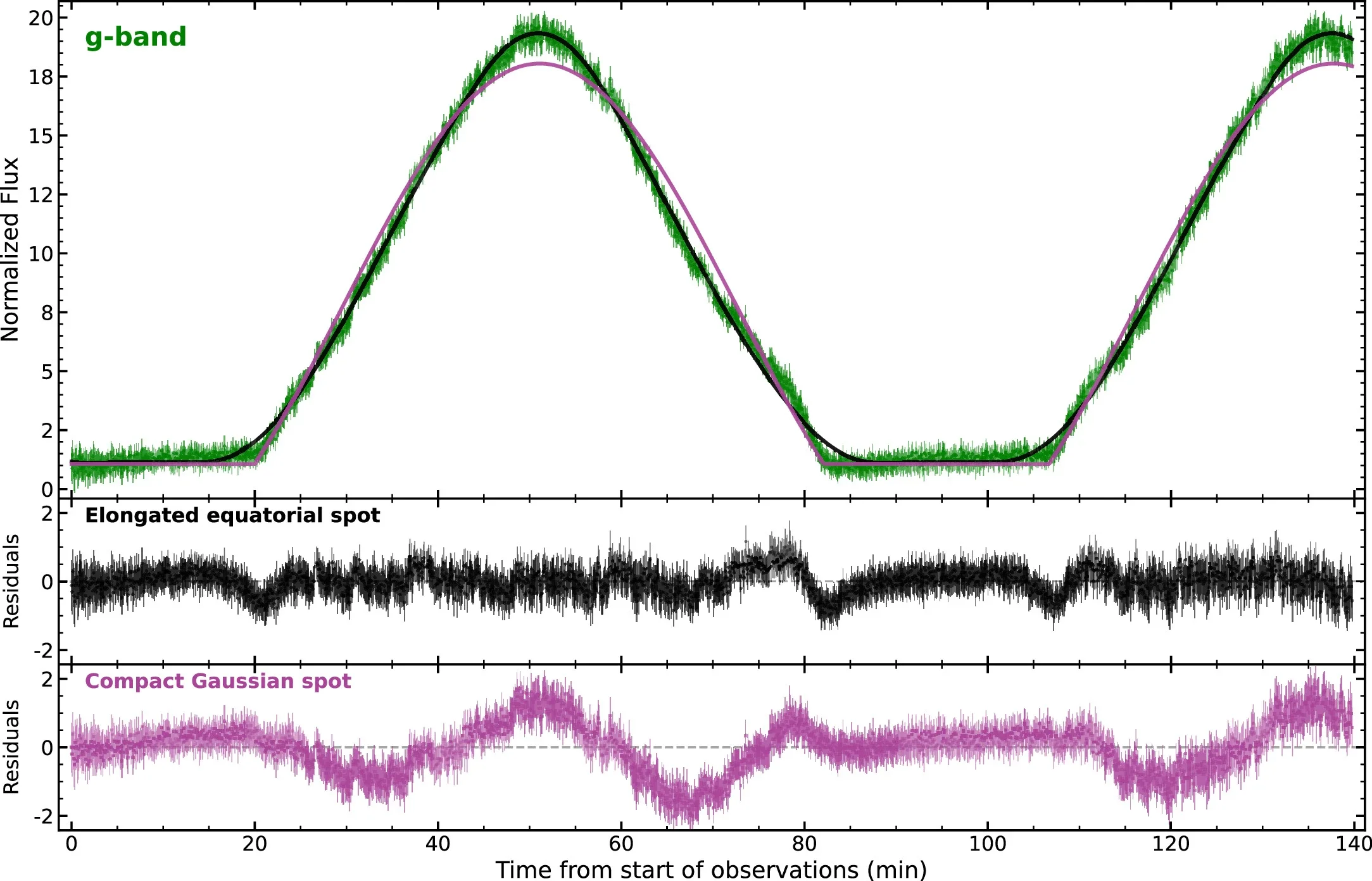
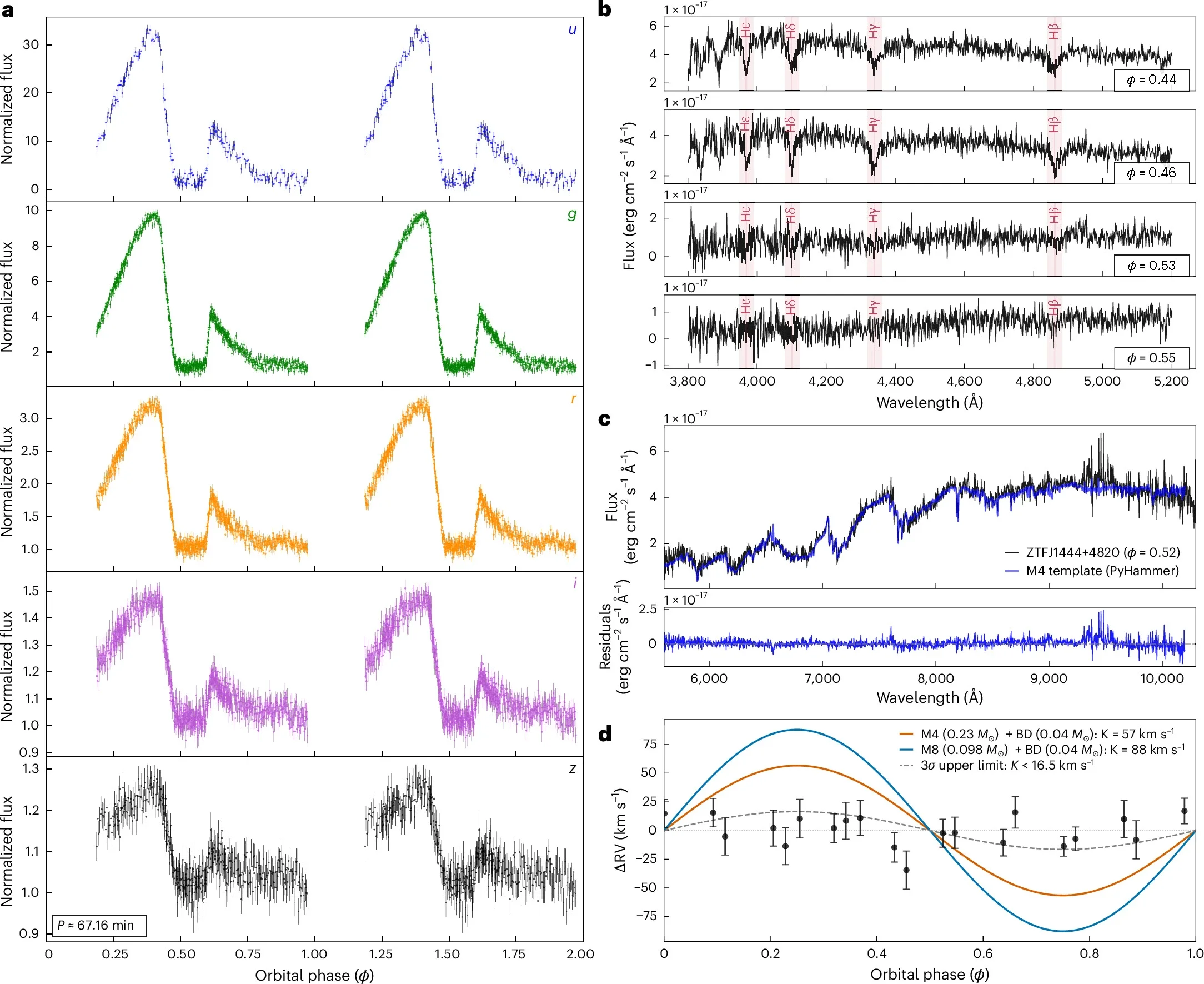
The wavelength measurements supported a hot spot as well. In the shortest-wavelength observing band, the system brightened more than thirtyfold relative to its minimum. In the longest-wavelength band, the increase was only about 1.4 times.
The estimated transfer rate is about one hundred-thousandth of Earth’s mass each year. Although substantial in familiar terms, that represents a small fraction of the brown dwarf’s mass. It helps explain how material loss could continue without immediately destroying the companion.
As the pair orbits, the heated impact region repeatedly turns toward Earth and then away. That changing view explains the recurring triangle in the light curve. Its peak marks the phase when the bright region is most visible.
The researchers argue that the transfer is stable and long-lived. However, they acknowledge that predicting its stability theoretically is difficult. Their analysis supports a phase probably lasting at least about ten million years, with potentially much longer lifetimes.
Billions of years therefore describes a possible outcome, not a guaranteed countdown. The observations establish ongoing transfer now. Models and lifetime arguments address how long that behavior might persist.
The paper also identifies ZTF J1444+4820 as a strong candidate for a similar interaction. Its orbital period is 67.16 minutes, and observations reveal eclipses alongside pronounced wavelength-dependent brightness changes. These features suggest another accretion hot spot.
Its structure remains uncertain because a brighter M4 star appears to dominate the combined spectrum. The authors interpret that star as a likely third member in a wider orbit. Higher-resolution observations are needed to identify the close pair’s components.
For ZTF J0440+2325, the evidence already establishes a different evolutionary path for some close companions. How these systems form, and how common they are, remains open. Further searches can test whether this gradual feeding represents a broader population.
These resources explore close brown dwarf binaries, direct-impact accretion and the different ways stars consume companions.
A Mass Transferring Brown Dwarf Binary on a 57 Minute Orbit: Reports a separate system where one brown dwarf transfers material directly onto another, offering a comparison with stellar accretion. (The Astrophysical Journal Letters, 2026)
Revealing a Main-sequence Star that Consumed a Planet with JWST: Uses infrared observations to investigate a planetary engulfment event and its aftermath. (The Astrophysical Journal, 2025)
A transiting brown dwarf in a 2 hour orbit: Describes a close brown dwarf and low-mass star pairing relevant to the possible precursors of interacting systems. (The Open Journal of Astrophysics, 2023)
Minimum Orbital Periods of H-Rich Bodies: Examines how mass and density constrain the shortest possible orbits of planets, brown dwarfs and stars. (The Astrophysical Journal, 2021)
V407 Vul: a direct impact accretor: Presents a foundational model in which a transferred gas stream strikes a white dwarf directly instead of forming a disk. (Monthly Notices of the Royal Astronomical Society, 2002)
Research findings are available online in the journal Nature Astronomy.
The original story “A small star is slowly consuming a brown dwarf, 300 light years away” is published in The Brighter Side of News.
Like these kind of feel good stories? Get The Brighter Side of News’ newsletter.
The post A small star is slowly consuming a brown dwarf, 300 light years away appeared first on The Brighter Side of News.


Leave a comment
You must be logged in to post a comment.