The fading light of SN 2024afav carried an unexpected rhythm. After the stellar explosion reached its brightest phase, its glow rose and fell through a sequence of bumps. The intervals between them grew shorter, creating an optical pattern astronomers describe as a chirp.
That accelerating rhythm points to a rapidly spinning magnetar concealed inside the expanding debris. A study published in Nature interprets the pattern as evidence that a tilted disk around the newborn neutron star was wobbling under the influence of general relativity.
The research, led by Joseph Farah while at UC Santa Barbara and Las Cumbres Observatory, offers a way to investigate an otherwise hidden power source. However, a companion study also finds evidence of interaction with surrounding gas, showing that this explosion’s behavior may involve more than one process.

SN 2024afav belongs to the hydrogen-poor, Type I class of superluminous supernovae. These events can radiate at least ten times more light than ordinary supernovae. That exceptional luminosity refers to their intrinsic output, rather than how bright they appear from Earth.
The Gravitational-wave Optical Transient Observer collaboration discovered the object on December 12, 2024. It lies approximately 327 megaparsecs away, equivalent to just over one billion light-years. The discovery date marks when its light was detected, not when the distant star actually exploded.
Las Cumbres Observatory’s global telescope network monitored the event for more than 200 days. The analysis combined measurements from LCO, ATLAS and KeplerCam. Repeated observations in multiple optical bands allowed the team to trace changes that sparse sampling could have missed.
The observations highlighted four clear brightness bumps, with another possible modulation. Their shrinking spacing was more informative than the existence of bumps alone. It suggested an evolving physical clock rather than unrelated episodes of brightening.
The word chirp describes that increasing repetition rate. It does not mean astronomers recorded an audible sound from the supernova. They measured changes in light arriving at their telescopes.
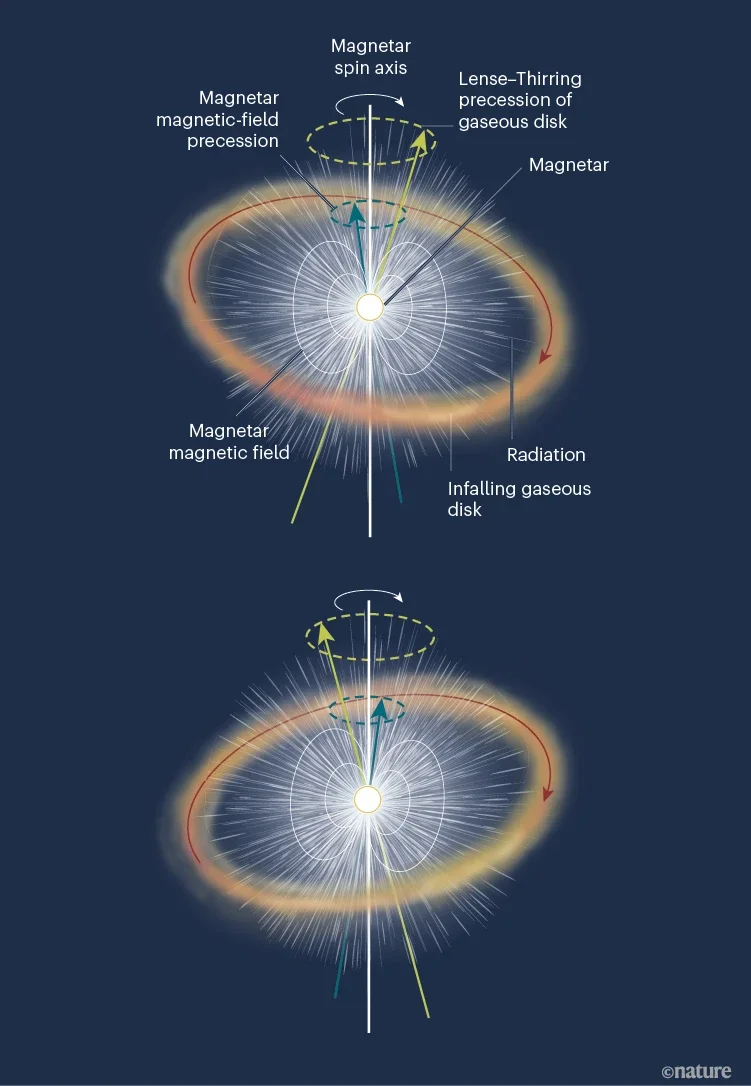
A magnetar is a neutron star with an exceptionally strong magnetic field. Such compact remnants can form when massive stellar cores collapse. If a newborn magnetar spins rapidly, it possesses a substantial reservoir of rotational energy.
In 2010, Dan Kasen and Lars Bildsten developed a model showing how that energy could sustain an unusually bright supernova. Stan Woosley independently investigated the same broad possibility. Energy released as the magnetar slows can heat the surrounding explosion debris.
That framework explains why a supernova might remain exceptionally luminous. A basic version, however, produces a relatively smooth decline after maximum brightness. It does not automatically explain a sequence of oscillations that speeds up.
Farah and colleagues therefore considered an additional structure around the central remnant. Some stellar material could fall back after the explosion and assemble into an accretion disk. If that disk’s axis were tilted relative to the magnetar’s spin, its motion could change how energy reaches the surrounding debris.
General relativity predicts that a rotating mass drags nearby spacetime with it. Around a spinning compact object, that frame-dragging can cause a misaligned disk to precess. The effect is called Lense–Thirring precession.
Precession is a change in the direction of the disk’s axis, comparable to the wobble of a spinning top. It is distinct from the disk material simply orbiting the neutron star. In the proposed model, the wobble changes how the magnetar’s energy is distributed.
As the disk moves inward, the relativistic influence strengthens and the precession becomes faster. That supplies a physical explanation for the shrinking intervals between brightness modulations. A changing disk could obscure or redirect emission, affecting how the surrounding debris is illuminated.
The observed optical light is not a direct photograph of that disk. Energy from the central engine passes through and is reprocessed by the expanding material. The researchers infer the hidden geometry from the timing and shape of the resulting light curve.
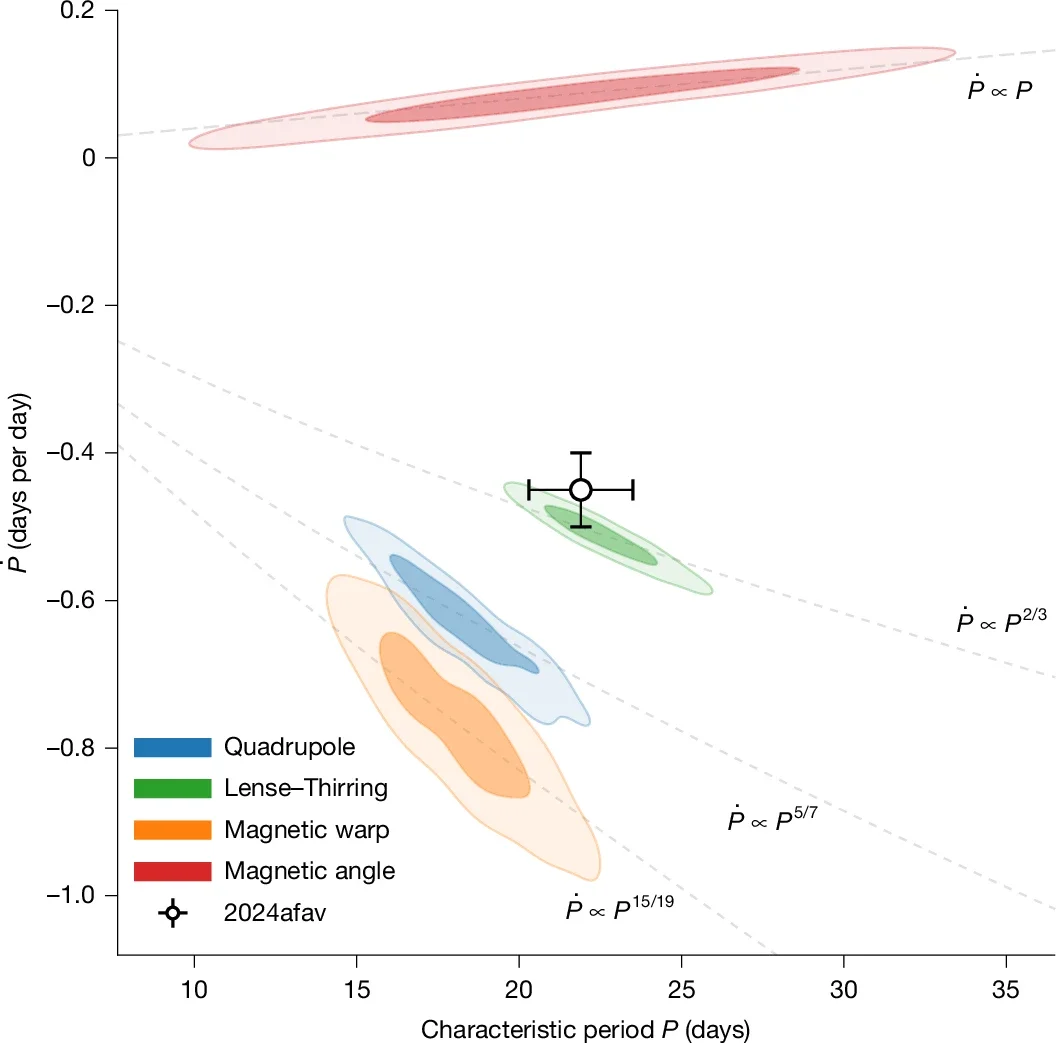
Farah said that among the explanations tested, “only Lense-Thirring precession matched the timing perfectly.” The team compared alternatives involving magnetic effects and other sources of precession. Those scenarios did not reproduce the observed timing evolution as successfully.
The combined model accounts for both the broad brightness evolution and the faster variations superimposed on it. Importantly, those two features provide separate constraints on the proposed central object. Their agreement strengthens the case for a magnetar engine.

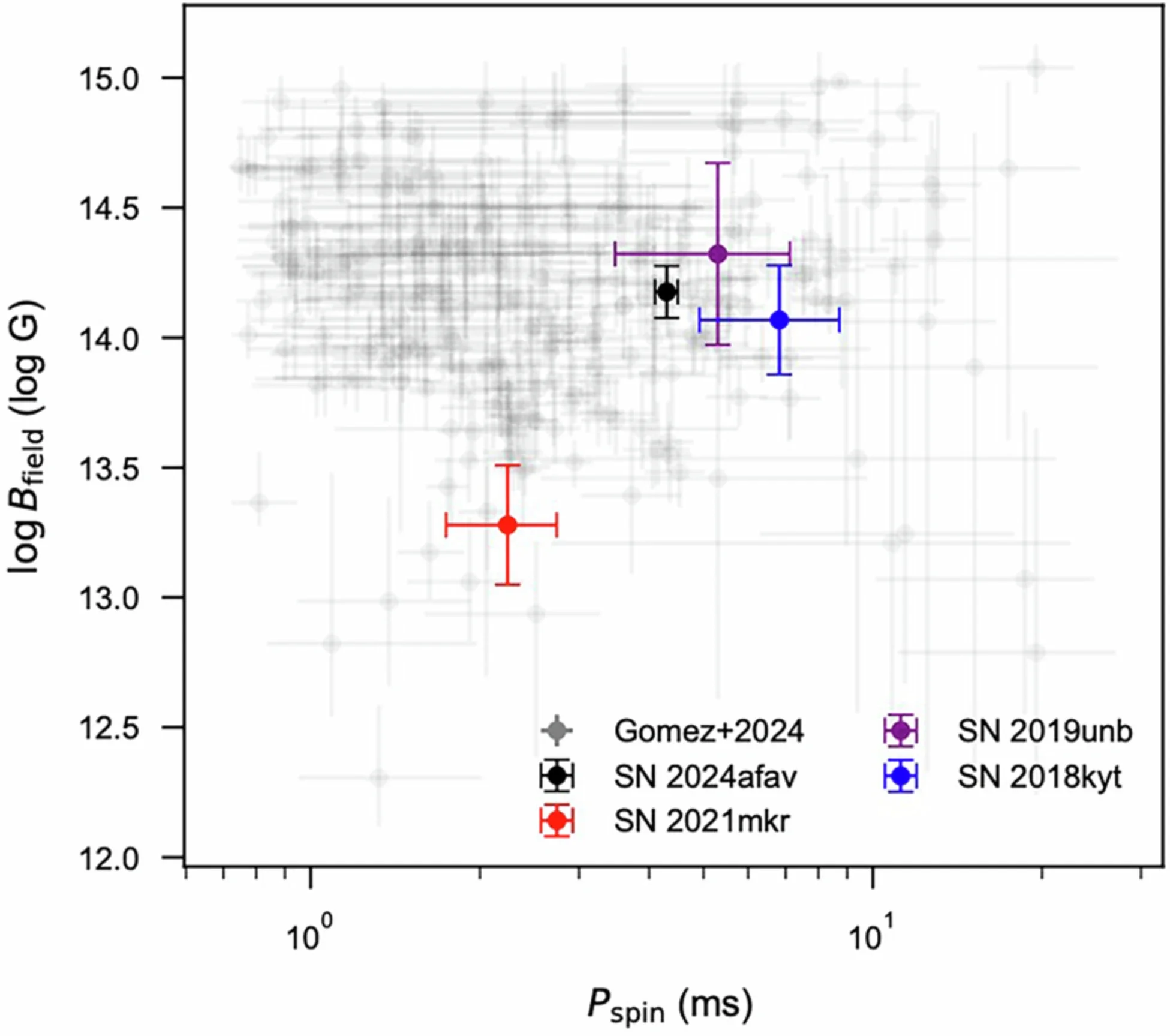
The analysis inferred a spin period of approximately 4.2 milliseconds, with a reported uncertainty of 0.2 milliseconds. That corresponds to roughly 240 rotations per second. The estimated magnetic field was 1.6 × 10¹⁴ gauss, with an uncertainty of 0.1 × 10¹⁴ gauss.
These are model-based estimates, not measurements from resolved images of the neutron star. They depend on assumptions about the compact object, the disk and how energy travels through the ejecta. Nevertheless, the consistency between the timing and luminosity constraints is a central result.
The researchers interpret the event as observational evidence of frame-dragging in a magnetar’s environment. That claim is narrower than saying general relativity had never mattered to supernova physics before. The advance concerns identifying this particular relativistic mechanism within a young explosion.
Exploding debris can also brighten when it collides with material shed before a star’s death. Farah’s team argued that reproducing the accelerating, nearly sinusoidal sequence through such collisions would require considerable fine-tuning. Their analysis did not exclude a contribution from circumstellar interaction.
A companion paper led by Harsh Kumar, published in The Astrophysical Journal Letters, provides relevant spectral evidence. It identified hydrogen, helium and oxygen features consistent with interaction between the ejecta and nearby material. Across its observations, it counted seven significant post-peak bumps.
The magnetar analysis and the spectroscopic study therefore address overlapping but different evidence. A central engine can power the explosion while interactions modify its later light and spectra. Determining their relative contributions requires combining both kinds of observations.
The result also does not establish that every superluminous supernova contains a magnetar. Other explosions may involve stronger circumstellar interaction or different central engines. More densely observed events will help test how widely the precession model applies.
Future surveys and sustained follow-up can search for similar accelerating patterns. Finding them would allow astronomers to compare hidden engines across multiple explosions, rather than rely on a single striking case.
These studies trace the magnetar model’s development and examine complementary evidence about unusually bright stellar explosions.
SN 2024afav: A Superluminous Supernova with Multiple Light-curve Bumps and Spectroscopic Signatures of Circumstellar Interaction: Presents companion spectroscopy indicating that surrounding material also influenced this event. (The Astrophysical Journal Letters, 2026)
Superluminous supernovae: an explosive decade: Reviews the observations and competing explanations that shaped understanding of superluminous explosions. (Astronomy & Geophysics, 2021)
Super-Luminous Type Ic Supernovae: Catching a Magnetar by the Tail: Compares observations of five superluminous supernovae with magnetar-powered light-curve models. (The Astrophysical Journal, 2013)
Supernova Light Curves Powered by Young Magnetars: Develops the theoretical framework connecting a young magnetar’s rotational energy with a supernova’s brightness. (The Astrophysical Journal, 2010)
Bright Supernovae from Magnetar Birth: Independently investigates how a spinning magnetar could power an exceptionally luminous explosion. (The Astrophysical Journal Letters, 2010)
Research findings are available online in the journal Nature.
The original story “Astronomers discover rare evidence of Einstein’s relativity playing out in a cosmic explosion” is published in The Brighter Side of News.
Like these kind of feel good stories? Get The Brighter Side of News’ newsletter.
The post Astronomers discover rare evidence of Einstein’s relativity playing out in a cosmic explosion appeared first on The Brighter Side of News.


Leave a comment
You must be logged in to post a comment.