An enormous magnetic boundary stretching outward from the Sun is turning out to be more complicated than a simple dividing line.
Measurements from the European Space Agency’s Solar Orbiter show that the heliospheric current sheet, or HCS, contains organized changes in the composition and temperature of its particles. Those chemical fingerprints may help scientists trace solar wind back toward the processes that released it from the Sun.
The results appear in The Astrophysical Journal in the study “Resolving Compositional Features of Solar Wind Source Regions near the Heliospheric Current Sheet at 0.3 au,” led by Keiichi Ogasawara of Southwest Research Institute. The paper was published Aug. 31.
The HCS separates enormous regions of the heliosphere in which the Sun’s magnetic field points in opposite directions. Solar rotation twists the sheet into a rippling spiral often compared with a ballerina’s skirt.
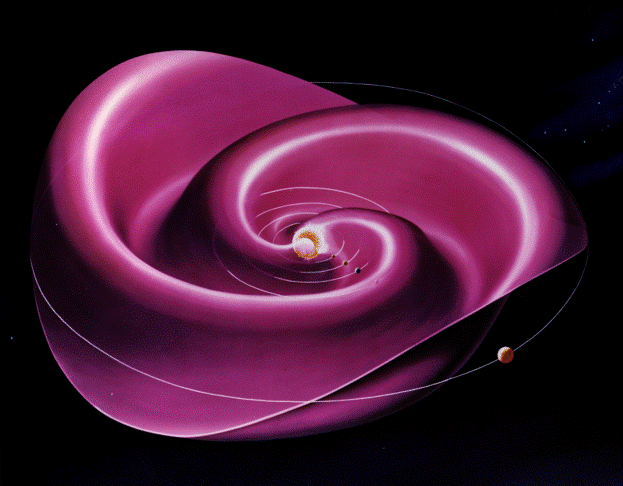
But the boundary also sits within the slow solar wind, making it an important place to investigate how material escapes the corona and enters interplanetary space.
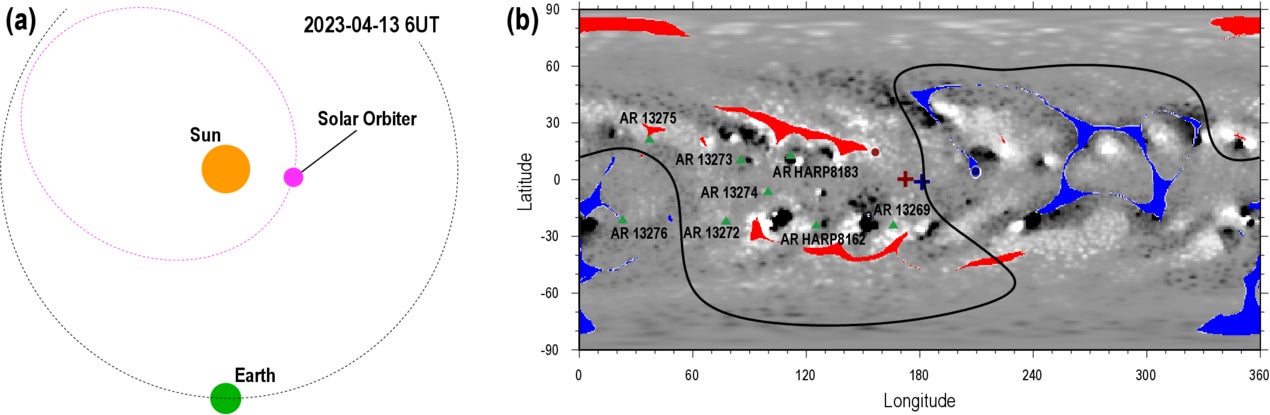
Solar Orbiter crossed the HCS on April 13, 2023, while traveling about 0.3 astronomical units from the Sun.
That is roughly 45 million kilometers, or 28 million miles. At such a distance, the spacecraft encountered solar wind much closer to its source than instruments near Earth normally do.
That proximity matters because the solar wind changes while traveling outward. Particles collide, turbulence develops and magnetic structures become distorted. Some clues about their original temperature and composition can therefore become difficult to reconstruct by the time the wind reaches Earth.
Solar Orbiter combined measurements from its magnetometer with all three instruments in its Solar Wind Analyser suite. Researchers examined proton speed, density and temperature, electron behavior, magnetic-field direction and several heavy-ion properties.
The crossing itself was not a clean passage through one narrow boundary.
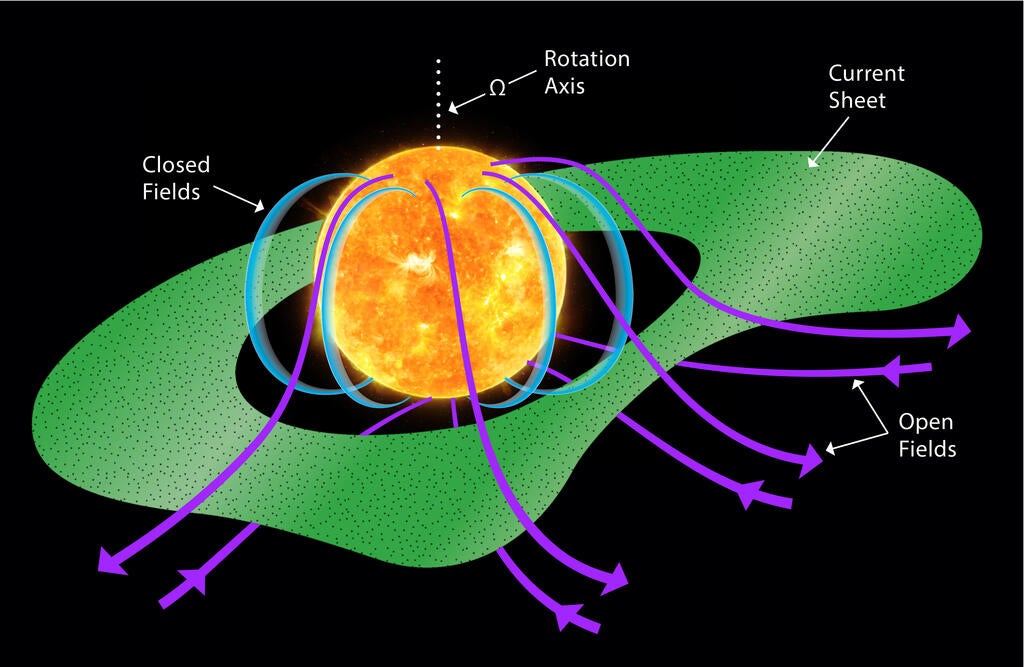
The spacecraft encountered multiple regions of high and low plasma pressure, repeated magnetic variations and changes in electron motion. These features support an emerging picture in which the near-Sun HCS contains smaller sheets, magnetic islands and structures produced by changing magnetic connectivity.
Near-Sun measurements from Solar Orbiter and NASA’s Parker Solar Probe have increasingly shown that the HCS is far more structured than the comparatively simple polarity boundary traditionally measured near Earth.
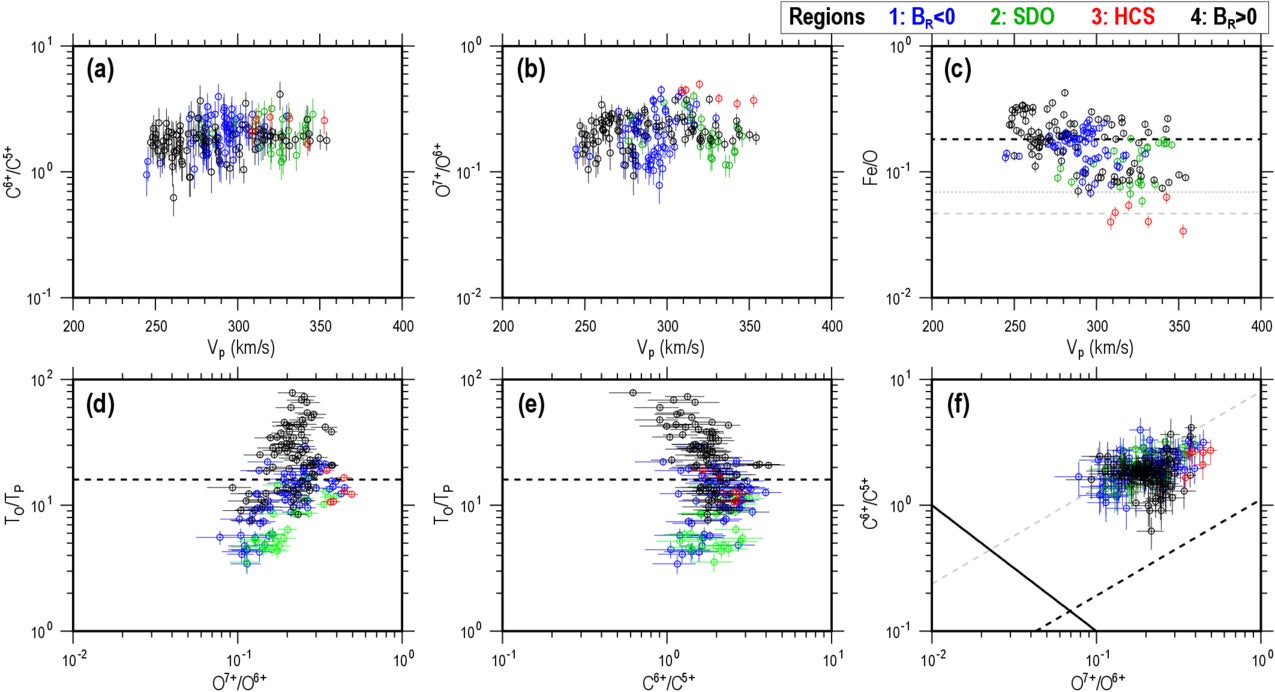
The clearest chemical signature involved iron and oxygen.
Scientists often use the ratio of iron to oxygen, Fe/O, to help determine where solar wind material originated. Elements are sorted in the Sun’s lower atmosphere through processes related to their first ionization potential, leaving different solar regions with recognizable abundance patterns.
During this Solar Orbiter crossing, however, Fe/O behaved in an unexpected way.
The ratio gradually decreased as the spacecraft approached the true magnetic sector boundary. It reached its lowest value almost exactly where the magnetic polarity changed.
The average Fe/O ratio within the core HCS region was about 0.0454, compared with roughly 0.157 and 0.156 in the surrounding magnetic sectors.
That close alignment is important.
“Within the HCS region, we identify a decrease in the ratio of iron and oxygen ions that lines up closely with the magnetic sector boundary itself,” Ogasawara said.
The surrounding plasma did not undergo an equally dramatic transformation. Instead, the elemental ratio changed sharply while many broader plasma characteristics remained comparatively similar.
One possible explanation involves gravitational settling inside long-lived closed magnetic loops. If plasma remains trapped for enough time, heavier ions can become depleted before that material is eventually released into the solar wind.
The authors describe that explanation as a possibility, not a confirmed mechanism. The unusually low Fe/O value does not perfectly reproduce earlier observations of coronal streamers, leaving the exact origin unresolved.
The team also tracked the temperature of oxygen ions relative to protons.
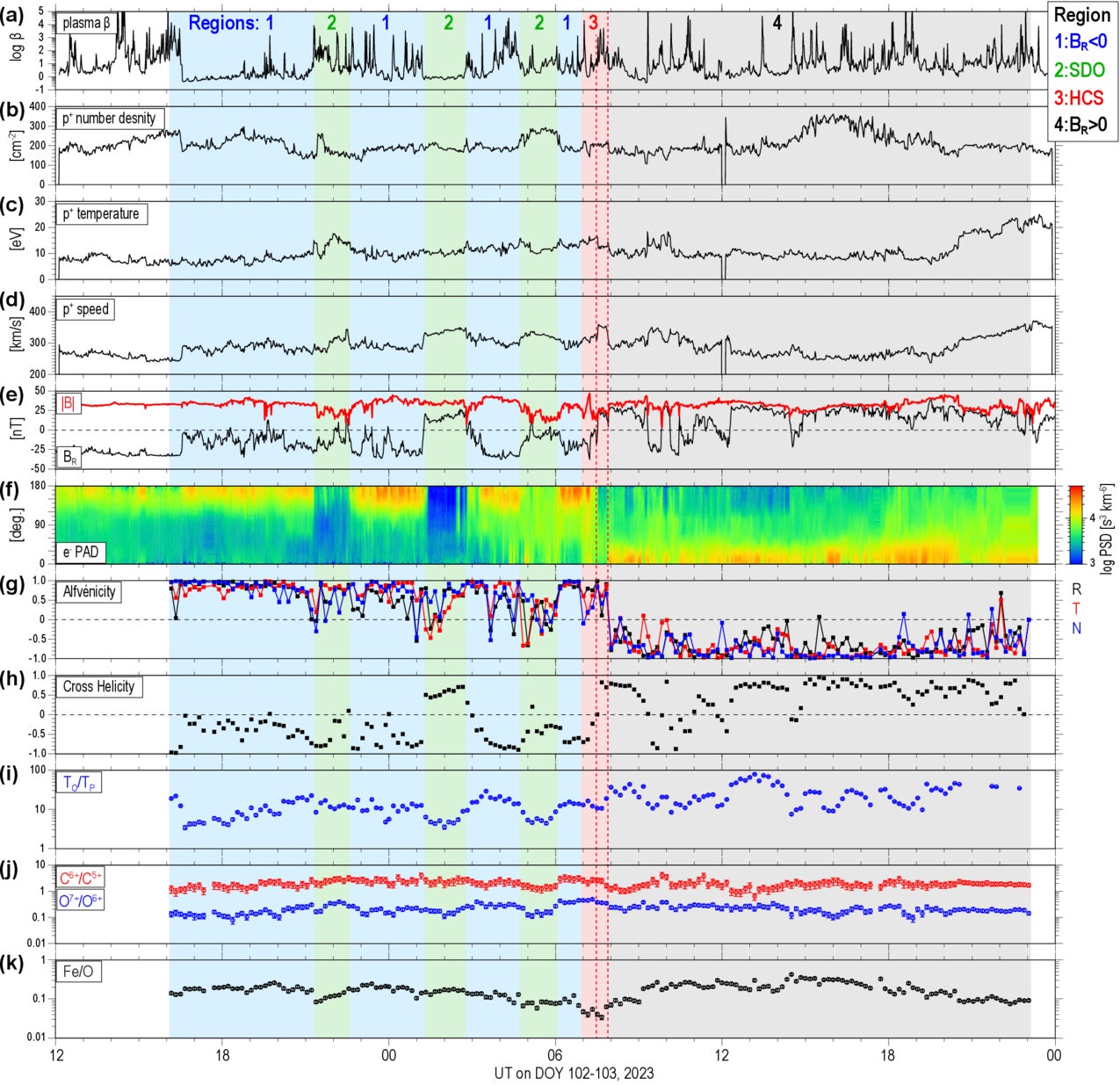
That measurement is particularly valuable close to the Sun because oxygen and protons have not yet completely exchanged enough energy through collisions to erase their earlier thermal histories.
The researchers found sharp local changes in oxygen-to-proton temperature around smaller structures near the HCS. Carbon and oxygen charge-state ratios, meanwhile, remained much more stable in some of those regions.
That combination places useful limits on where the structures could have formed.
The charge states of heavy ions become effectively fixed, or “freeze in,” relatively close to the Sun. If magnetic restructuring occurs afterward, it can rearrange plasma without substantially changing those charge-state fingerprints.
Solar Orbiter’s observations are therefore consistent with some small-scale structures forming after charge states were established, possibly through magnetic reconnection. The authors stress that the measurements do not uniquely identify reconnection as the cause.
On one side of the HCS, oxygen also became extraordinarily hot relative to protons. The oxygen-to-proton temperature ratio frequently exceeded 16, showing preferential heating beyond what simple mass scaling would predict.
The measurements strengthen the idea that solar wind composition functions like a fingerprint.
Magnetic fields tell scientists how plasma is connected to the Sun. Ion abundances and charge states can reveal the conditions in which that plasma was heated, confined and released.
Combining those measurements offers a way to trace the solar wind backward.
That question matters beyond basic solar physics. Solar wind drives conditions throughout the heliosphere, influences auroras and contributes to space weather that can affect satellites, communications and technological infrastructure.
The new observations do not solve the origin of the HCS or the slow solar wind.
They also come from only one rare crossing at 0.3 au. The authors explicitly caution that their physical interpretations are not unique and need to be tested with larger samples and dedicated modeling.
What the measurements provide instead is a sharper target.
Any successful explanation of how the heliospheric current sheet forms must now account not only for its magnetic reversal, but also for the organized chemical and thermal fingerprints traveling within it.
These studies examine how magnetic connectivity, reconnection and coronal structure shape the solar wind observed by Solar Orbiter and Parker Solar Probe.
Multi-source connectivity as the driver of solar wind variability in the heliosphere: Solar Orbiter observations linked changes in solar wind speed, composition and Alfvénic behavior to shifting magnetic connections among coronal holes and active regions, demonstrating how multiple source regions create structured solar wind. (Nature Astronomy, 2024)
Direct observations of a complex coronal web driving highly structured slow solar wind: Extreme-ultraviolet and coronagraph observations revealed a dynamic web of reconnecting magnetic structures in the middle corona that appears to feed highly structured slow solar wind into the heliosphere. (Nature Astronomy, 2023)
Slow Solar Wind Connection Science during Solar Orbiter’s First Close Perihelion Passage: This study describes coordinated Solar Orbiter observations designed to connect slow solar wind measured in situ with specific open-closed magnetic boundaries and source regions on the Sun. (The Astrophysical Journal Supplement Series, 2023)
Observational Evidence of S-web Source of the Slow Solar Wind: Solar Orbiter and Hinode observations traced a dense, slow solar wind stream to a narrow open-field corridor associated with the magnetic separatrix web, supporting the S-web model of slow-wind production. (The Astrophysical Journal, 2023)
Parker Solar Probe Observations of Solar Wind Energetic Proton Beams Produced by Magnetic Reconnection in the Near-Sun Heliospheric Current Sheet: Parker Solar Probe detected reconnection exhausts inside the near-Sun HCS that accelerated protons and produced energetic particle beams, showing that the current sheet can actively transform particle energy. (Geophysical Research Letters, 2022)
Research findings are available online in The Astrophysical Journal.
The original story “ESA’s Solar Orbiter reveals how the Sun’s corona transforms into solar wind” is published in The Brighter Side of News.
Like these kind of feel good stories? Get The Brighter Side of News’ newsletter.
The post ESA’s Solar Orbiter reveals how the Sun’s corona transforms into solar wind appeared first on The Brighter Side of News.


Leave a comment
You must be logged in to post a comment.