A quantum computer can do more than calculate an answer. It can also become a laboratory for reading the behavior of quantum systems that are difficult to probe with conventional methods.
Researchers have demonstrated a generalized form of quantum computational spectroscopy, or QCS, on a programmable silicon-photonic processor. The method reconstructed spectral information from static, open and periodically driven quantum systems using the same basic framework.
The work was led on the theoretical side by Jinzhao Sun of Queen Mary University of London.
Spectroscopy normally reveals information about matter by measuring how it responds to energy or light. Computational spectroscopy instead uses mathematical models to predict spectral properties, but complex quantum systems can overwhelm conventional computers.
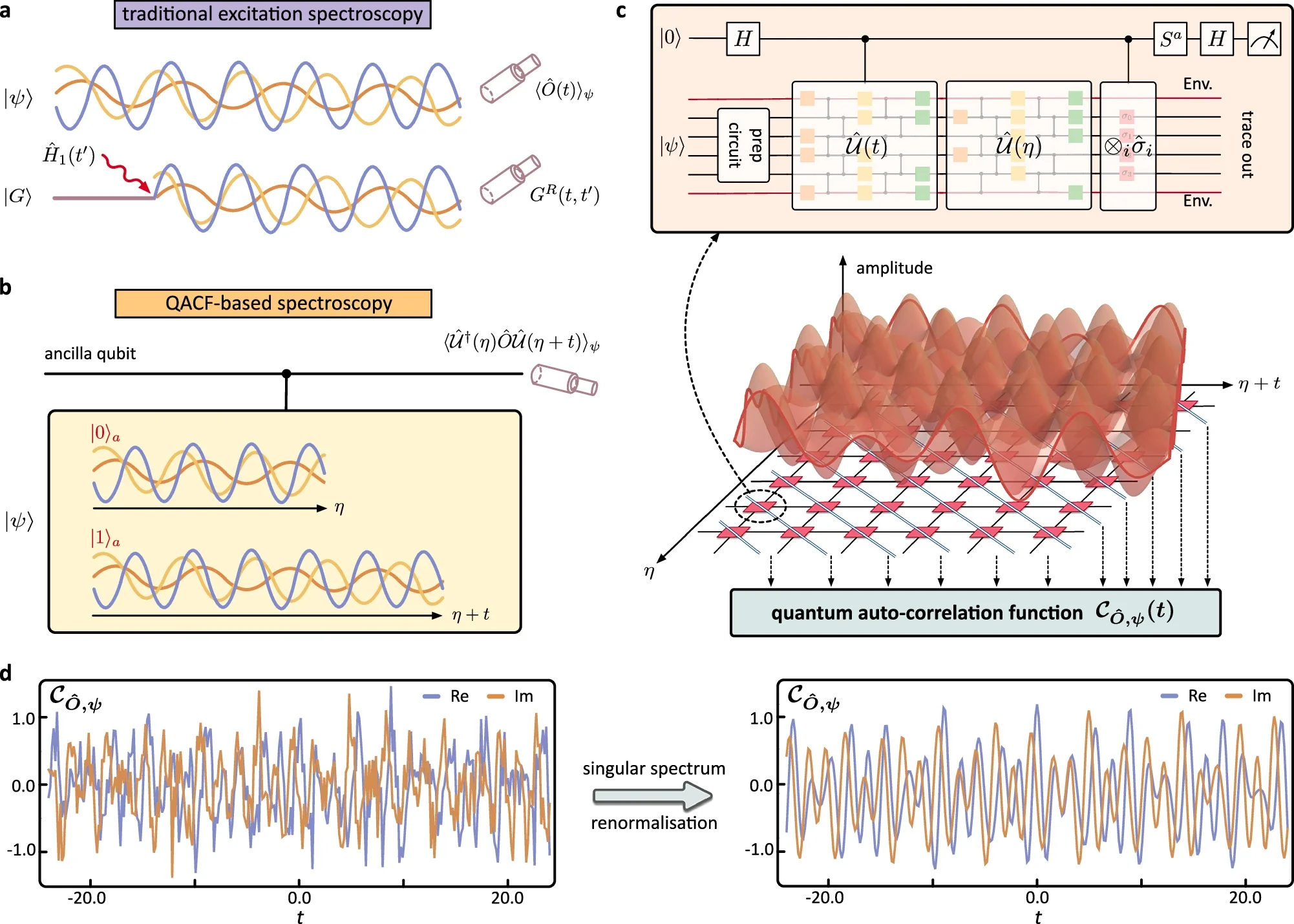
QCS centers on a quantity called the quantum autocorrelation function, or QACF.
The team reconstructed that function with an ancilla-assisted Hadamard test, a quantum circuit that follows a system’s controlled time evolution while preserving coherence.
That design changes what appears in the resulting spectrum.
Conventional approaches can produce frequencies tied to differences between energy levels. QCS suppresses those cross-terms, leaving oscillations associated directly with quasi-eigenenergies.
A Fourier transform then converts the time-dependent signal into a spectrum with peaks corresponding to those energies.
Classical processing still plays an important role. Researchers used Gaussian windowing and singular spectrum renormalisation to improve spectral extraction and reduce random noise.
With the time integral restricted to four Gaussian widths on either side, the calculated truncation error stayed below 0.01%.
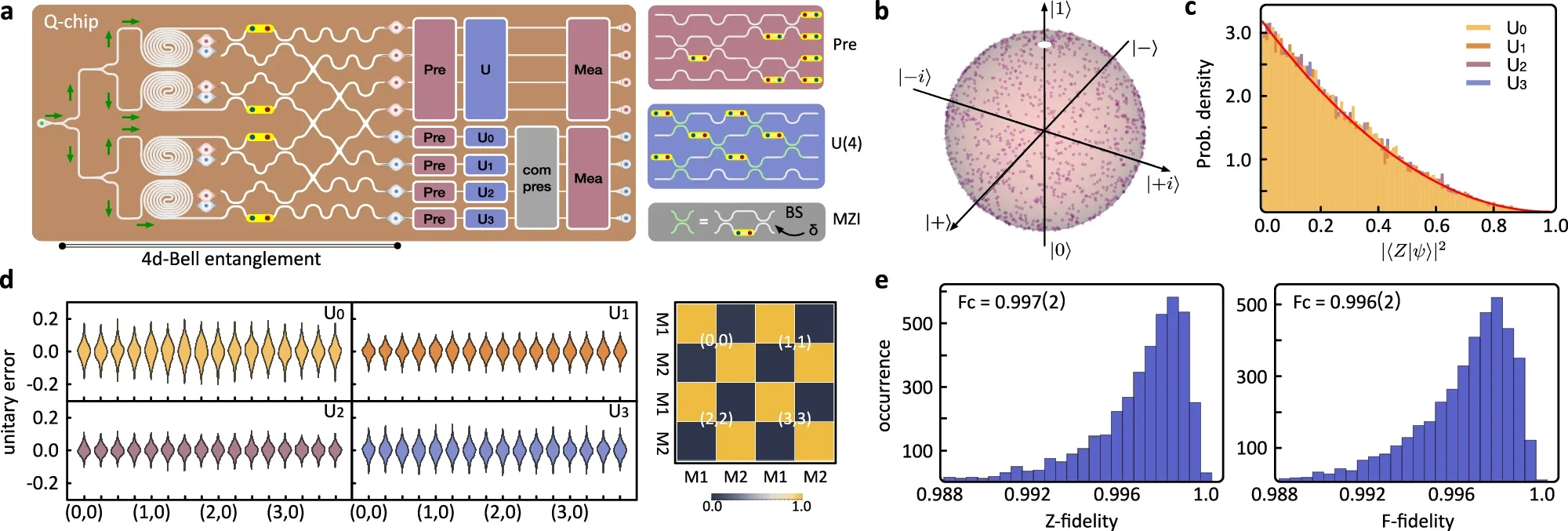
The experiments used a programmable silicon-photonic quantum processor that generated a four-dimensional entangled Bell state of signal and idler photons.
Integrated interferometers carried out programmable operations. The device covered 99.2% of the targeted operation range, while measured classical fidelities consistently exceeded 0.996.
The first test used a two-spin anisotropic Heisenberg system in an external magnetic field.
With 120 time steps and a Gaussian window width of 6, QCS recovered four spectral peaks at -4.257, -1.410, 2.158 and 3.499.
The corresponding theoretical energies were -4.258, -1.401, 2.159 and 3.500.
Each point in the time series used roughly 1,000 photon-coincidence counts.
The team also reconstructed the four eigenstates using quantum state tomography. Their fidelities ranged from 0.995 to 0.998.
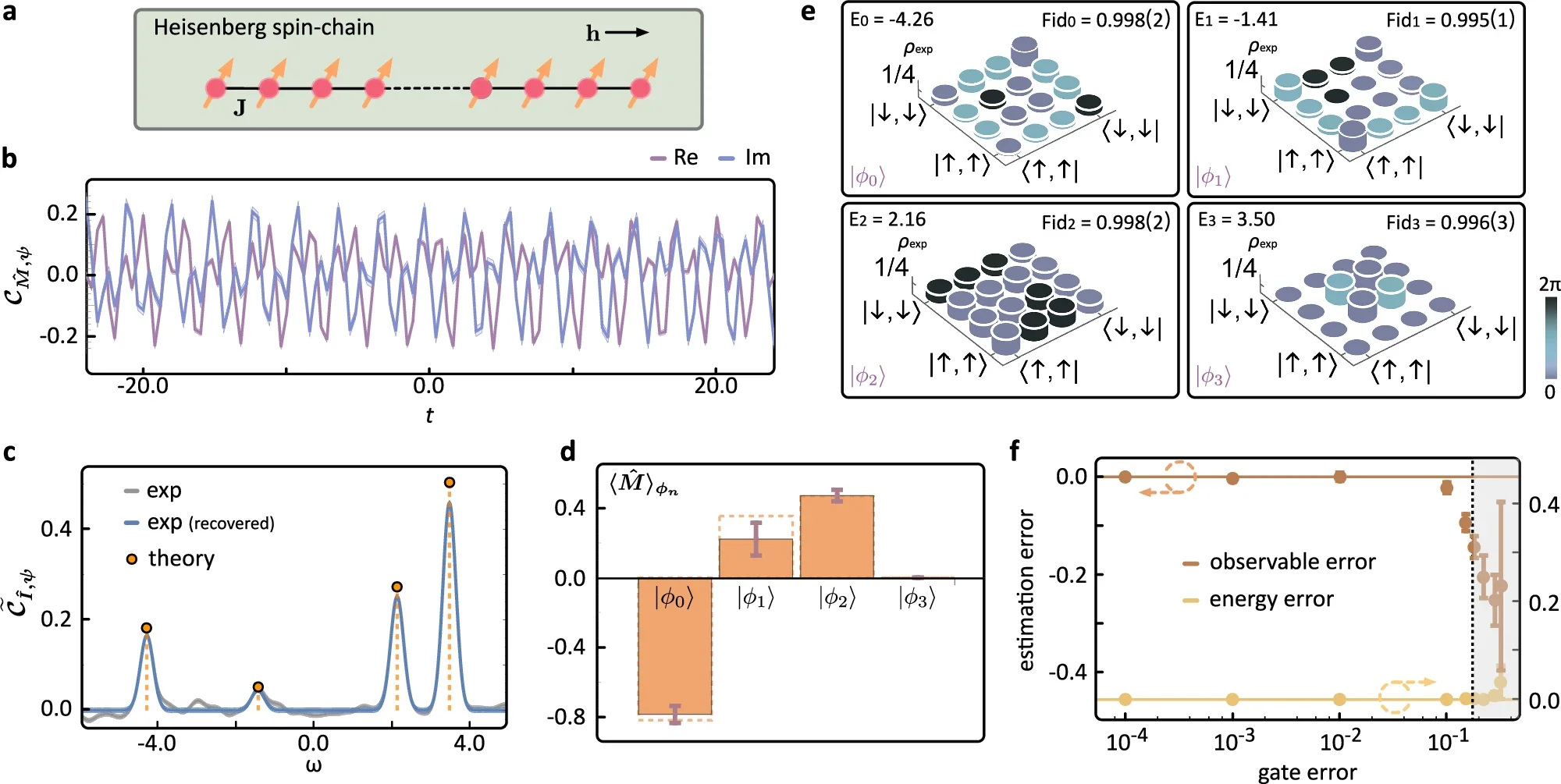
To explore performance beyond the small experimental system, researchers simulated an eight-site spin chain with periodic boundary conditions.
They estimated the ground-state energy and the spin correlation between the most distant sites, using 1,000 samples for each generalized Hadamard test.
Errors remained relatively small while gate noise stayed below the projection probability of the target eigenstate.
Once noise approached that probability, however, the errors increased rapidly.
That result points to a practical limit for scaling QCS on imperfect hardware.
The researchers then moved beyond ordinary closed quantum systems and tested a non-Hermitian model, where eigenstates need not be mutually orthogonal.
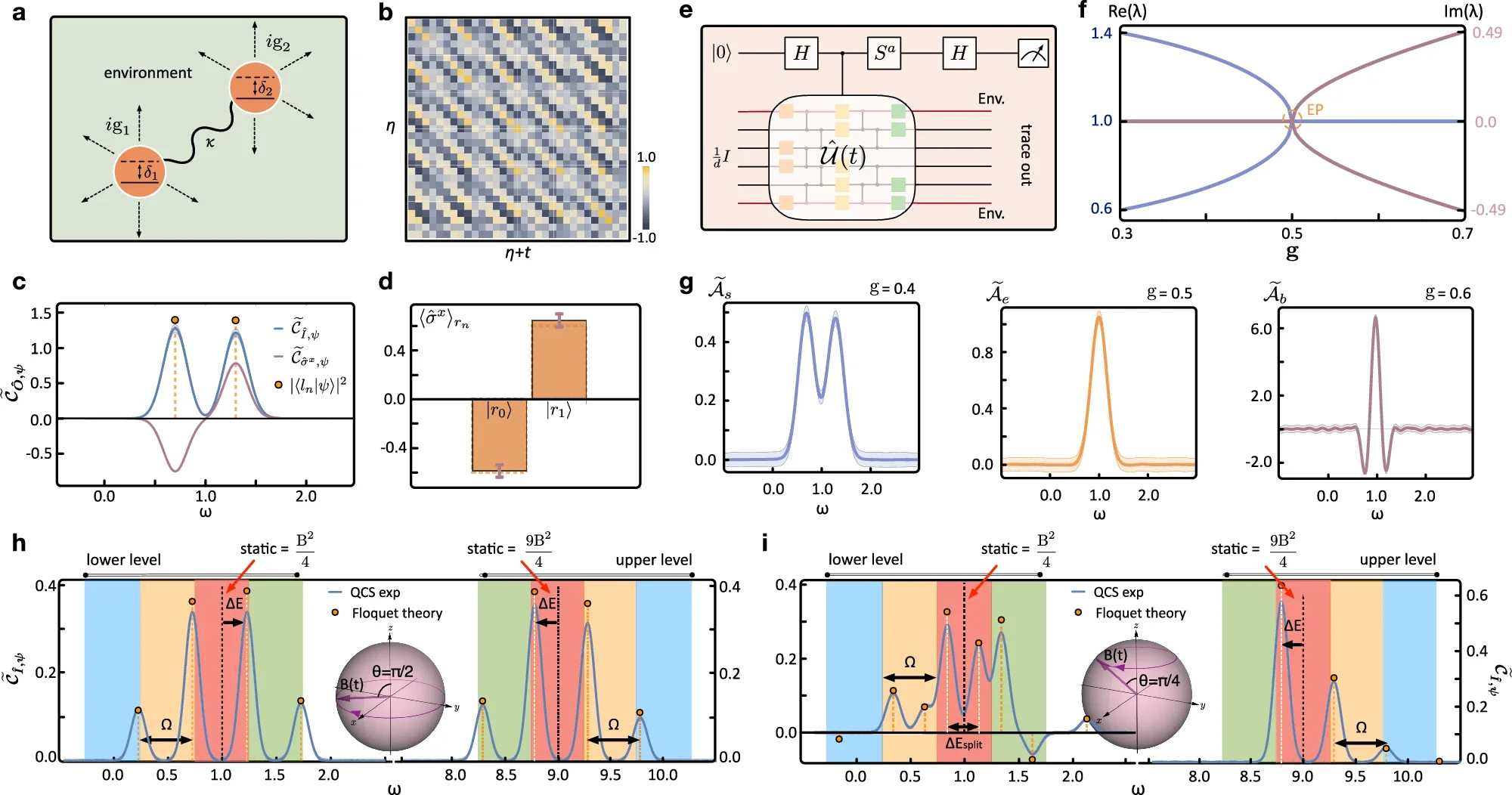
The non-Hermitian experiment used two coupled modes with equal detunings of 1.0 and a coupling coefficient of 0.5.
An adjustable gain or loss parameter, g, controlled the system’s phase.
At g = 0.4, QCS produced peaks at 0.700 and 1.302.
The team then tested g = 0.4, 0.5 and 0.6, corresponding to the parity-time exact phase, the exceptional point and the broken phase.
At g = 0.5, the eigenenergies coalesced.
QCS captured that transition directly in the spectrum.
Beyond the exceptional point, negative spectral amplitudes and oscillating behavior appeared as the eigenenergies developed imaginary components.
Those features showed that QCS could recover useful information even when the system fell outside the assumptions of standard Hermitian quantum mechanics.
The final experiment examined nuclear quadrupole resonance under a periodically driven magnetic field.
The field magnitude was 2 and the driving frequency was 0.5. Researchers used a Gaussian window width of 15 and 150 discrete time steps.
Without driving, the system had four eigenstates grouped into two degenerate energy levels.
Periodic motion of the magnetic field produced Floquet-Bloch bands and repeated spectral structures that QCS resolved experimentally.
When the field traced the equator, both energy levels shifted by 0.228.
That shift gave an estimated topological phase of 0.912π, approaching the predicted π phase for adiabatic evolution.
A different path produced a more unusual signature.
When the field traveled around a polar circle at an angle of π/4, the lower energy level split into two peaks.
Researchers identified that splitting as evidence of SU(2) topological holonomy.
It allowed them to estimate a gauge-invariant Wilson loop close to the theoretical value of -0.504.
The same QCS framework handled static spectra, a non-Hermitian phase transition and topology in a driven system.
That breadth is the main scientific advantage of the approach.
It suggests quantum computers could eventually serve not only as calculators, but as tools for investigating quantum behavior that is difficult to reproduce or analyze conventionally.
Possible research areas include physics, chemistry and materials science, where computational spectroscopy can test theoretical or hypothetical systems before experiments are built.
The silicon-photonic demonstration remains a proof of principle.
Scaling to more photons and dimensions will make photon-generation efficiency, optical loss, crosstalk and circuit calibration increasingly difficult.
The current results therefore do not establish a ready-made spectroscopy platform for large quantum systems.
Still, the experiments show that controlled quantum evolution, combined with classical spectral processing and noise reduction, can extract several different kinds of information through one generalized method.
As quantum hardware improves, QCS could give researchers another way to study many-body, open and strongly driven quantum systems that remain difficult for conventional computational tools.
Research findings are available online in the journal Nature Communications.
The original story “Quantum chip opens new way to read complex quantum systems” is published in The Brighter Side of News.
Like these kind of feel good stories? Get The Brighter Side of News’ newsletter.
The post Quantum chip opens new way to read complex quantum systems appeared first on The Brighter Side of News.


Leave a comment
You must be logged in to post a comment.