Helium atoms have pushed a familiar rule of X-ray generation far beyond its expected limit, producing photons at energies nearly twice the conventional cutoff. The unusual signal appears to come from two tightly linked electrons returning to the atom together.
The result challenges the standard picture of high-order harmonic generation, or HHG, a process that converts laser light into coherent extreme-ultraviolet and X-ray radiation. The work was carried out by teams at TU Wien and the University of California San Diego.
For decades, HHG has been described largely through the motion of one electron. A strong laser field pulls that electron from an atom, accelerates it, then drives it back. When the electron recombines with the atom, its energy can emerge as a much higher-frequency photon.
“The mechanism behind short X-ray pulses has been well known for a long time,” says Prof. Tenio Popmintchev from the Institute of Photonics at TU Wien. “The laser tears a single electron away from the atom. The electron is then accelerated in the laser’s electric field until it eventually collides with the atom again. The energy it loses in the process is emitted in the form of light.”
That standard process has a clear energy ceiling. The conventional cutoff scales to about 3.2 times the ponderomotive energy, a measure of the energy gained by an electron oscillating in a laser field.
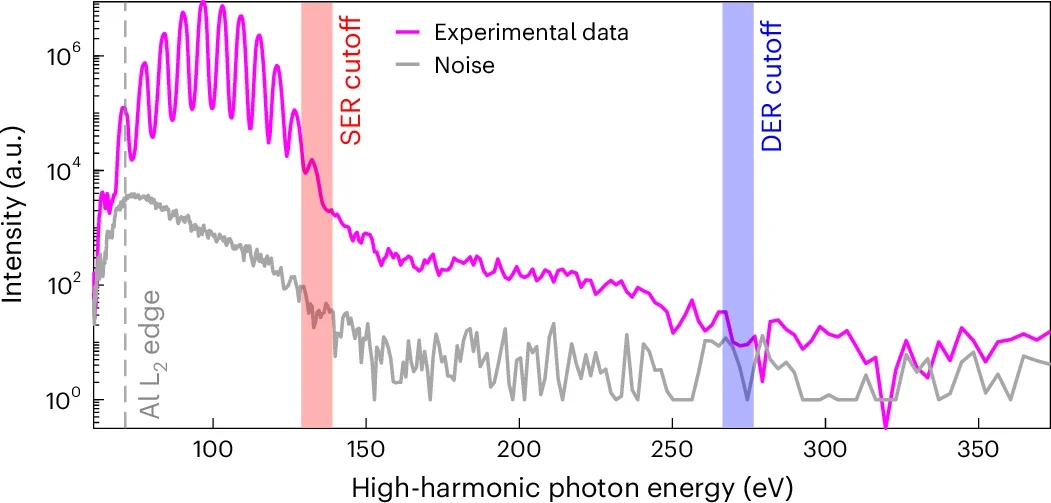
In the helium experiments, however, the team saw another, much weaker band of X-ray emission well above that limit. The conventional signal ended around 120 to 140 electronvolts, while the secondary plateau extended to roughly 270 to 280 electronvolts.
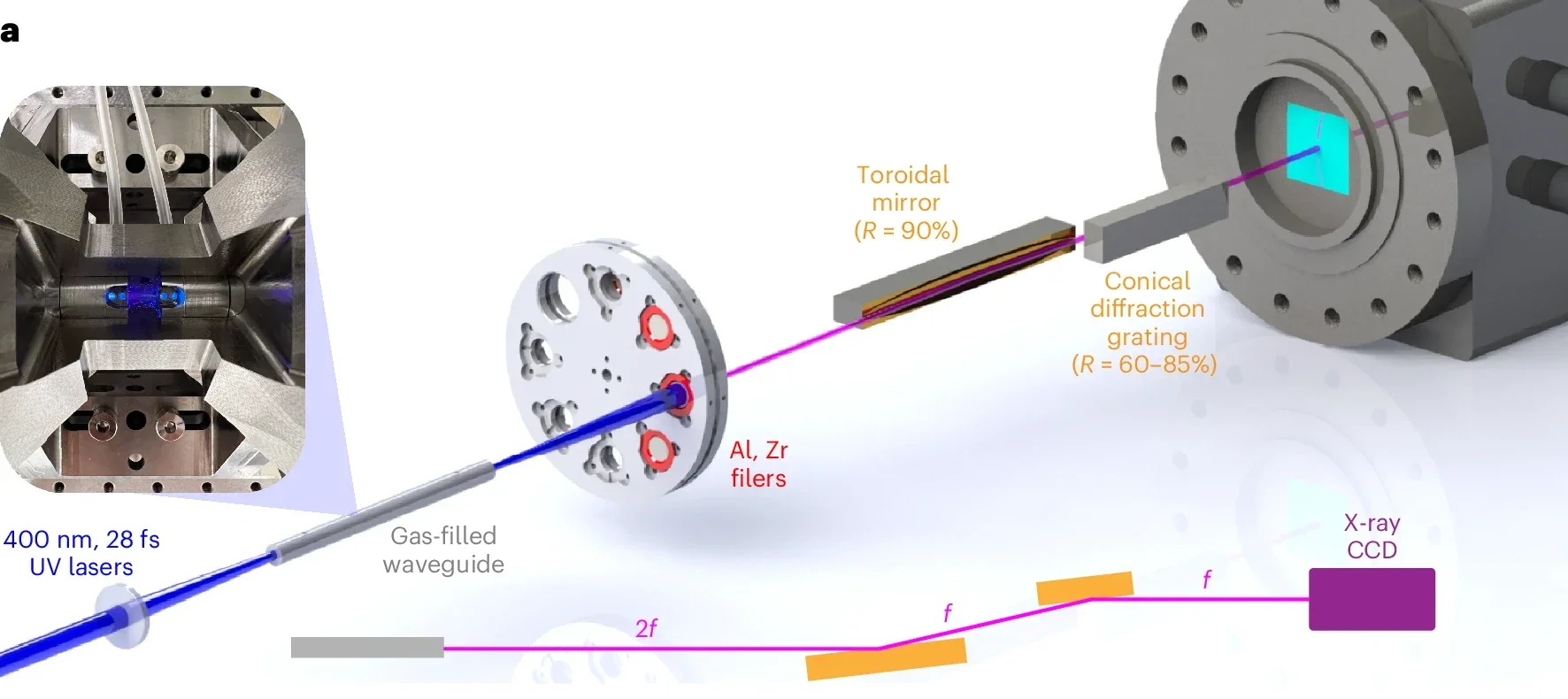
The researchers used 400-nanometer ultraviolet pulses lasting 28 femtoseconds and sent them through a gas-filled hollow-core waveguide. A conical-diffraction X-ray spectrometer measured the radiation.
At laser intensities above 2 × 10^15 watts per square centimeter, the unusual helium signal began to emerge. The team detected emission as high as 280 electronvolts, reaching the soft X-ray region known as the water window.
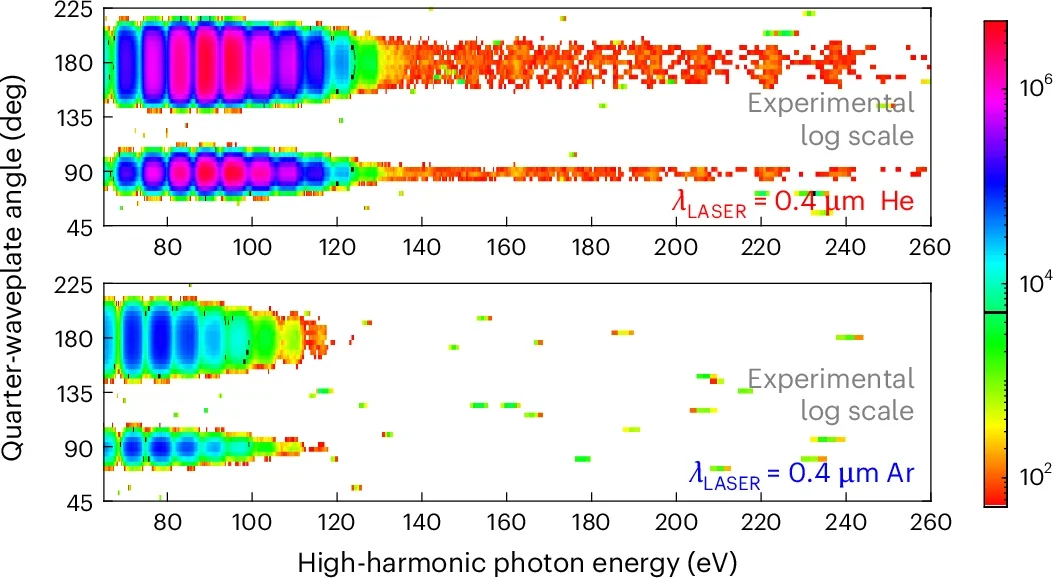
The same secondary feature did not appear in argon or neon. Even after a 30-minute exposure with argon, the researchers detected no comparable extension. With helium, the extended signal became visible within seconds.
Helium offers an unusually clean setting for testing electron-electron interactions because it contains only two electrons bound to its nucleus. Without inner-shell electrons to screen their interaction, the pair can display especially strong quantum correlations.
“Using UV driving pulses, we can arrange for both electrons to return to the atom at exactly the same time,” says Dimitar Popmintchev, a postdoctoral researcher in Tenio Popmintchev’s team at TU Wien. “The energy of two electrons is then released all at once. And when more energy is available, a single higher-energy X-ray photon with higher frequency can also be generated.”
The team attributes the secondary plateau to double-electron recombination, or DER. In this proposed process, two correlated electrons are ionized at different times, travel along different paths, and then recombine with the parent ion simultaneously. Their combined kinetic energy can be released as one unusually energetic photon.
Trajectory calculations predict higher energy scaling for this two-electron route than for conventional single-electron recombination. Depending on the path, the predicted cutoff can reach 4.7 or 5.5 times the ponderomotive energy.
Measurements matched the higher scaling. As laser intensity changed, the DER cutoff followed an approximately 5.5-times relationship.
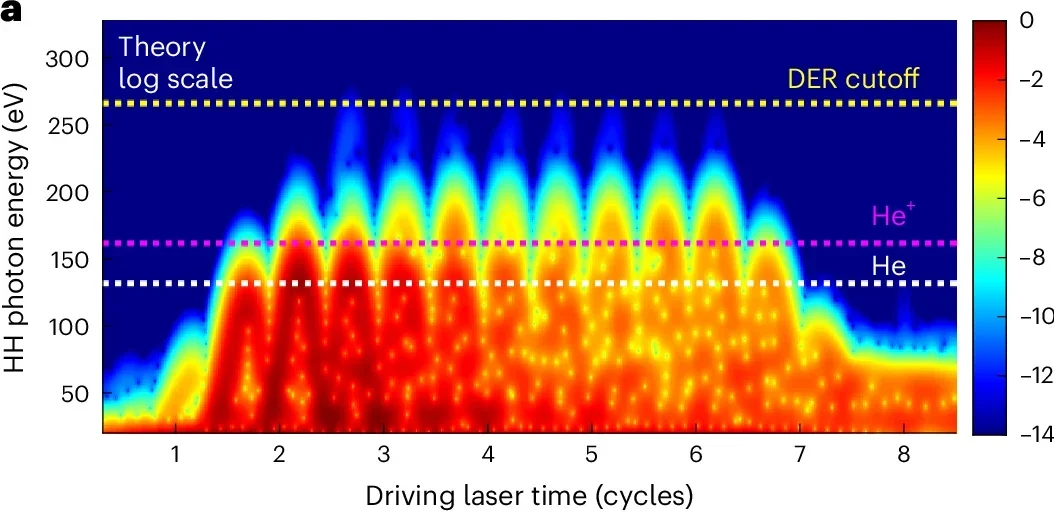
Time-dependent Schrödinger equation calculations also produced a weak secondary plateau consistent with the measured photon-energy range. In the simulations, the DER emission appeared only after about 2.5 laser cycles, indicating that the process lasts more than one cycle and requires a strong external field.
That long duration may help explain why ultraviolet driving pulses were important. The researchers report that UV light can support a broader phase-matching window, allowing emission from multiple laser cycles to build coherently.
The calculations did not reproduce the observed strength of the signal. Experimentally, the difference between the conventional and secondary plateaus was close to four orders of magnitude. In the single-atom calculations, it was nearly ten orders of magnitude.
The authors propose two reasons for the stronger experimental signal. The HHG process was intentionally overdriven, creating more plasma and encouraging additional ionization. Large-scale phase-matching effects may also amplify the weak two-electron contribution.
Ellipticity tests supplied another check. When the laser polarization became strongly elliptical, both the conventional and secondary plateaus disappeared. That behavior supports a rescattering process, because electrons on strongly off-axis trajectories are less likely to return to the ion.
The team considered several alternatives. High-harmonic wave mixing has produced cutoff extensions before, but not on the scale seen here. Emission from ionized helium could also shift the cutoff, yet the expected increase would be only about 30 electronvolts, far below the more than 100-electronvolt extension observed.
The measured secondary cutoff also followed the scaling expected for double-electron recombination rather than the established single-electron rule.
Still, the authors describe DER as the most consistent explanation, not as an absolutely closed case. Some details, including the ellipticity dependence of the two-electron wavepackets and the full macroscopic phase-matching behavior, still require more complete quantum simulations.
The secondary plateau could turn HHG into a direct probe of electron-electron correlation on femtosecond-to-attosecond timescales. Its shape, cutoff energy and response to laser polarization may reveal how paired electrons move and interact under intense fields.
The researchers suggest extending the method to molecules, liquids, solids and strongly correlated materials. Attosecond pump-probe experiments could also track how electron correlations develop during recombination.
The X-ray signal remains intrinsically weak because correlated electron pairs are rare and must meet strict timing conditions. Even so, the work points to a way of using high-harmonic light not only as a source of ultrafast X-rays, but also as a sensor of many-electron quantum behavior.
These resources explore how high-harmonic light can reveal correlated electron motion, many-body quantum effects and ultrafast dynamics in atoms and quantum materials.
Reduced density matrix description of high-harmonic generation in multielectron atoms: Exploring subcycle correlation effects
This work develops a way to quantify electron correlations during individual fractions of a laser cycle and applies it to helium, neon, beryllium and magnesium, showing how ultrafast correlations can alter high-harmonic spectra. (Physical Review Research, 2025)
Many-Body Effects on High-Harmonic Generation in Hubbard Ladders
Researchers examined high-harmonic generation in strongly correlated Mott insulators and found that interactions among charge and spin excitations can reshape spectra and even produce additional plateaus. (Physical Review Letters, 2025)
Many-body enhancement of high-harmonic generation in monolayer MoS₂
This study shows that electron-electron interactions can substantially affect high-harmonic generation in a two-dimensional semiconductor, supporting the broader idea that HHG can probe many-body physics beyond isolated atoms. (Nature Communications, 2024)
Probing ultrafast electron correlations in high harmonic generation
This theoretical work established a framework for using high-harmonic spectra to track changing electron correlations on ultrafast timescales, helping lay the groundwork for correlation-sensitive HHG spectroscopy. (Physical Review Research, 2020)
Impact of two-electron dynamics and correlations on high-order-harmonic generation in He
A detailed helium calculation found that allowing both electrons to participate dynamically can substantially extend the predicted high-harmonic spectrum, making it an especially relevant precursor to newer experiments involving correlated helium electrons. (Physical Review A, 2017)
Research findings are available online in the journal Nature Photonics.
The original story “Helium atoms generate X-rays nearly twice the expected energy limit” is published in The Brighter Side of News.
Like these kind of feel good stories? Get The Brighter Side of News’ newsletter.
The post Helium atoms generate X-rays nearly twice the expected energy limit appeared first on The Brighter Side of News.


Leave a comment
You must be logged in to post a comment.