A handful of ancient teeth from China are giving scientists an unusual look at one of the hardest chapters in human evolution to read.
For decades, Homo erectus has stood at the center of that mystery. The species was the first known member of the human genus to leave Africa, spreading across huge stretches of Eurasia and lasting for nearly 2 million years. Yet even with its importance, researchers have had little molecular evidence to work with. Fossils of H. erectus are rare and culturally invaluable, which has made destructive testing a nonstarter in many cases.
That impasse may now be starting to shift.
A team led by Fu Qiaomei of the Institute of Vertebrate Paleontology and Paleoanthropology at the Chinese Academy of Sciences recovered protein evidence from six H. erectus teeth using a minimally invasive acid-etching technique that left the teeth’s overall morphology intact. The work, published in Nature, points to a possible genetic connection between East Asian H. erectus, Denisovans, and some present-day human populations.
It also offers a new way to study ancient human remains without heavily damaging them.
Homo erectus has long been one of the most important and most frustrating species in paleoanthropology. Its fossils appear across three continents. The lineage reached western Asia by about 1.8 million years ago, showed up in Europe between 1.4 million and 1.1 million years ago, and persisted in parts of Asia far later. In China, the record stretches back roughly 2.1 million to 1.6 million years ago and seems to end around 400,000 to 300,000 years ago. In Java, H. erectus may have survived until about 100,000 years ago.
Yet molecular clues from the species have remained almost nonexistent.
Before this research, the only recovered molecular data from H. erectus came from a 1.77-million-year-old tooth from Dmanisi in Georgia. Those peptides did not include the single amino acid changes needed to clearly distinguish H. erectus from other human lineages.
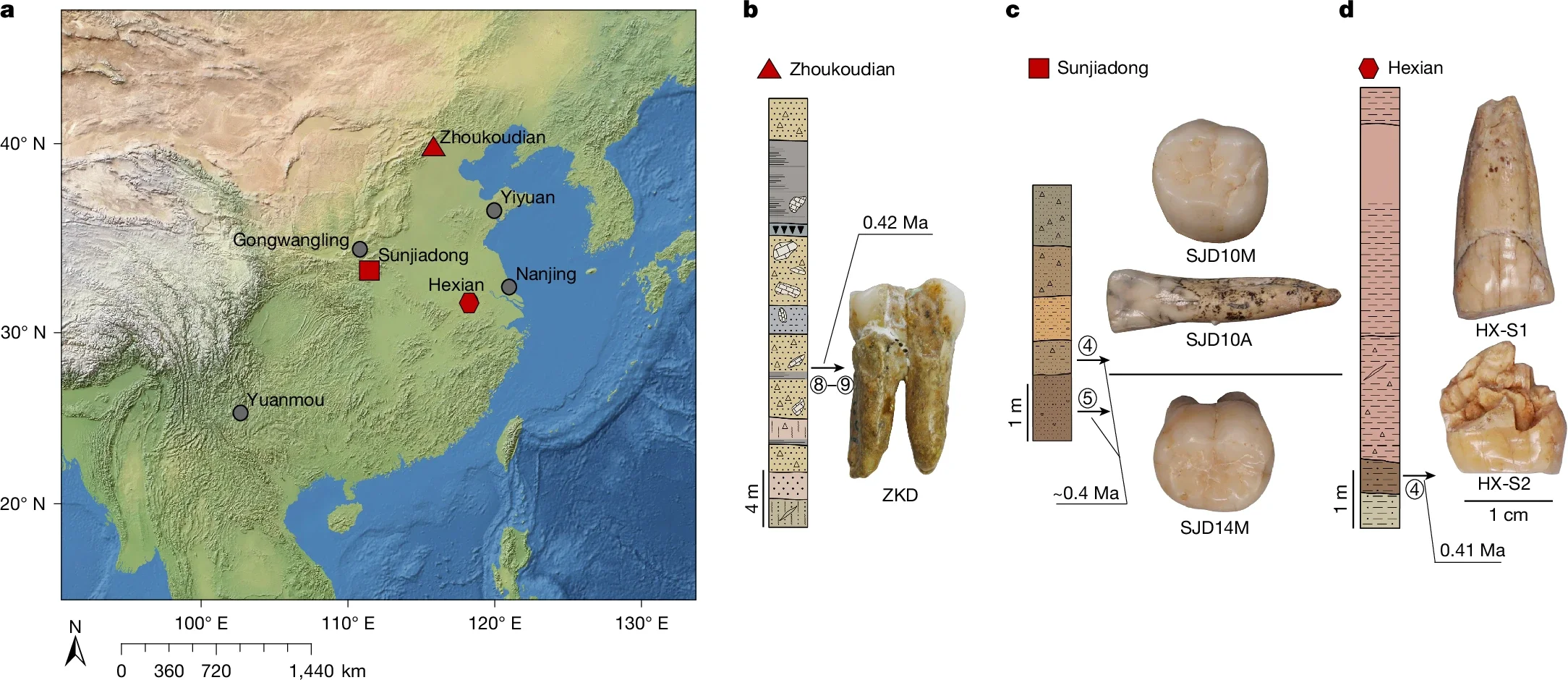
The new study focused on six teeth from three Chinese sites: Zhoukoudian near Beijing, Hexian in Anhui Province, and Sunjiadong in Henan Province. Together, the samples date to around 400,000 years ago. They come from both northern and southern China and represent fossils that are roughly contemporary.
The team also included a tooth from Harbin, China, associated with an earlier reported Denisovan skull, for comparison.
Before turning to the human fossils, the researchers tested animal remains from the same sites to see whether proteins had survived at all. Ancient proteins did not appear in the dentin or bones from dozens of animal samples, but they did show up in enamel from a smaller number of animal teeth. That result suggested human enamel might still preserve useful molecular traces.
It did.
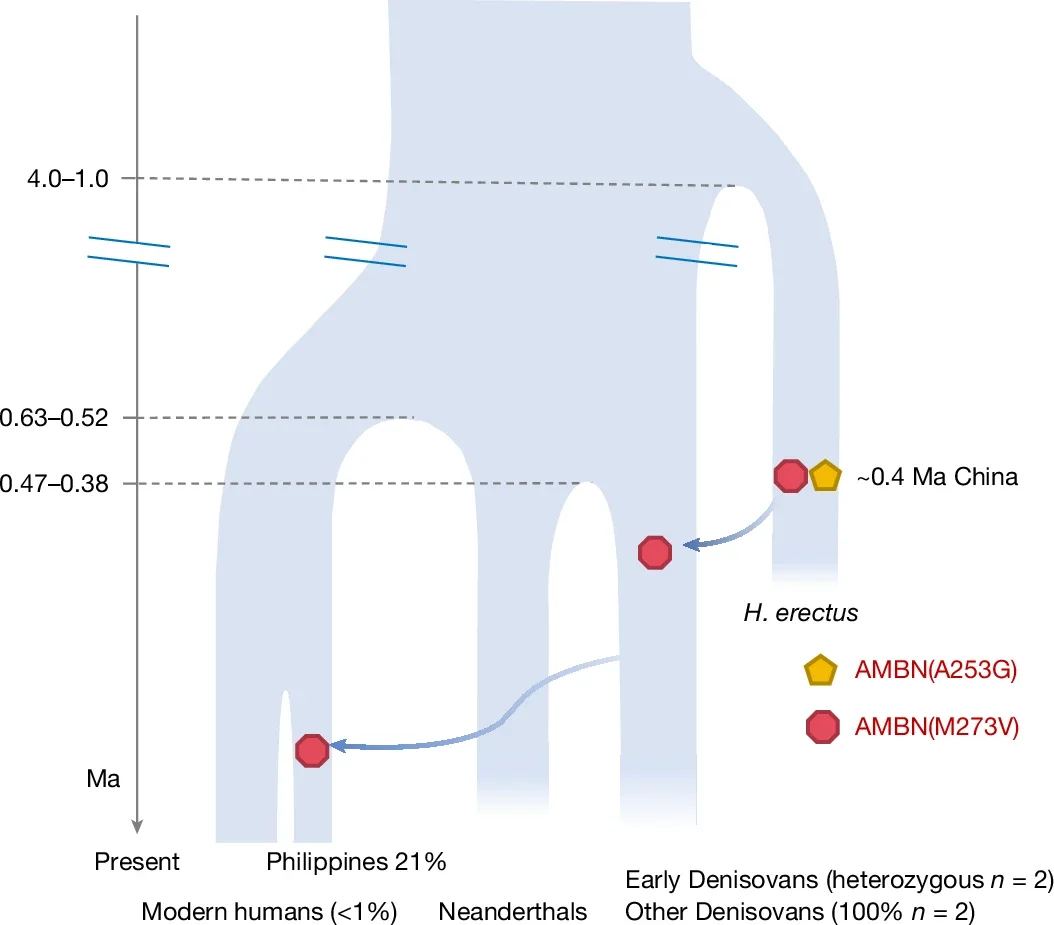
Using liquid chromatography tandem mass spectrometry and several analysis pipelines, the team recovered ancient enamel proteins from all six H. erectus teeth and the Harbin tooth. Across the seven specimens, they identified between 650 and 3,457 peptides from 6 to 11 enamel-related proteins after filtering.
The researchers then checked whether those proteins were truly ancient and endogenous rather than contamination, using several measures including amino acid composition, peptide length, protein breakdown patterns, and elevated deamidation levels associated with age-related degradation.
One striking feature of the study was not just what the team found, but how they found it.
Because ancient human fossils cannot easily be sampled with traditional destructive methods, the group used a micro-destructive approach based on acid etching. That allowed them to recover molecular information while preserving the fossils’ shape. The study also introduced new experimental and computational tools for paleoproteomics, including a sex determination method based on the male-specific enamel protein AMELY and a cross-checking workflow that used tandem mass spectrometry alongside multiple data analysis systems.
The sexing results suggested that the Zhoukoudian tooth, both Hexian teeth, two of the Sunjiadong teeth, and the Harbin sample came from males. One adult Sunjiadong tooth was identified as female.
The most important results came from two amino acid variants in the enamel protein ameloblastin, or AMBN.
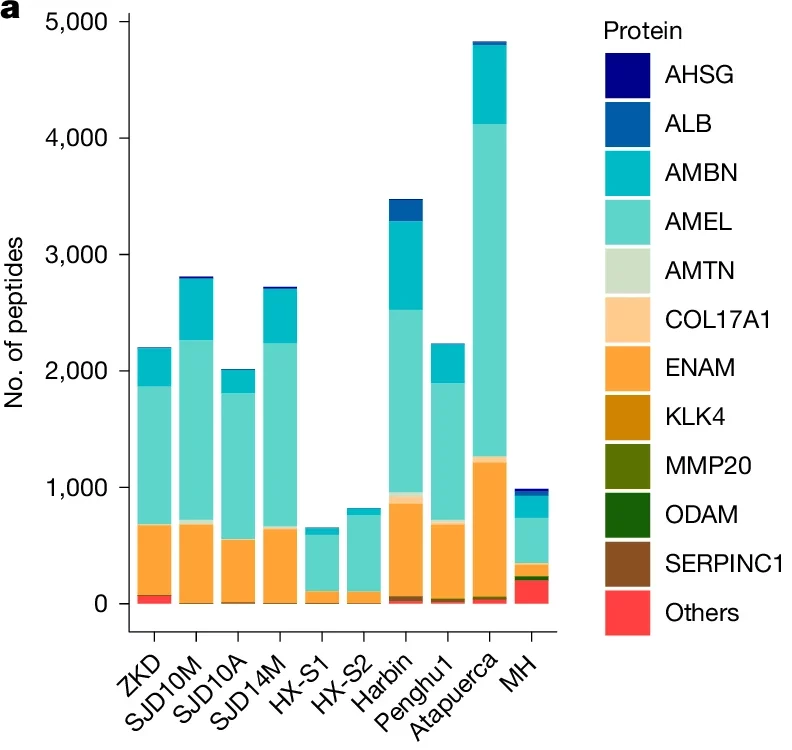
The first, called AMBN(A253G), had not been reported before. It appeared in all six H. erectus samples from Zhoukoudian, Hexian, and Sunjiadong. The mutation was not seen in other available primate or human comparative data, including Denisovans, Neanderthals, Homo antecessor, the Dmanisi H. erectus sample, or modern humans in the Human Genome Diversity Project. Because the variant appeared in fossils from three separate Chinese sites, the researchers argue that it marks these Middle Pleistocene H. erectus as part of the same evolutionary population.
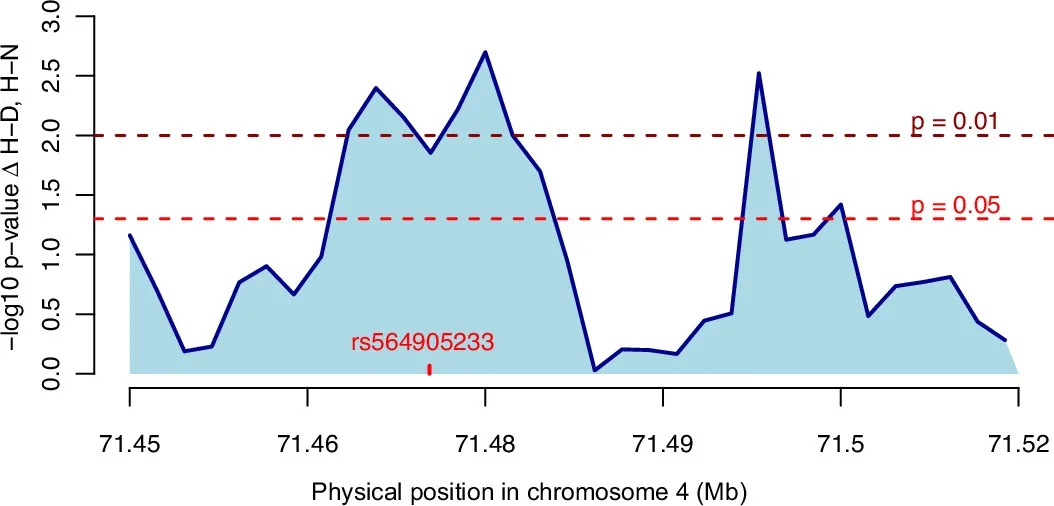
That matters for more than classification. Hexian fossils have been debated because of their unusual morphology and suggestions that they might be closer to Denisovans. The protein evidence places them with H. erectus instead.
The second variant, AMBN(M273V), may carry even broader implications. It also appeared in all six H. erectus teeth. Previously, this variant had been treated as Denisovan-specific. But the new findings suggest that view was too simple.
Instead, the researchers propose that this variant may have entered the Denisovan lineage through admixture with a population linked to these East Asian H. erectus groups. From there, it may have reached some modern humans through Denisovan introgression. Today, the related SNP appears at notable frequency in the Philippines, at lower levels in India and Papua New Guinea, and is absent from most other modern human populations cited in the research.
That does not mean the fossils from Zhoukoudian, Hexian, and Sunjiadong were Denisovans. The study argues the opposite. Differences in age, morphology, and known genetic variants separate them from early Denisovans such as the Harbin individual. But the shared AMBN(M273V) signal raises the possibility that populations related to these H. erectus individuals contributed genetic material to Denisovans, who later passed some of it into modern humans.
A concurrent Nature commentary described the enamel proteins from the six Chinese teeth as providing “new insights into how ancient genetic material was eventually introduced into modern human populations.”
The broader value of the work may lie in method as much as ancestry.
Ancient DNA often fails to survive deep time, especially in warmer environments. Proteins can sometimes last longer, but recovering them from precious fossils has posed ethical and technical problems. This study lays out a framework for doing that work with far less damage than older approaches required.
It also shows that enamel proteins can answer questions that bones alone cannot.
Still, the conclusions come with limits. The research centers on six H. erectus teeth from three sites in China, all dating to about 400,000 years ago, plus one Harbin comparison sample. The authors present a possible model of gene flow rather than a settled lineage map. They also note that more molecular evidence from H. erectus across other regions and time periods will be needed to clarify the species’ diversity, its microevolution, and its interactions with Denisovans.
That uncertainty is part of what makes the findings interesting.
Homo erectus was once known mostly through skull shape, jaw structure, and stone tools. Now, a small set of proteins from tooth enamel is starting to add something more intimate: traces of population history, carried at the level of specific amino acid changes, across hundreds of thousands of years.
This work gives researchers a less invasive way to study ancient human fossils that cannot easily be sampled for DNA.
It also expands the role of paleoproteomics in human evolution research, especially for sites and time periods where genetic material has not survived.
If the methods hold up across more fossils, they could help scientists test long-running debates about ancient populations, trace interactions between extinct human groups, and better understand how deeply rooted some pieces of modern human ancestry may be.
Research findings are available online in the journal Nature.
The original story “Homo erectus and modern humans may have more in common than previously thought” is published in The Brighter Side of News.
Like these kind of feel good stories? Get The Brighter Side of News’ newsletter.
The post Homo erectus and modern humans may have more in common than previously thought appeared first on The Brighter Side of News.

