Apple in iOS 27 introduced iPhone Handoff, a new eSIM feature that allows you to use the same number on two iPhones and seamlessly swap between them. The number is only active on one iPhone at a time, so it’s not like having two independently active lines.
It’s also different from Apple’s existing Handoff feature for continuing an app task on another Apple device. Here’s what you need to know about the new iPhone Handoff feature.
When you switch phones with iPhone Handoff, your calls, voicemail, messages (including iMessage, RCS, SMS, and MMS) and Find My location move to the active iPhone. You’ll see a “Switched to this iPhone” message on the screen to confirm the change.
Other data synced with iCloud will automatically update across your devices, and third-party apps work across both devices, though some third-party apps may require a separate sign-in or take time to sync. Any banking apps you use may also ask you to approve access on the other device.
Both iPhones must be running iOS 27 or later. They’ll also need to be:
iPhone Handoff works with Dual SIM as long as both eSIMs are from carriers that support iPhone Handoff. Both eSIMs must be set up for iPhone Handoff separately, one at a time. Once set up, both eSIMs switch together simultaneously when you unlock your iPhone.
iPhone Handoff is available through T-Mobile in the United States and Telekom in Germany. Verizon (U.S.) and EE (U.K.) will support iPhone Handoff later this year.
AT&T has so far not committed to supporting iPhone Handoff, with a company spokesperson recently pointing to the carrier’s existing eSIM activation and transfer options instead.
T-Mobile is charging customers $5 per month to use iPhone Handoff.
In Germany, Deutsche Telekom is charging €6.95 per month for iPhone Handoff, but only on plans that do not already include multi-SIM functionality. An added multi-SIM costs €6.95 per month (one is included with the current MagentaMobil L plan and two with XL).
No other carriers have announced pricing yet.
iPhone Handoff can be enabled when setting up a new iPhone. At the “Set Up Cellular” screen, choose “Use Number on This iPhone and Another,” then follow the prompts on both phones.
If both iPhones are already set up, open Settings ➝ Cellular on the phone you want to add. Tap Set Up Cellular or Add eSIM, choose Use Number on This iPhone and Another, and follow the prompts. You then get to choose which device is your main iPhone (ideally, the one you use most often) and which is your secondary iPhone.
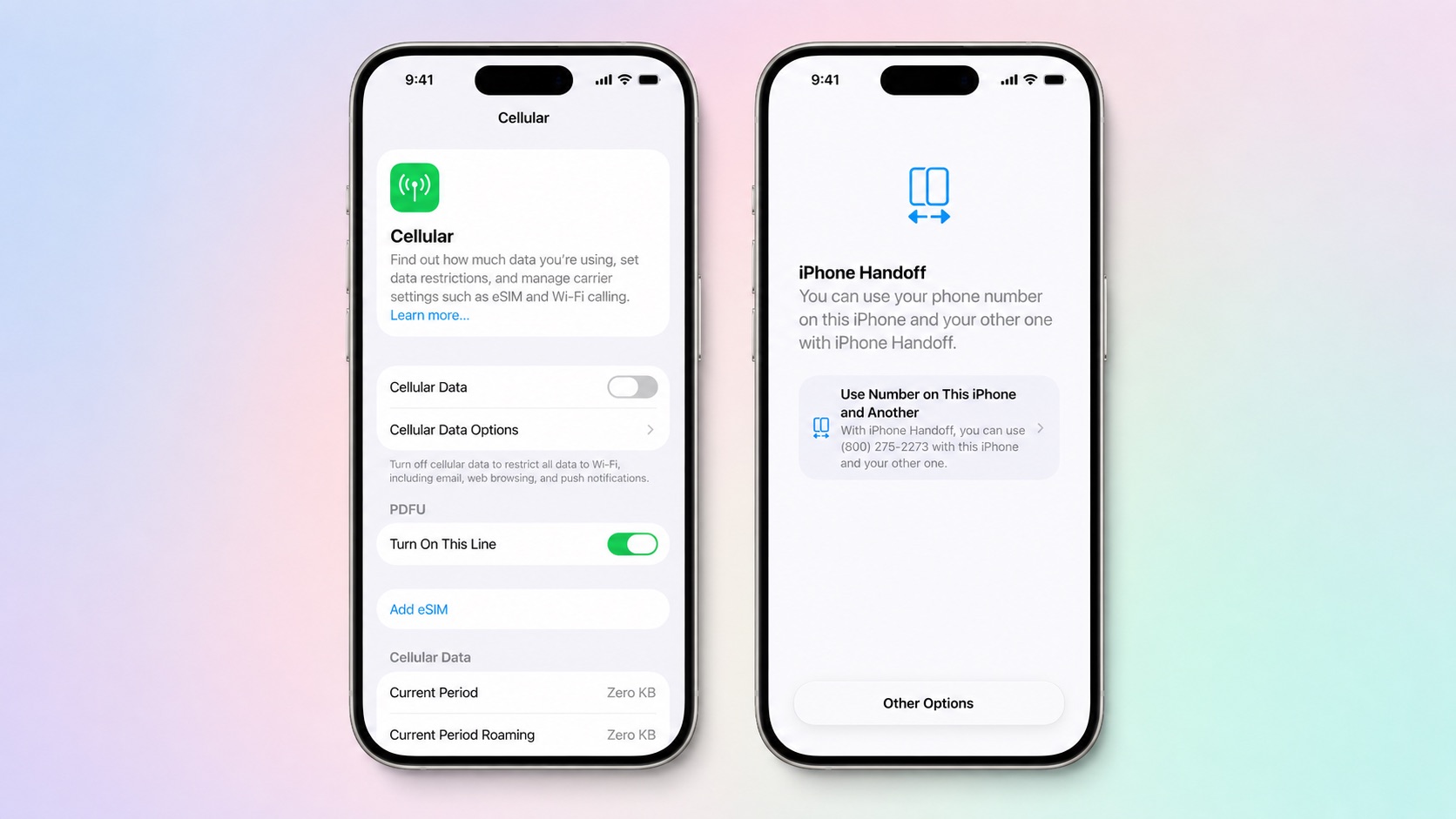
After setup, unlock either phone to make your number active on it.
If you have an Apple Watch, it won’t switch its pairing to the other device when your phone number moves, so make sure you pair it with the iPhone you expect to use most. Also, some Wallet items, including certain transit passes and IDs, may only work on one device at a time.
Carrier account management and some services like Call Forwarding and Caller ID will remain tied to your main iPhone.
Yes, but you need to transfer the eSIM from either iPhone to the replacement device. The below steps should be followed while your new iPhone is placed next to your existing devices that use iPhone Handoff.
The eSIM will deactivate on the old iPhone you transferred from.
If you want to stop using iPhone Handoff at any time, you need to contact your carrier. Simply deleting an eSIM from your iPhone may not stop the carrier from charging you for the service.
This article, “iPhone Handoff in iOS 27: How It Works, Pricing, and Carrier Support” first appeared on MacRumors.com
Discuss this article in our forums


Leave a comment
You must be logged in to post a comment.