The “little red dots” scattered across the distant universe have become one of the James Webb Space Telescope’s most stubborn mysteries. They look tiny, intensely red and unusually bright, yet astronomers have struggled to determine what produces their light.
A closer look now suggests many of these objects sit inside extremely compact galaxies containing roughly a billion solar masses in stars. Their brilliant centers may be young supermassive black holes that grew rapidly before their host galaxies finished building most of their stars.
The findings, published in Nature Astronomy, come from an analysis led by Yiyang Zhang of Wuhan University. The team examined 217 little red dots using high-resolution images from the James Webb Space Telescope, or JWST.
The objects come from the COSMOS-Web field, a broad survey of the distant universe covering an area about three times the apparent size of the Moon. More than 400 little red dots have been identified there.
These objects sit at redshifts of about 5 to 9, meaning their light comes from an era when the universe was roughly a billion years old or younger. Their apparent size is remarkably small. Most of their light comes from a region less than 2% the size of the Milky Way.
That compact appearance is part of what has made them so difficult to explain.
One leading idea holds that many little red dots contain actively feeding supermassive black holes. In some models, a black hole sits inside dense material that produces something resembling the glowing surface of a star, sometimes described as a “black hole star.” Other explanations place more emphasis on extreme star formation.
Finding faint galaxies around the bright central objects could help astronomers distinguish among those possibilities.
The problem is that the central source overwhelms almost everything around it. At the red wavelengths measured by JWST, the host galaxy can be far dimmer than the center.
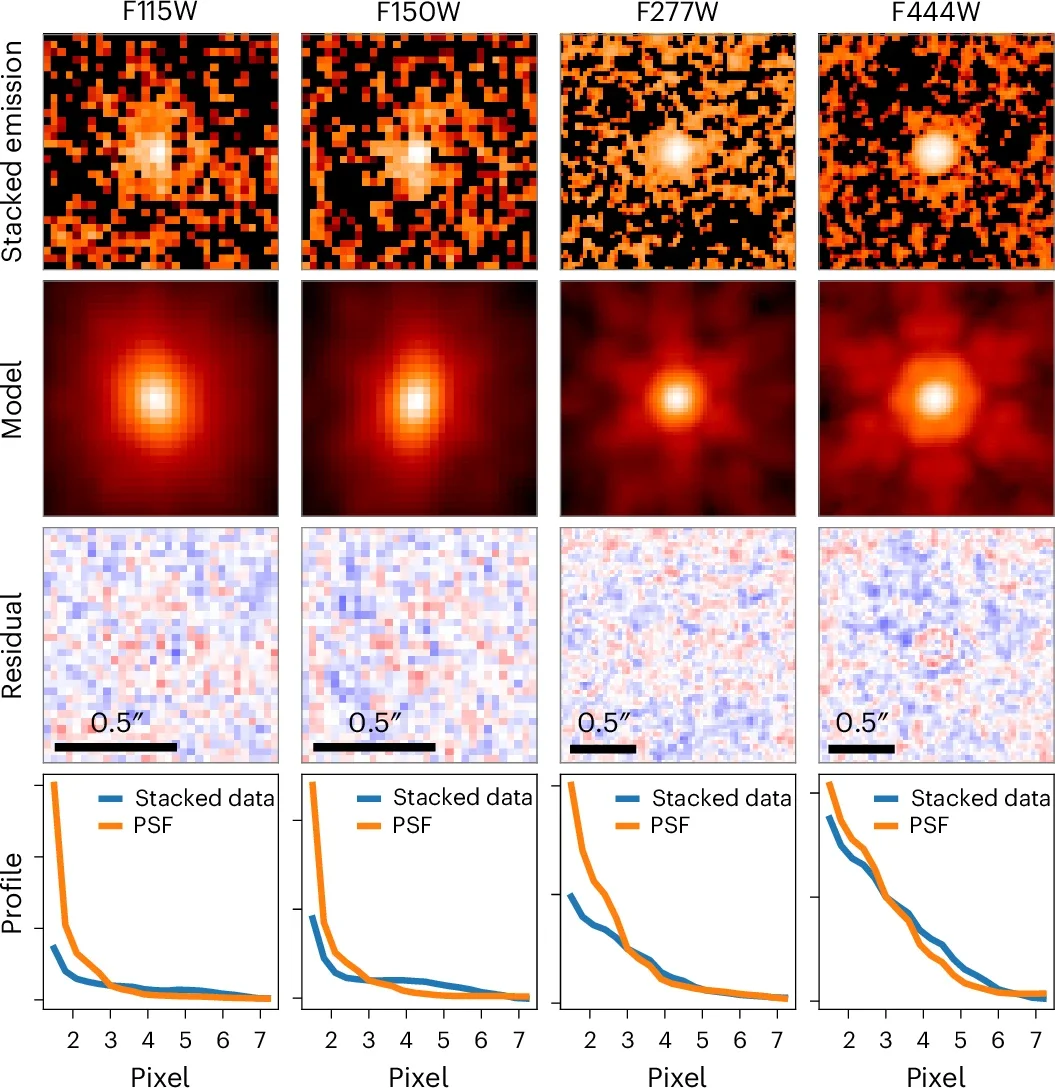
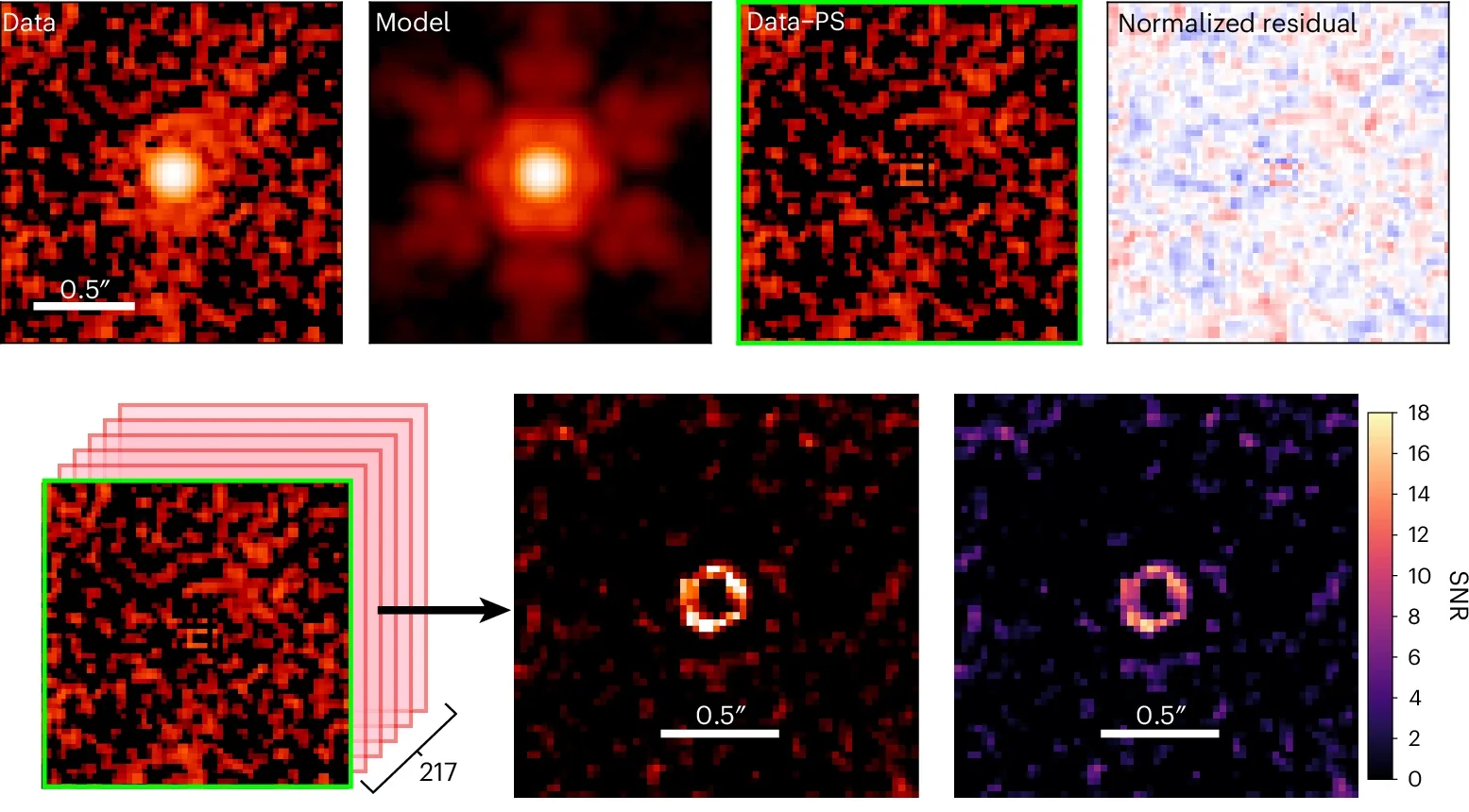
The researchers tackled that problem by modeling the telescope’s point-spread function, the characteristic pattern produced when a point-like source is imaged. They subtracted that central light from each object and then combined, or stacked, the residual images.
Stacking 217 objects brought out light too faint to see reliably around most individual dots.
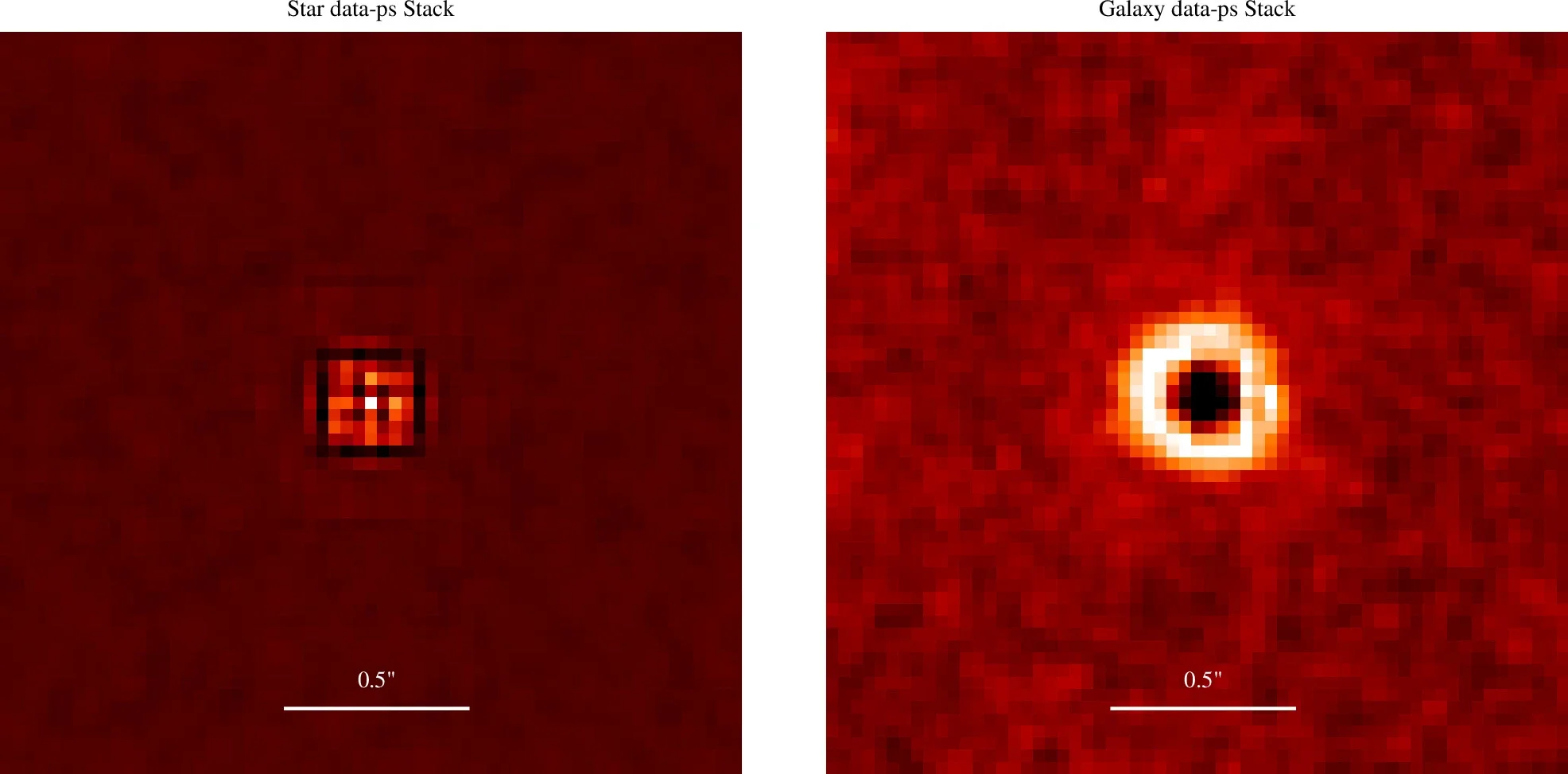
A ring-like excess appeared around the center in the stacked F444W image. The total signal-to-noise ratio of that structure reached 72.2. A control test using 263 stars did not produce the same feature, helping the team rule out a mismatch in the telescope’s optical model as the explanation.
The result provides strong evidence that little red dots contain extended structures rather than being purely point-like sources.
The wavelength of that extended light also matters.
At shorter wavelengths, the extended component contributes a larger share of the total emission. Its median contribution falls from about 60% in the F115W band to roughly 12% in F444W. In the stacked analysis, the extended component supplies about 40% of the shorter-wavelength light but only 10% to 20% at longer wavelengths.
That means the central object dominates strongly in the redder bands.
The host galaxies themselves are exceptionally compact. In rest-frame optical light, the average effective radius is about 210 parsecs, or roughly 685 light-years. In ultraviolet light, that radius grows to about 392 parsecs.
Comparable star-forming galaxies at similar stellar masses have a median size of about 518 parsecs. That makes the little red dot hosts roughly 2.5 times more compact.
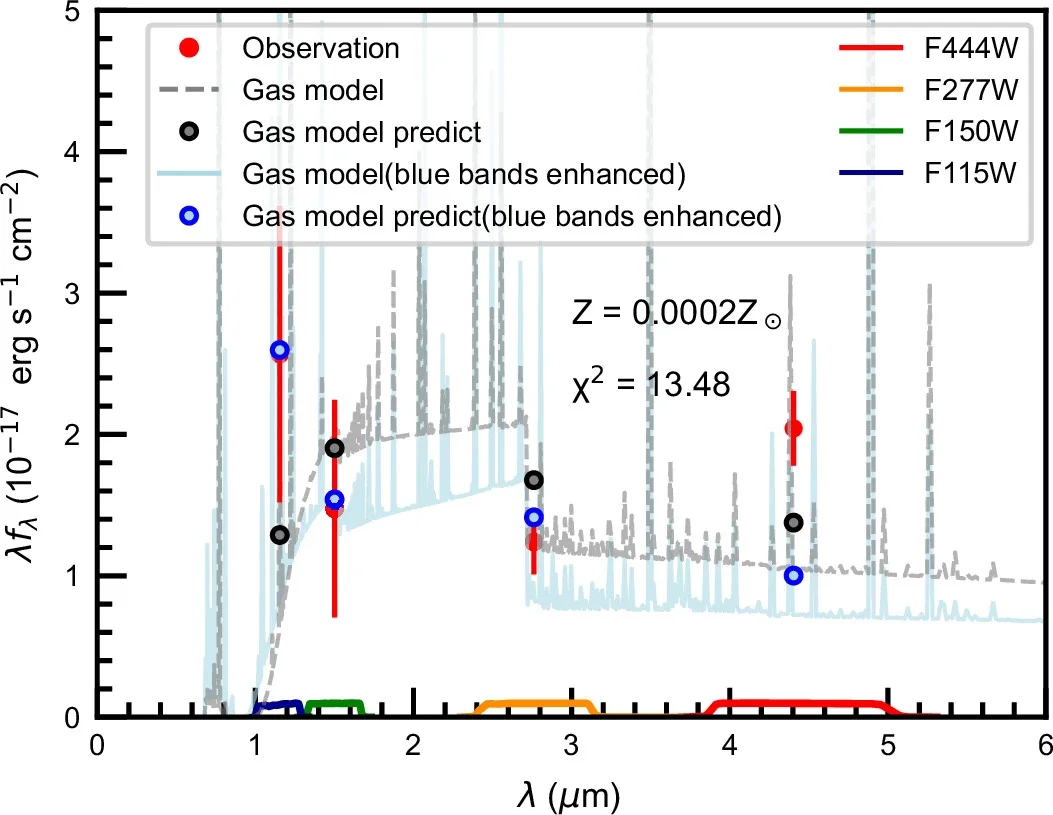
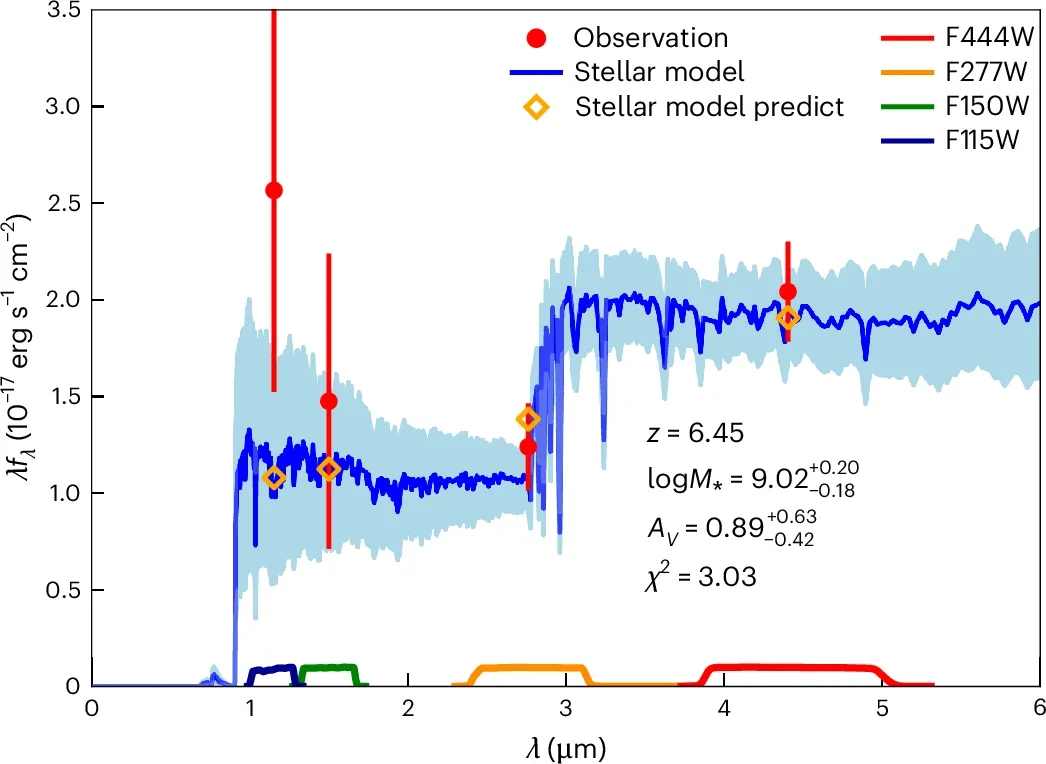
The team also modeled the light from the extended component to determine what might produce it. The results were consistent with a star-forming galaxy containing about 1 billion solar masses in stars, only a small fraction of the stellar mass of the Milky Way.
A model based only on nebular gas could reproduce some ultraviolet light under certain assumptions, but it could not adequately match the rest-frame optical emission in F444W. A model combining stars and gas naturally shifted toward a solution dominated by stars, with only a minor gas contribution.
The researchers therefore concluded that the extended light is primarily stellar, although gas could contribute at shorter wavelengths.
The difference between ultraviolet and optical size adds another clue. Ultraviolet emission associated with recent star formation extends farther from the center than the older stellar distribution traced by optical light. The authors say that pattern provides evidence for an early stage of inside-out galaxy growth.
The findings may also sharpen one of the larger questions surrounding little red dots: how black holes and galaxies grew together in the young universe.
Estimates of black hole masses in these systems remain highly uncertain. Previous work has placed them across a broad range, from millions to as much as a billion times the Sun’s mass.
If the central objects are massive black holes, their small host galaxies raise the possibility that black hole growth raced ahead of stellar growth.
The study also found little evidence for heavy dust attenuation in the extended emission, although the authors caution that current observations do not settle the dust question. Existing mid- and far-infrared measurements cover limited areas and lack the depth needed for a firm conclusion.
There are other important limits. Most of the 217 objects do not yet have spectroscopic confirmation, leaving uncertainty about their distances and the composition of the sample.
The extended emission is also too faint to detect around most individual little red dots, so the results describe the population on average rather than every object separately.
Even with those uncertainties, the faint surrounding light changes the picture. Little red dots appear to live inside small, dense stellar systems rather than floating alone as unexplained pinpoints.
Exactly how those systems formed, and exactly what powers their brilliant centers, remains unresolved. But the galaxies surrounding them are finally beginning to come into view.
These resources examine what may power little red dots, how rapidly early black holes grew and what their abundance and environments reveal about galaxy formation in the young universe.
Little red dots as young supermassive black holes in dense ionized cocoons
Detailed JWST spectroscopy indicates that many little red dots can be explained by young supermassive black holes embedded in dense cocoons of ionized gas. The analysis also suggests their black hole masses may be substantially lower than earlier estimates based on broad spectral lines. (Nature, 2026)
A direct black-hole mass measurement in a little red dot at high redshift
This work reports a direct black hole mass measurement for a little red dot at redshift 7.04. The object appears to contain a black hole whose mass exceeds the allowed stellar mass of its host, offering unusually direct evidence that black hole growth can dominate very early systems. (Nature, 2026)
Little red dots: the assembly of early supermassive black holes in the JWST Era
This review brings together evidence from JWST optical and ultraviolet observations, submillimeter measurements, and radio and X-ray studies to assess competing explanations for little red dots. It also examines their possible role in building the first supermassive black holes. (Frontiers in Astronomy and Space Sciences, 2026)
The growth of light seed black holes in the early Universe
Cosmological simulations show how black holes formed from the remnants of the earliest stars could undergo rapid growth in dense environments. The results address how relatively small initial black hole seeds might become progenitors of the massive black holes JWST observes at early cosmic times. (Nature Astronomy, 2026)
An analysis of 434 little red dots in COSMOS-Web examines whether their emission is dominated by active black holes or unusually compact stellar populations. Their abundance presents an important constraint on models of early black hole and galaxy assembly. (The Astrophysical Journal, 2025)
Research findings are available online in the journal Nature Astronomy.
The original story “JWST’s mysterious ‘little red dots’ may hide early black holes inside tiny galaxies” is published in The Brighter Side of News.
Like these kind of feel good stories? Get The Brighter Side of News’ newsletter.
The post JWST’s mysterious ‘little red dots’ may hide early black holes inside tiny galaxies appeared first on The Brighter Side of News.


Leave a comment
You must be logged in to post a comment.