At the center of the Milky Way, a faint star is racing around a black hole at a speed no other known star in our galaxy has matched. Its orbit may soon let astronomers test how a spinning black hole twists spacetime.
The star, named S301, reaches roughly 25,000 kilometers per second, or about 15,500 miles per second, near Sagittarius A*, the Milky Way’s central black hole. That is more than 8% of the speed of light and about 100,000 times faster than a commercial plane.
S301 also passes closer to Sagittarius A* than any other star observed so far. At its nearest point, it comes within about 12 times the Earth-sun distance, roughly comparable to the distance between Saturn and the sun.
The work was led by researchers using the European Southern Observatory’s Very Large Telescope Interferometer in Chile.
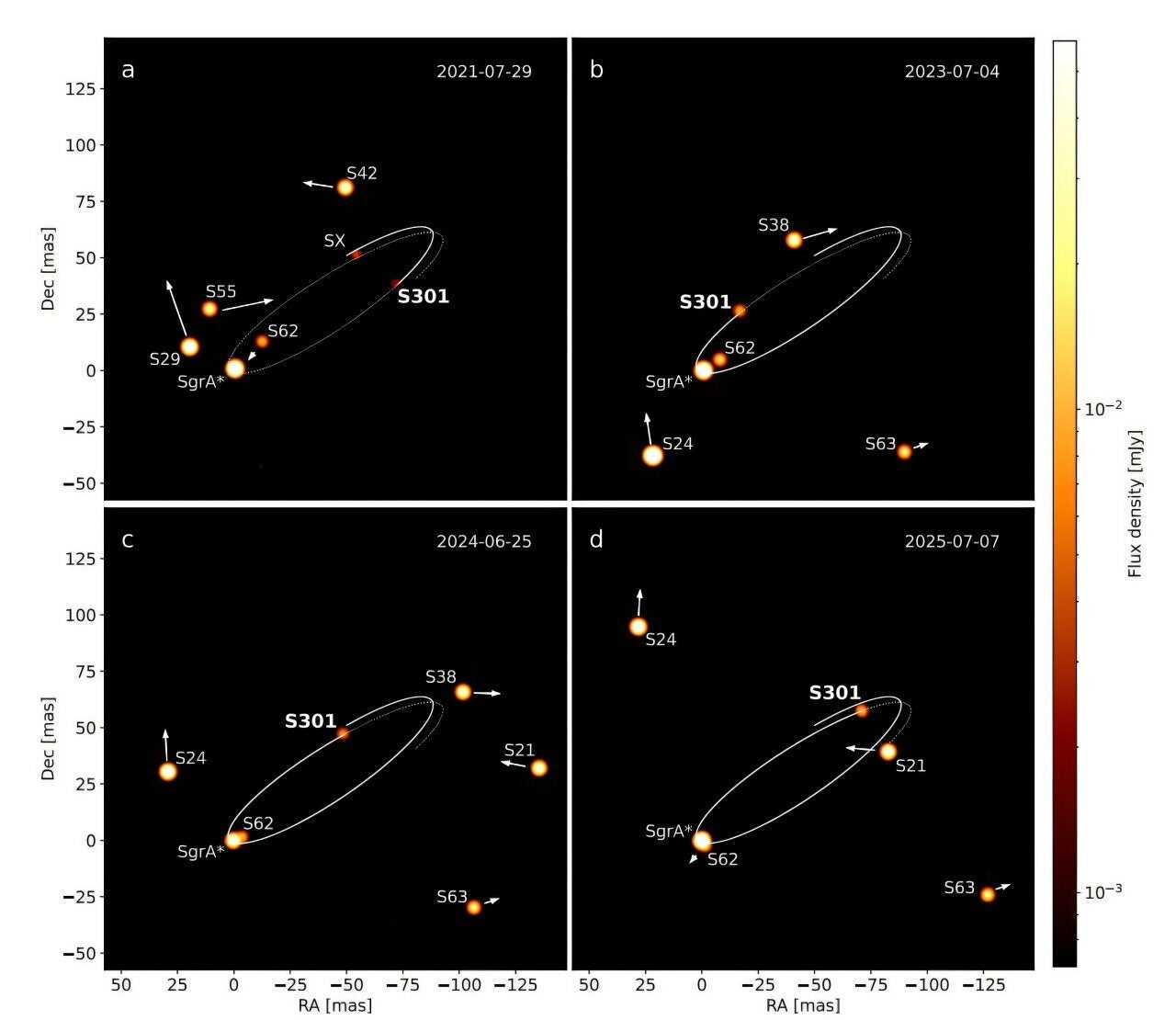
“Decades of carefully tracking stars orbiting our galaxy’s central black hole, Sagittarius A*, have led to this breakthrough discovery of a very promising star. Because it orbits so close to Sagittarius A*, S301 opens a new window to the fundamental properties of spacetime in this extreme black-hole environment,” says Reinhard Genzel, director at the Max Planck Institute for Extraterrestrial Physics.
S301 takes just 8.7 years to complete one orbit around Sagittarius A*, a black hole with a mass of about four million suns. The previous record holder, S55, also called S0-102, takes about 12 years.
“What is special about this star is that it’s orbiting Sagittarius A* on a very tight orbit, taking just 8.7 years to complete it, and is approaching the black hole at a mere 12 times the distance of Earth to the sun. That is unprecedented,” says Felix Mang, a Ph.D. student at MPE and author of the study.
The star follows an extremely stretched orbit with an eccentricity near 0.98. Its closest approach lies only about 136 to 142 Schwarzschild radii from the black hole, roughly 10 times closer than the well-studied star S2.
That close passage produces large relativistic effects. The orbital fit indicates that S301’s point of closest approach shifts by about 1.9 to 2 degrees during each orbit because of Schwarzschild precession.
S301 could push tests of gravity further. In general relativity, a rotating black hole drags nearby spacetime with it, an effect known as Lense-Thirring precession.
The effect weakens rapidly with distance, making it difficult to detect. S301’s unusually tight orbit gives astronomers a rare opportunity to look for it through stellar motion.
“With this star we hope to measure, within the next 10 years, the spin of the black hole,” says Mang.
Stefan Gillessen of MPE adds, “For the first time, we would actually be able to measure very directly the spin of a massive black hole, which would be a key test of Einstein’s theory.”
Forecasts using simulated future observations suggest S301 could constrain the black hole’s spin parameter to an uncertainty below 0.2 and its orientation to about plus or minus 30 degrees by 2035. Those are projections, not current measurements.
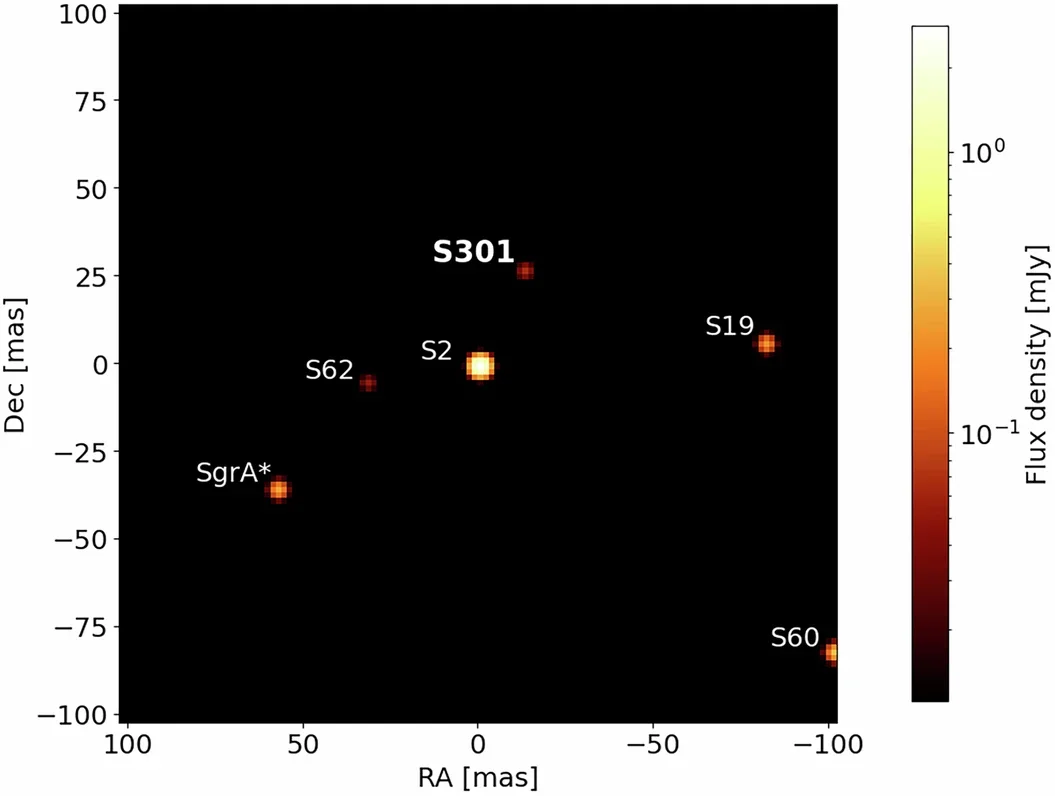
S301 appears about two billion times dimmer than Betelgeuse in the sky. The team detected it with the VLTI and its GRAVITY instrument, now called GRAVITY+ after an infrastructure upgrade.
The VLTI combines light from four 8-meter telescopes, creating a virtual telescope with about 15 times the spatial resolution of a single 8-meter telescope.
“Worldwide, Paranal is the only place where you can do this type of observation because no other observatory in the world has four 8-meter telescopes that can act together as an interferometer,” says Frank Eisenhauer, GRAVITY+ principal investigator and director at MPE.
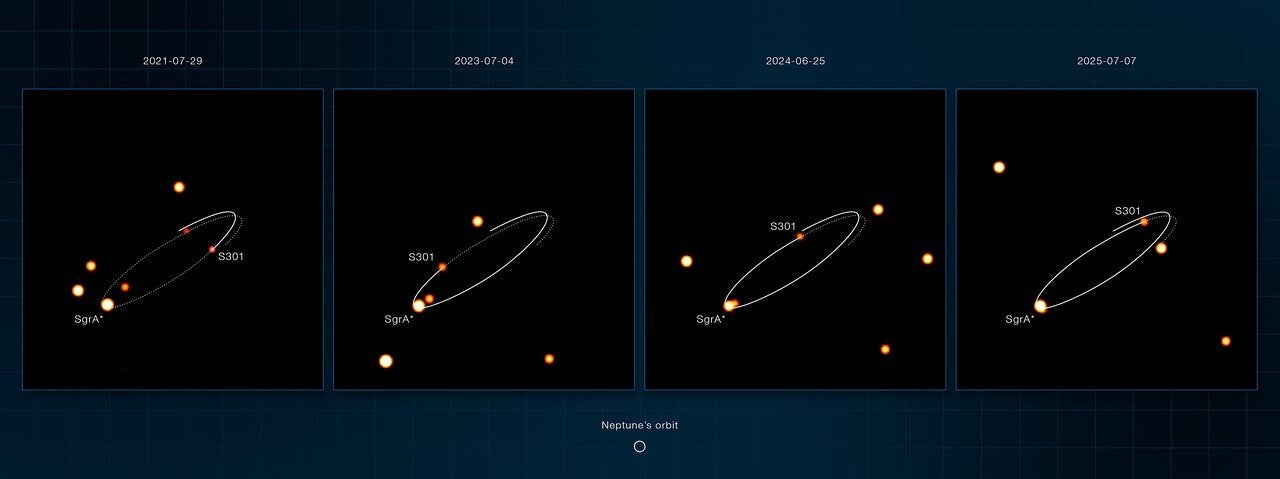
The team first spotted S301 in spring 2023, about 15 milliarcseconds northwest of Sagittarius A*. Researchers followed it in 2024 and 2025 and traced possible earlier positions to 2021 and 2017.
In total, 19 astrometric positions outline an ellipse on the sky. The team has not yet measured S301’s radial velocity, leaving two possible orientations for its orbit.
S301’s brightness matches an early F-type main-sequence star with a mass no greater than about 1.5 suns and a radius between roughly 1.4 and 1.6 solar radii.
Its orbit offers clues about how it arrived so close to Sagittarius A*. Stars are unlikely to form there because of the black hole’s strong tidal forces.
The researchers argue that S301 may once have belonged to a compact binary system. In the proposed Hills mechanism, Sagittarius A* can tear apart a close pair, trapping one star while ejecting the other at high speed.
Its current semi-major axis points to a former binary separation of about 0.1 astronomical unit. The extreme eccentricity is consistent with such an event, although another possibility remains. If S301 spent tens of millions of years near the Galactic Center, gravitational encounters could have altered its orbit. The team estimates about a 3% chance of finding an eccentricity this high in a thermal distribution.
S301 gives astronomers a new natural test particle for studying gravity near a massive black hole. Continued tracking could strengthen tests of general relativity, constrain any extended mass around Sagittarius A*, and provide the first direct stellar-dynamics measurement of the black hole’s spin.
The next closest passage is expected in 2031. Observations with GRAVITY+ and the future MICADO instrument on ESO’s Extremely Large Telescope could add the precision needed to follow at least two full orbits.
“That would be a dream come true,” says Mang.
Over longer periods, sufficiently precise measurements could also help researchers probe the black hole’s quadrupole moment and test the Kerr no-hair relation. For now, S301 stands out because its orbit reaches a region of spacetime that other known stars around Sagittarius A* do not.
These resources explore how stars move around the Milky Way’s central black hole, how astronomers test general relativity there, and what those orbits can reveal about the black hole’s environment, history and rotation.
Impact of a granular mass distribution on the orbit of S2 in the Galactic center
This analysis examines how individual unseen objects near Sagittarius A* could perturb S2’s orbit, an important complication when using stellar motion to isolate subtle relativistic effects around the black hole. (Astronomy & Astrophysics, 2025)
The S2 orbit and tidally disrupted binaries: Indications for collisional depletion in the Galactic center
This work uses S2 and models of tidally disrupted binaries to investigate the stellar population near Sagittarius A*, providing useful context for scenarios in which close stellar encounters with the black hole produce highly eccentric captured stars. (Astronomy & Astrophysics, 2025)
A binary system in the S cluster close to the supermassive black hole Sagittarius A*
Astronomers report the first spectroscopic binary identified in the S cluster, showing that binary systems can survive near Sagittarius A* and offering new evidence about how stars evolve and interact in this extreme environment. (Nature Communications, 2024)
Improving constraints on the extended mass distribution in the Galactic center with stellar orbits
By combining observations of several stars orbiting Sagittarius A*, this research tightens constraints on additional mass surrounding the central black hole, a key factor when interpreting precision tests of gravity from stellar trajectories. (Astronomy & Astrophysics, 2024)
Evidence of a past merger of the Galactic Centre black hole
This study uses inferred properties of Sagittarius A*’s spin to examine its possible formation history, finding that a past supermassive black hole merger could reproduce the black hole’s proposed rapid rotation and unusual spin orientation. (Nature Astronomy, 2024)
Research findings are available online in the journal Nature.
The original story “Milky Way’s fastest star revolves around the central black hole at 8% the speed of light” is published in The Brighter Side of News.
Like these kind of feel good stories? Get The Brighter Side of News’ newsletter.
The post Milky Way’s fastest star revolves around the central black hole at 8% the speed of light appeared first on The Brighter Side of News.


Leave a comment
You must be logged in to post a comment.