Flat metal sheets can become curved structural shells when carefully folded pieces lock together into a continuous network. A new origami-inspired method turns that idea into modular building blocks, allowing complex forms to grow from manageable parts. The approach could simplify fabrication without requiring builders to fold one enormous sheet.
Alfonso Parra Rubio, a graduate student at MIT’s Center for Bits and Atoms, led the research with collaborators in Italy, Austria and Japan. Their paper, published in the International Journal of Space Structures, describes a system of interlocking folded cells.
Small aluminum prototypes demonstrate the geometry, while a room-sized sculpture at the Boston Public Library extends the fabrication approach beyond the laboratory.

The starting point is the work of artist and scientist Ron Resch, who developed intricate folded patterns in the 1960s. His tessellations repeat geometric units across a surface to create three-dimensional forms. The new research adapts that tradition for structural assembly rather than treating the whole surface as one continuous folded sheet.
Each building block combines two triangular, tripod-shaped folded elements. The researchers mirror and rotate the elements so that one blocks the folding motions available to the other. Together, they form a constrained unit that cannot freely change shape through its original folding mechanism.
That geometric rigidity does not mean the metal becomes infinitely stiff. Like other structures, it can still deform when loaded. The design instead removes unwanted folding motion while organizing the material to resist bending more effectively.
Connecting many units produces a hexagonal network of hollow beams. The beams interweave through junctions where three directions meet, creating paths that distribute loads across the structure. The assembled form therefore gains its behavior from both the individual folds and the connections between modules.
“This helps us build strong structures while minimizing the amount of material we are using,” Parra Rubio said. The system achieves its constrained configuration with two material layers. Some other structural origami approaches require three layers to block the available folding motions.
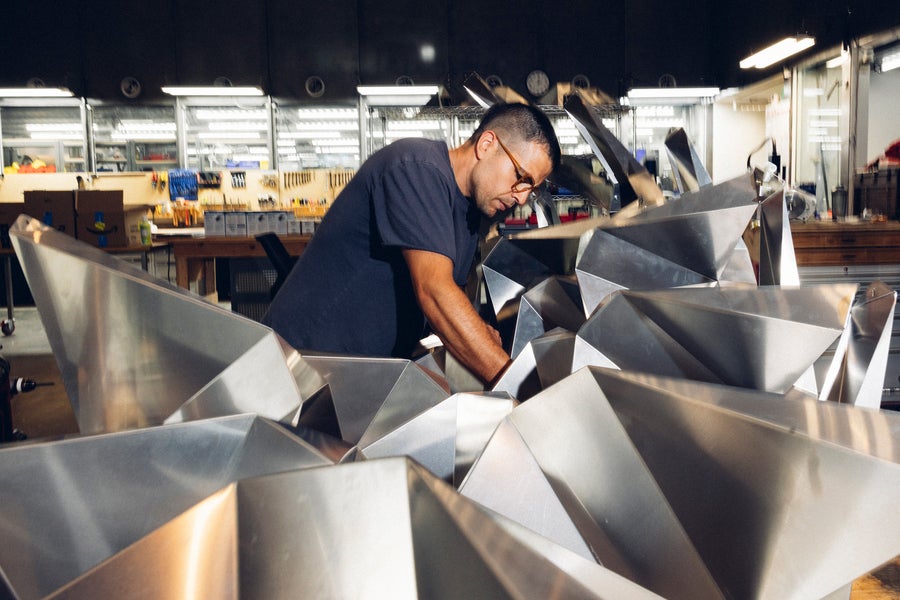
The researchers examined the importance of assembly geometry using computer simulations of a three-point bending test. Two models used the same unit cell but connected the pieces differently. Both had identical mass, area, sheet thickness, loading and support conditions.
Each modeled array contained three by seven cells and weighed 160 grams. The simulations used 0.5-millimeter aluminum sheet, a central load of 30 newtons and supports 200 millimeters apart. Under those conditions, the woven-beam arrangement was up to 3.5 times stiffer than the comparison arrangement.
That result measures resistance to bending in a particular simulated configuration. It does not establish a universal advantage over conventional buildings or every other origami structure. Nor does stiffness alone establish the maximum load a finished structure could safely carry.
The paper attributes the improvement partly to the continuity of the beam cross sections. Their geometry remains structurally connected across the joins, helping transfer bending and shear forces. The three intersecting directions also spread loading through the network rather than concentrating it along one line.
Material savings and the stiffness comparison address related but different questions. Using two layers instead of three can reduce the material needed for geometric constraint. The 3.5-fold simulated advantage, however, came from comparing arrangements with equal mass, rather than testing one model with a third less material.
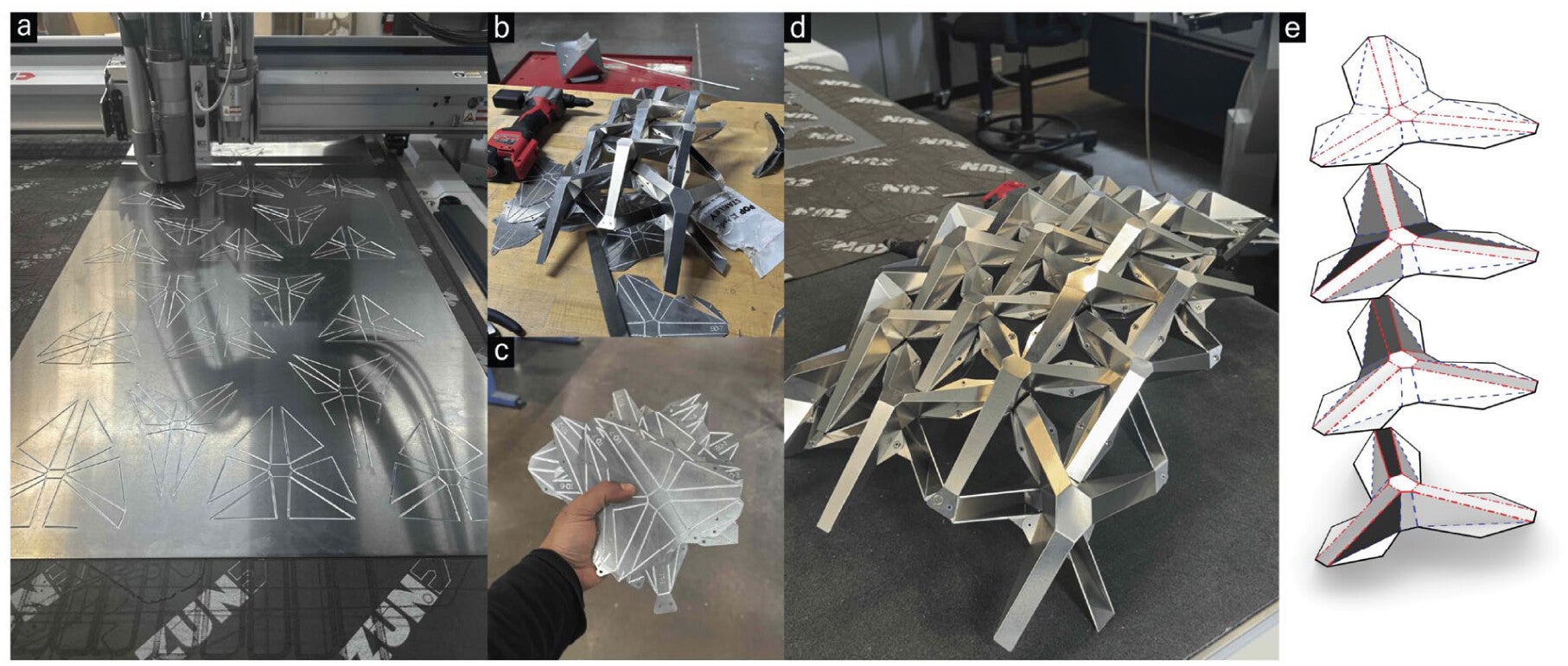
Designing a flat repeating lattice is comparatively straightforward because its cells share regular geometry. Curved surfaces introduce a harder problem: each folded component must fit its neighbors while remaining manufacturable from a flat sheet. A shape that looks right on a computer may otherwise require stretching the material.
The team addressed this by solving the folding geometry locally for each cell. Its numerical workflow adjusts both a flat pattern and its corresponding three-dimensional form until their geometry agrees sufficiently. Fixed connection points help ensure that separately calculated pieces will still meet during assembly.
This local approach avoids requiring an entire complex shell to unfold into one continuous sheet. It also reduces the size of the manufacturing problem to individual components. Curvature can then emerge from the combined geometry of many pieces.
The research involved Riccardo Foschi of the University of Bologna, Rupert Maleczek of the University of Innsbruck and Tomohiro Tachi of the University of Tokyo. Neil Gershenfeld, director of MIT’s Center for Bits and Atoms, is the senior author. MIT graduate student Erik Strand also worked with Parra Rubio on design automation described in the institutional announcement.
The workflow is not yet automatic for every desired shape. Some configurations fail to converge, requiring adjustments to numerical settings or input geometry. The paper identifies strongly curved and topologically complex surfaces as important limitations of the current approach.
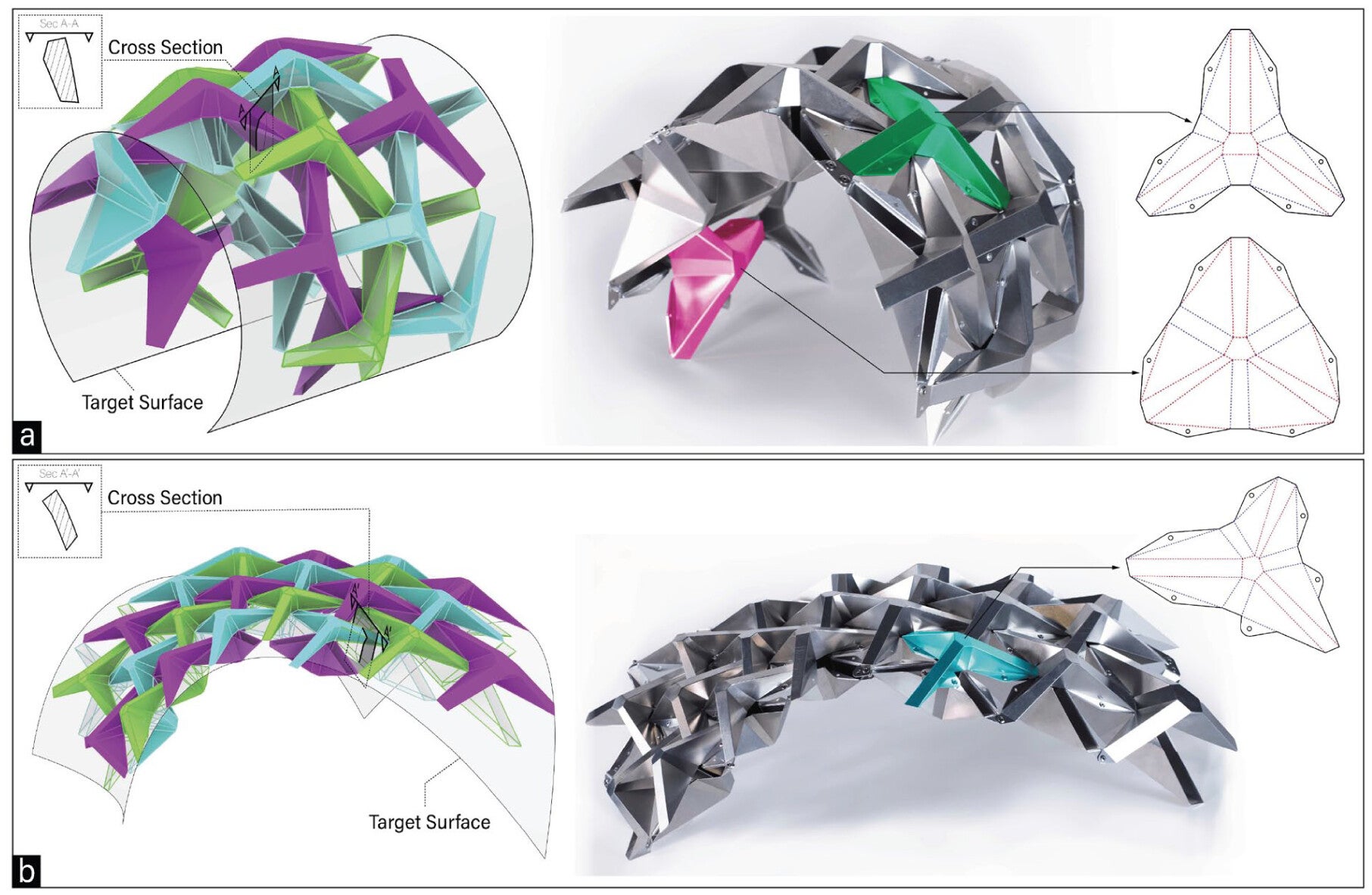
The paper reports two physical prototypes measuring roughly 0.3 to 0.6 meters. One follows a surface curved in a single direction, while the other has a more complex, doubly curved form. Both demonstrate how individually folded pieces can produce a continuous structural lattice.
The researchers fabricated those models from 1.2-millimeter aluminum alloy sheets. Computer-controlled equipment cut the outlines and engraved the folding patterns before manual folding. Blind rivets fastened the finished components together.
For more complex geometry, each component can be different. The doubly curved prototype therefore required careful labeling and tracking during fabrication. Modular construction simplifies the scale of each piece without eliminating the need to organize the complete assembly.
A larger demonstration, Lexicon, brought folded aluminum into the Boston Public Library. The suspended sculpture was created by Parra Rubio and Strand with collaborators and assembled by a team without professional construction experience. Its construction in a matter of days illustrates fabrication at room scale, rather than demonstrating a completed emergency shelter.
The researchers propose shipping flat components for rapid assembly into disaster-relief shelters. Other possibilities include aircraft components, modular robots, building facades and acoustic panels. These are potential uses of the structural method, rather than applications validated by the reported prototypes.
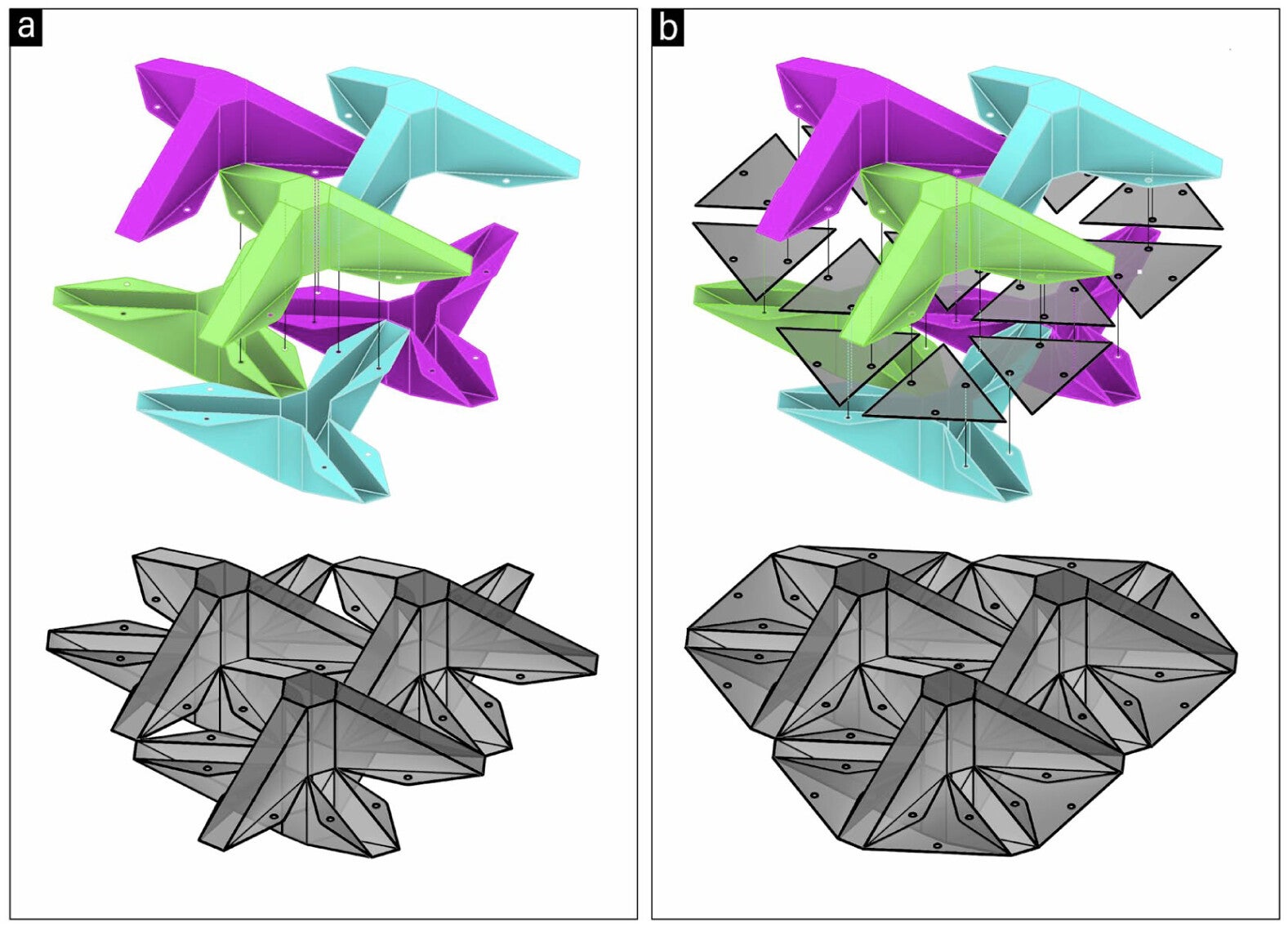
The hollow, interconnected spaces could also accommodate additional functions. The authors discuss insulation, heat exchange and routing electrical systems, alongside openings for ventilation and daylight. Their study does not report measured thermal or acoustic performance for those possibilities.
The current lattice also imposes restrictions on the overall shape. Its hexagonal pattern requires three beams to meet at interior junctions, a rule that cannot fit every curved surface. The team is exploring arrangements that incorporate square cells and junctions with four connections to extend the range of possible structures.
Future work will explore larger structures, bolted connections and more complex curvature. The researchers also want design tools that adjust internal cell geometry more flexibly and are easier to use. The next challenge is to establish how those geometric choices and connections affect performance as the system moves toward practical architectural structures.
These resources connect recent fabrication research with earlier work on cellular materials and freeform folding geometry.
Modular Origami Approach for Rigid Foldable Steel Load-Bearing Plate Lattices in Arbitrary Sizes
This conference paper presents folded steel lattice modules and mechanical testing, providing context for manufacturing structural materials from flat sheet stock. (Springer Nature, January 2026)
Hierarchical Discrete Lattice Assembly: An Approach for the Digital Fabrication of Scalable Macroscale Structures
An ACM conference study demonstrates robots assembling larger structures from grouped lattice blocks, offering a complementary approach to scaling modular fabrication. (ACM Symposium on Computational Fabrication, November 2025)
Kirigami Corrugations: Strong, Modular, and Programmable Plate Lattices
This conference paper explores folded plate lattices with tunable mechanical behavior, including structures and robots with curved forms. (ASME IDETC-CIE Proceedings, 2023)
Research findings are available online in the journal International Journal of Solids and Structures.
The original story “MIT’s origami construction offers a new way to build lightweight curved structures” is published in The Brighter Side of News.
Like these kind of feel good stories? Get The Brighter Side of News’ newsletter.
The post MIT’s origami construction offers a new way to build lightweight curved structures appeared first on The Brighter Side of News.


Leave a comment
You must be logged in to post a comment.