A turkey-sized dinosaur nicknamed the “hell chicken” may have stripped flesh from fruit with a sliding, toothless jaw. Its unusual skull suggests a feeding style quite different from the bone-crushing bites associated with large predators. The discovery adds a possible fruit specialist to the familiar world of T. rex and Triceratops.
The newly named species, Infernogallus jamesi, appears in a Nature Communications study led by Gregory Funston of Stony Brook University. Researchers from the Royal Ontario Museum, North Dakota Geological Survey and other institutions helped investigate its anatomy.
They propose that fruit formed part of a specialized soft-plant diet, while acknowledging that fossilized stomach contents would provide a stronger test.
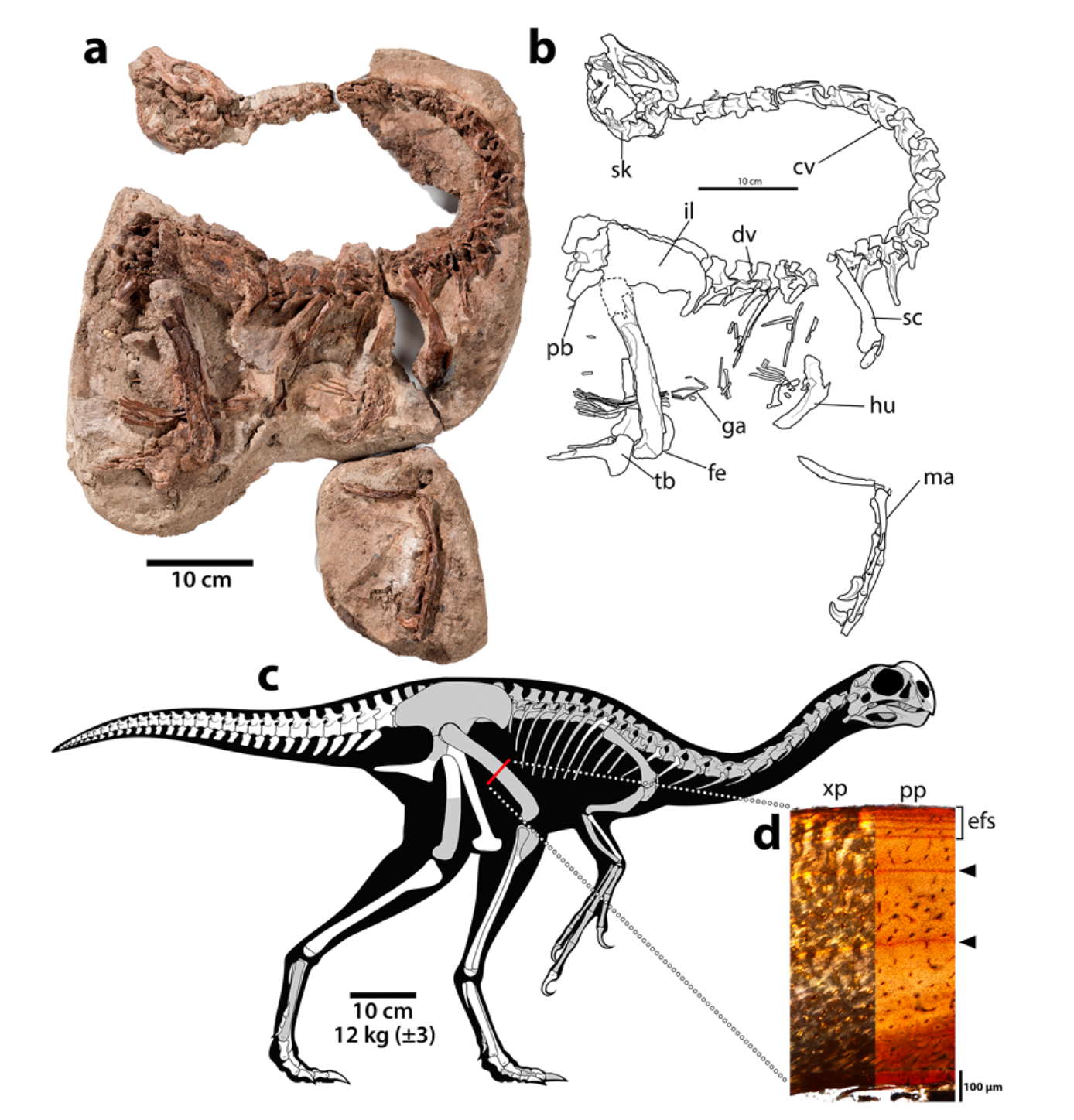
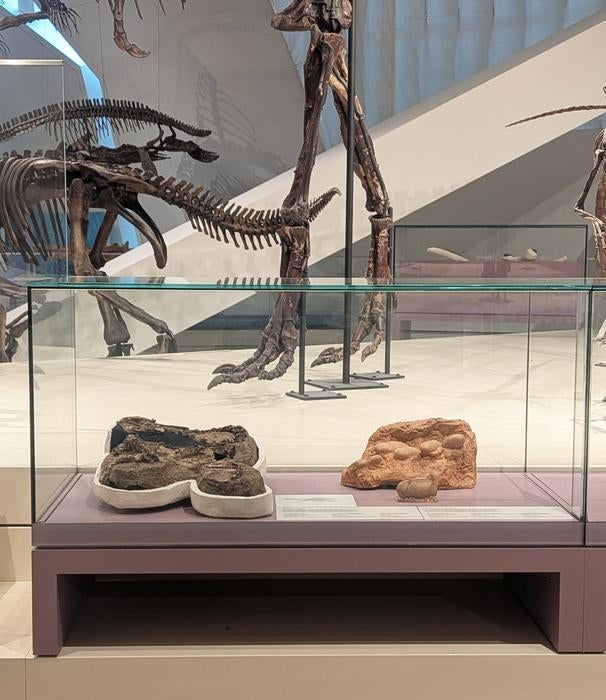
The animal belonged to the caenagnathids, a group of toothless oviraptorosaur dinosaurs whose feeding habits have long puzzled paleontologists. Their remains often consist of scattered bones, leaving important parts of their skulls unknown. The new specimen preserves a nearly complete skull with bones still joined in their original anatomical arrangement.
That skull accompanies a partial skeleton from Montana’s Hell Creek Formation, a rock unit dating to the latest Cretaceous. Additional material assigned to the species comes from Montana, South Dakota and North Dakota. The study describes five specimens, including separate pieces that the authors interpret as belonging to one individual.
The main skeleton was discovered in July 2011 and acquired by the Royal Ontario Museum in 2012. Its estimated body mass was about 12 kilograms, with a range of nine to 15 kilograms. That makes it small for its group, rather than a miniature version of one of its giant neighbors.
Thin sections of several leg bones helped establish that the animal had reached skeletal maturity. Closely spaced growth marks near the bones’ outer surfaces indicated slowing growth. The researchers estimated that it was at least six years old, and probably seven, when it died.
The name Infernogallus combines references to Hell Creek and the animal’s small, birdlike appearance. Its modest size is scientifically important because small dinosaurs are less likely to leave complete remains. Without evidence of maturity, researchers might mistake such an animal for a youngster of a larger species.
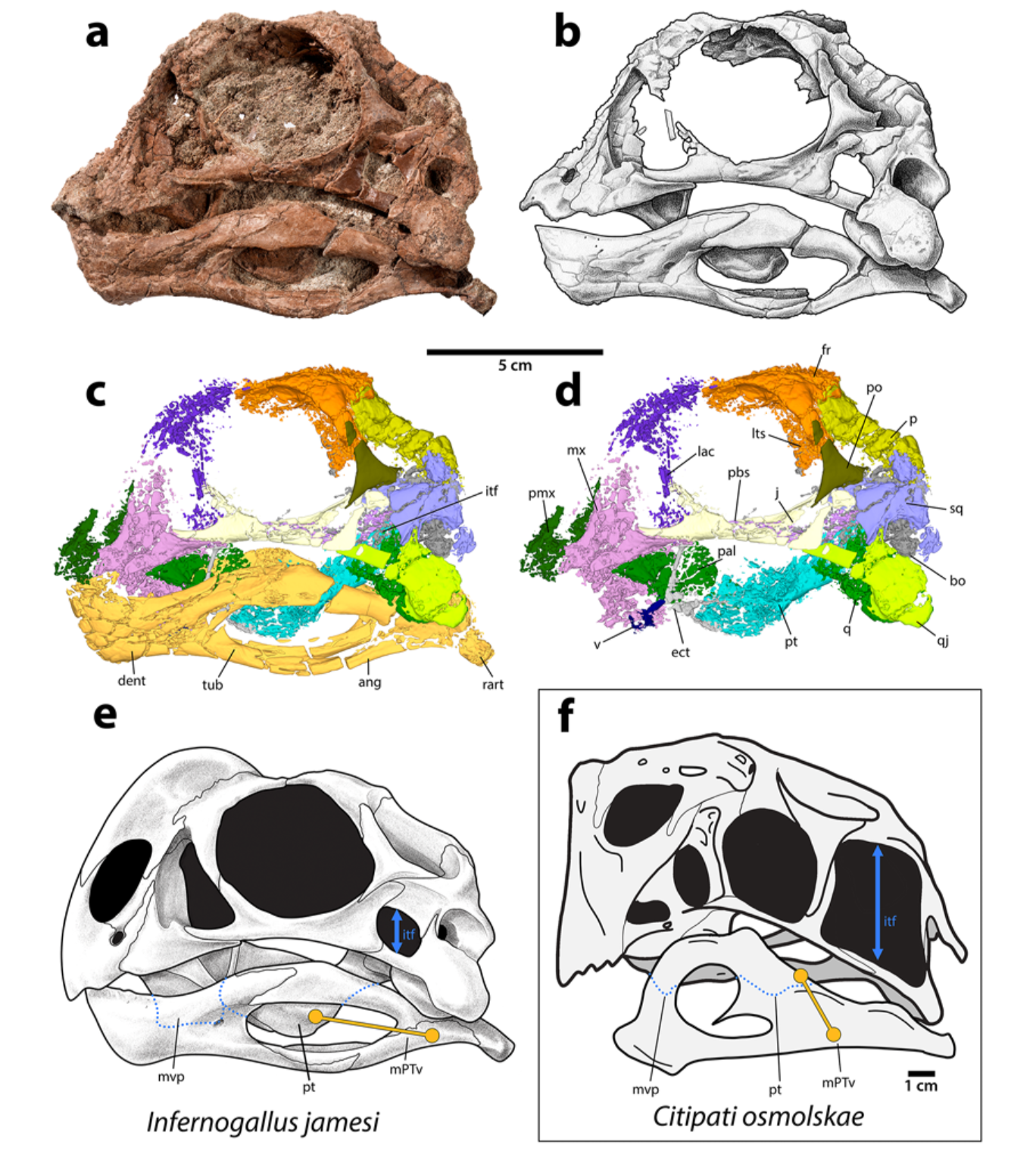
CT scans allowed the team to reconstruct individual skull bones and examine structures hidden inside the fossil. The researchers also digitally corrected crushing that occurred after death. Those reconstructions exposed an exceptionally modified palate, the bony roof of the mouth.
Parts of the palate curved downward into the oral cavity. This changed the arrangement of muscles associated with moving the lower jaw. Instead of emphasizing an up-and-down bite, important muscles would have pulled more strongly along a front-to-back direction.
The joint connecting the lower jaw to the skull also supported that interpretation. A rounded ridge fitted into a saddle-like surface, permitting forward and backward sliding. Virtual articulation suggested as much as 15 millimeters of movement, about 14% of skull length, although living soft tissues would have affected the true range.
Ridges and grooves on the opposing surfaces of the mouth provided another clue. Sliding these textured surfaces against one another could mash, shear or crush soft food. Attachment features also suggested that a strong, mobile tongue helped position material during processing.
This was not simply a powerful bite aimed in a new direction. The team inferred a reduced capacity for vertical biting compared with other oviraptorosaurs. That combination made hard seeds, nuts and tough vegetation less convincing dietary matches than soft plant material.
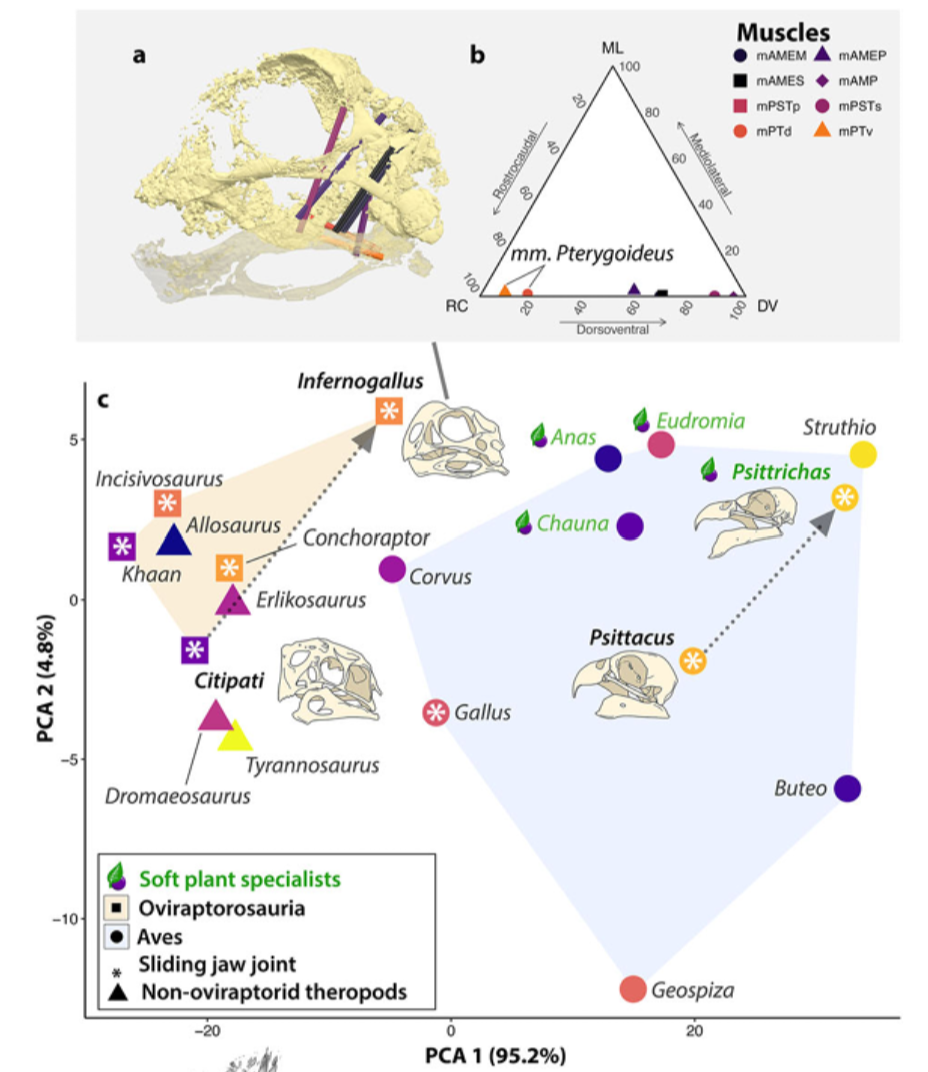
To explore possible functions, the researchers compared jaw-muscle orientations across 19 dinosaur and bird species. They examined the directions in which reconstructed muscles would act, rather than measuring a preserved dinosaur’s muscles. Some attachment locations required inference from related animals because the fossil did not expose every relevant surface.
The closest overall comparison was the vulturine parrot, Psittrichas fulgidus. This living bird eats fruit pulp and discards the seed, unlike parrots that use strong cracking bites to reach seeds. Its jaw organization shares important features with the reconstructed dinosaur.
No living comparison matches every feature of Infernogallus. Some leaf-eating birds and herbivorous sea turtles also share individual aspects of its feeding apparatus. The argument for fruit therefore rests on a combination of anatomy, inferred movement and ecological context.
The authors conclude that soft, fleshy fruit is a plausible dietary specialization. They also state that other soft plant materials probably formed a significant part of the diet. The evidence does not establish that the dinosaur ate fruit exclusively or identify a particular fruit in its last meal.
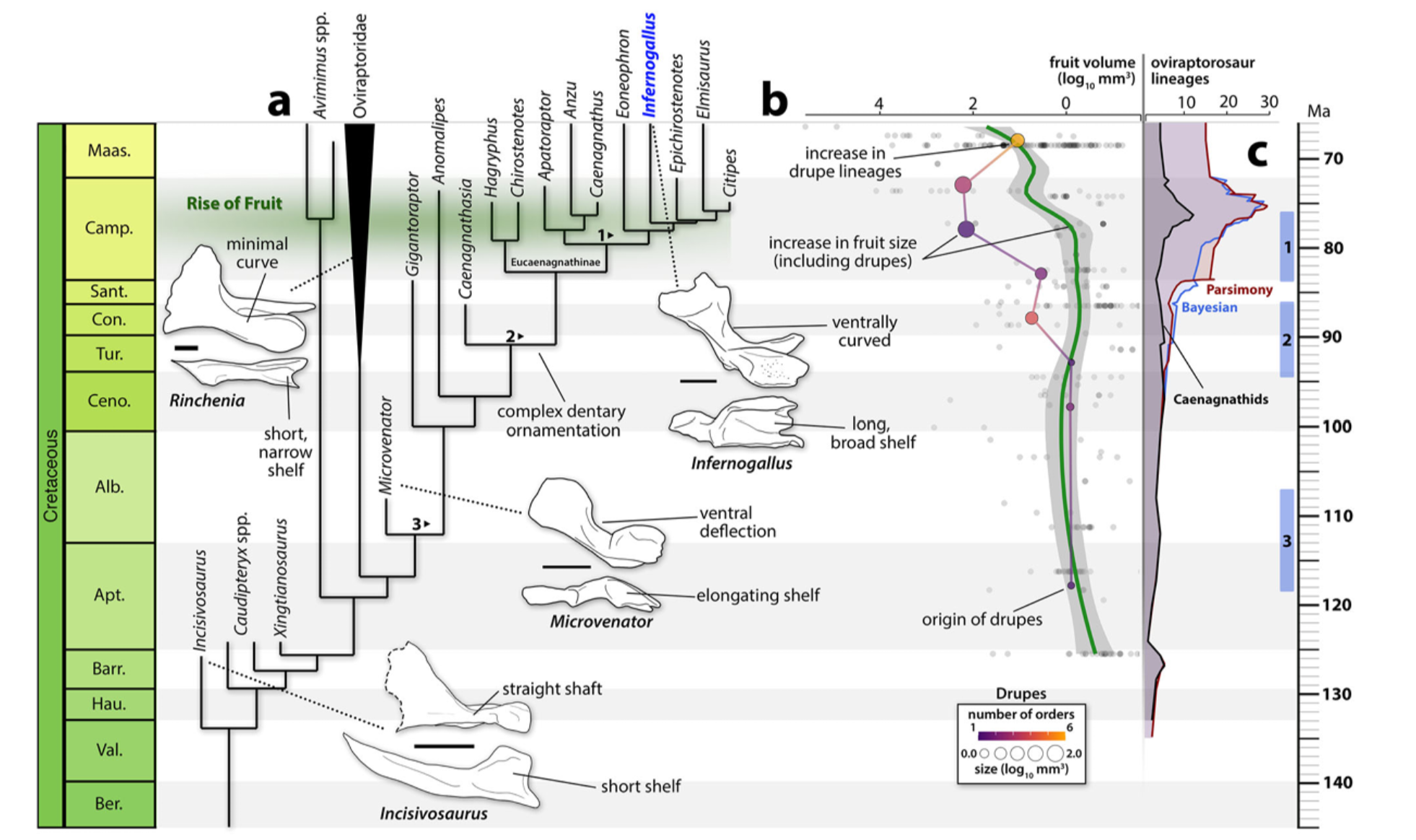
The proposed diet matters because paleontologists have struggled to connect dinosaur diversification directly with the spread of flowering plants. Flowering plants produce fruits, and their increasing variety offered new feeding opportunities during the Cretaceous. However, broad comparisons of plant and dinosaur diversity have not consistently shown matching patterns.
Funston and colleagues investigated a narrower connection by reconstructing caenagnathid evolutionary relationships and comparing their timing with the fruit fossil record. Their analyses suggest that potentially relevant feeding adaptations arose early in the group. More specialized relatives appeared alongside increases in the size and diversity of fleshy fruits.
Particular attention went to drupe-like fruits, which surround a large seed with fleshy tissue. A mouth that mashed the flesh while leaving the seed could exploit these foods differently from a seed-cracking animal. That possibility helps explain why elaborate processing structures might accompany a relatively weak vertical bite.
The timing supports the proposed relationship, but does not prove that dinosaurs drove fruit evolution. Nor does a likely fruit diet establish that Infernogallus dispersed seeds effectively. Its contribution to plant reproduction remains an ecological question, rather than a demonstrated result of the study.
The discovery also complicates efforts to reconstruct dinosaur communities shortly before their mass extinction. A small specialist can represent a distinct ecological role that isolated bones fail to reveal. Finding one in the heavily studied Hell Creek Formation suggests that functional diversity remains incompletely sampled.
“This discovery shows that we still have a lot to learn about the world of T. rex, and about dinosaurs more generally,” said senior author David Evans. He is chief curator of natural history at the Royal Ontario Museum. The specimen expands that picture without settling whether dinosaurs overall were declining before the extinction.
Fruit specialization may also have brought vulnerability when food webs collapsed. The authors contrast potentially seasonal fruit flesh with more persistent seeds, which earlier research has proposed as important to some birds’ survival. That remains an interpretation of extinction risk, not a confirmed account of how this species died out.
Further discoveries could sharpen the dietary case. Fossilized stomach contents, more detailed biomechanical models and better comparisons with feeding behavior in living birds would all help. They could reveal whether this unusual jaw primarily processed fruit, other soft plants or a mixture of both.
These resources combine recent research on dinosaur feeding and fruit evolution with foundational studies of caenagnathids and extinction.
A new oviraptorosaur (Dinosauria: Theropoda) from the end-Maastrichtian Hell Creek Formation of North America
The description of Eoneophron infernalis uses bone histology to distinguish a smaller caenagnathid from juvenile members of a larger species, providing context for hidden Hell Creek diversity. (PLOS ONE, January 2024)
Patterns of variation in fleshy diaspore size and abundance from Late Triassic–Oligocene
A fossil database tracks changes in fleshy seed-bearing structures, supplying broader context for the Cretaceous expansion of flowering-plant fruits. (Biological Reviews, December 2023)
Cranial muscle reconstructions quantify adaptation for high bite forces in Oviraptorosauria
Digital reconstructions investigate strong bites in other oviraptorosaurs, highlighting the contrast with the sliding, soft-food processing proposed for Infernogallus. (Scientific Reports, February 2022)
Research findings are available online in the journal Nature Communications.
The original story “Turkey-sized ‘hell chicken’ dinosaur had a jaw suited to mashing fruit” is published in The Brighter Side of News.
Like these kind of feel good stories? Get The Brighter Side of News’ newsletter.
The post Turkey-sized ‘hell chicken’ dinosaur had a jaw suited to mashing fruit appeared first on The Brighter Side of News.


Leave a comment
You must be logged in to post a comment.