An invisible shock wave surrounding Jupiter is giving physicists a rare look at how nature handles enormous flows of energy without ordinary particle collisions.
NASA’s Juno spacecraft recorded unusually detailed electrical and magnetic activity while crossing Jupiter’s bow shock in December 2024. The observations revealed a surprisingly rich collection of plasma waves, including multiple harmonics that could help heat a wider range of particles than comparable processes near Earth.
The findings come from a University of Iowa-led international team and were published in Nature Communications under the title “Plasma wave observations from Juno spacecraft at the Jovian bow shock.”
Researchers also found evidence that part of the shock repeatedly reforms every several seconds. Together, the observations make Jupiter a nearby laboratory for understanding collisionless shocks, a class of structures that also appears around stars, supernova remnants and other energetic environments throughout the universe.
The solar wind continuously carries charged particles outward from the Sun at supersonic speeds. When that flow reaches a strongly magnetized planet, it cannot simply continue unchanged through the planet’s magnetic environment.
Instead, a bow shock forms ahead of the magnetosphere. Solar-wind particles abruptly slow, heat and change direction as they cross this boundary.
The process is somewhat analogous to the shock wave created by a supersonic aircraft, but there is an important difference. Ordinary atmospheric shocks can dissipate energy through frequent collisions between molecules. Space plasma is so thin that direct particle collisions are far too rare to do the job.
Electromagnetic fields and waves must instead transfer the incoming flow energy into heat and energetic particles.
Earth’s bow shock has been studied extensively by spacecraft, giving physicists a detailed picture of several important wave-particle interactions. Jupiter presents a more extreme case because its vast magnetosphere and outer Solar System environment produce different shock conditions.
“Jupiter has found its own way to deal with the solar wind, through plasma waves that are stronger and exhibit richer harmonic structures,” corresponding author Jayasri Joseph said.
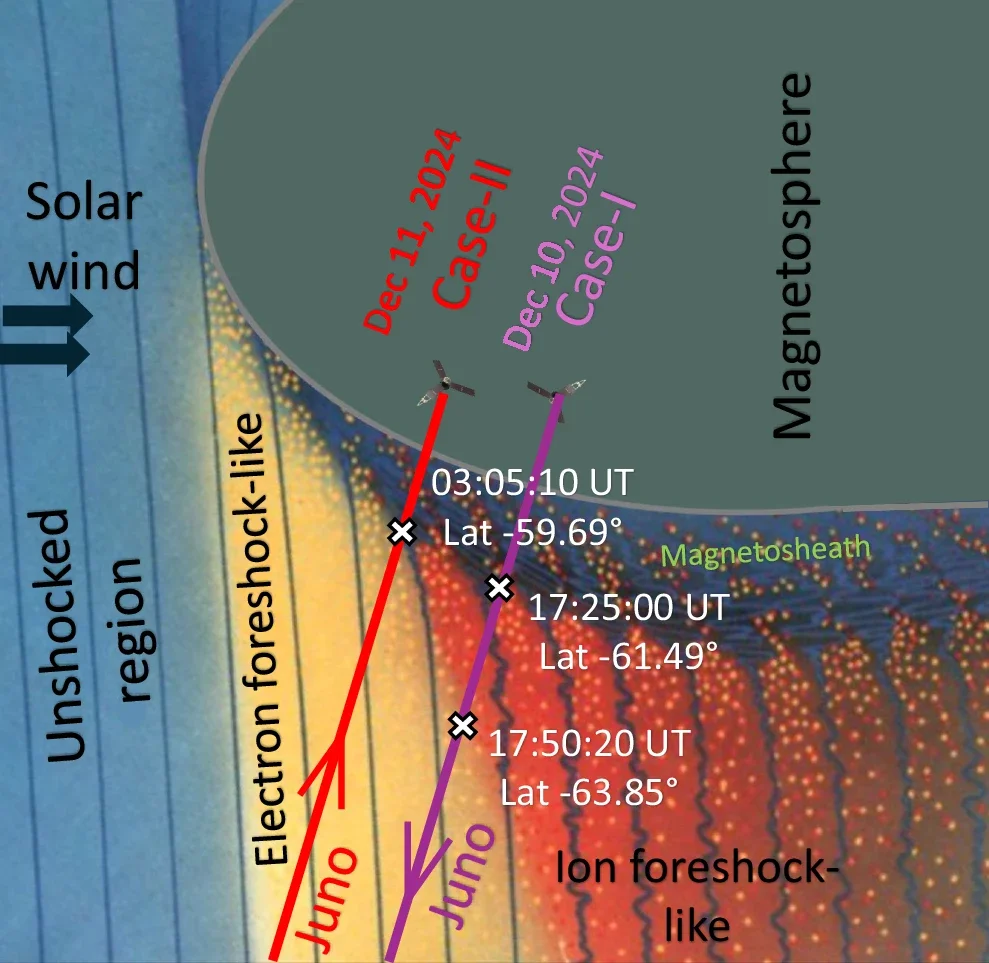
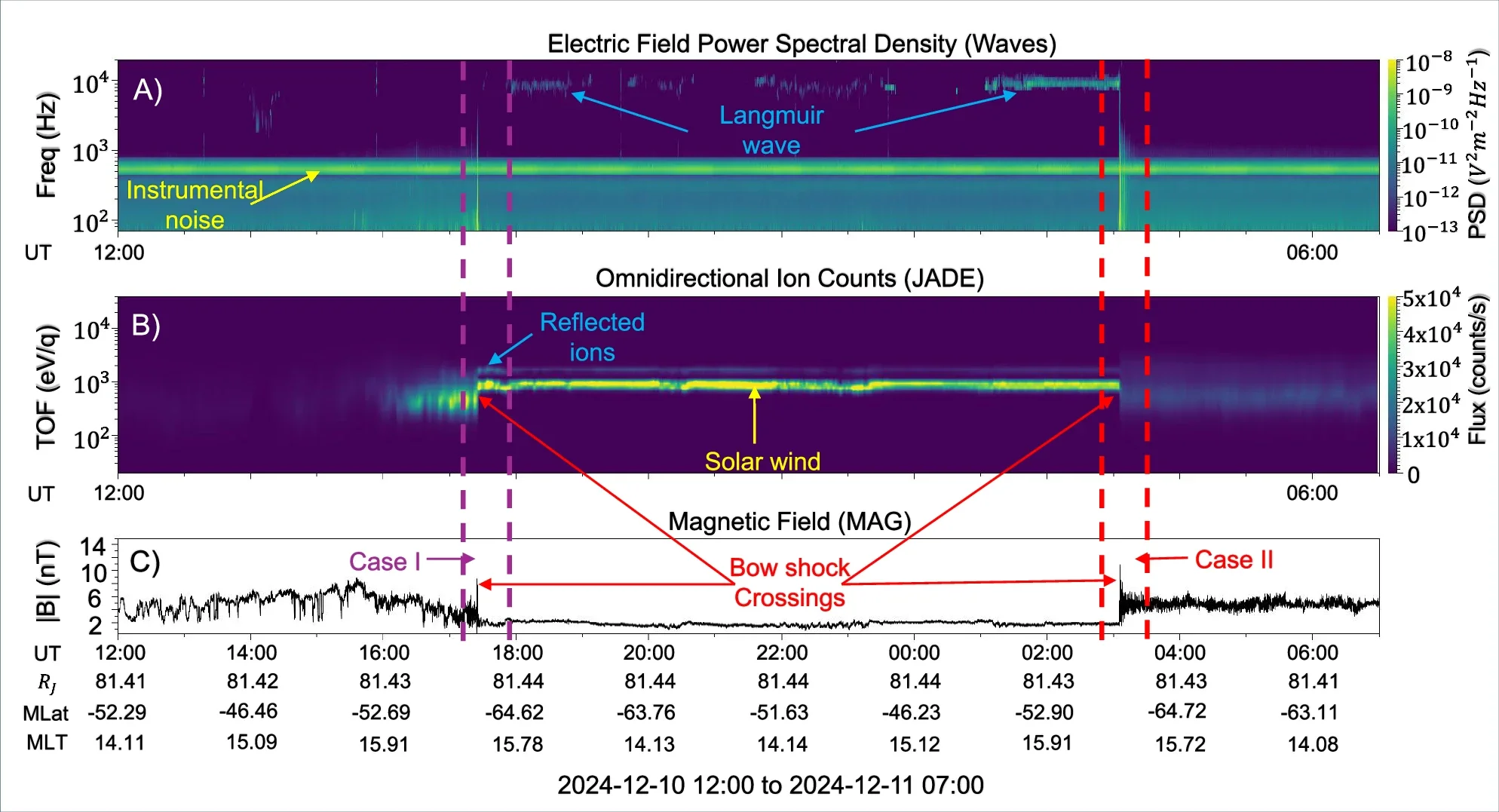
Juno crossed Jupiter’s bow shock twice between Dec. 10 and Dec. 11, 2024, at a distance of about 81 Jupiter radii from the planet.
The first crossing occurred as the spacecraft moved outward from the magnetosheath into the solar wind. The second occurred several hours later when Juno traveled back into the magnetosheath.
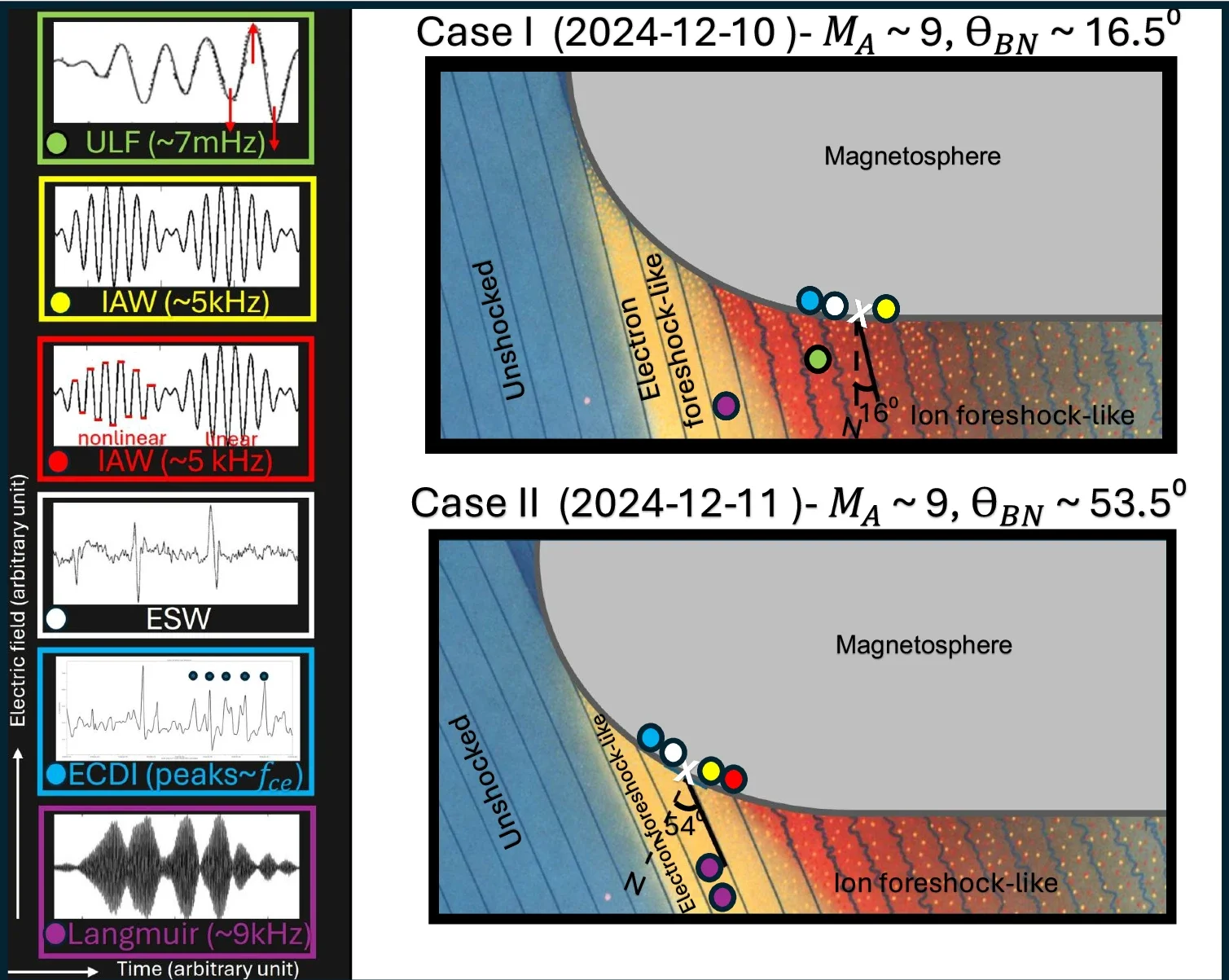
Both had an Alfvénic Mach number of roughly nine, meaning the incoming plasma flow was traveling much faster than the characteristic speed at which magnetic disturbances propagate through it. Their magnetic geometries, however, differed considerably.
That difference gave researchers two views of how Jupiter’s shock behaves.
Juno’s Waves instrument recorded electric-field waveforms at 50,000 samples per second with 16-bit resolution. Earlier missions had crossed Jupiter’s bow shock, but their measurements lacked the combination of time resolution and dynamic range needed to resolve many of the fine-scale features now visible.
The team combined those measurements with magnetic-field observations and charged-particle data to reconstruct what was happening around the shock.
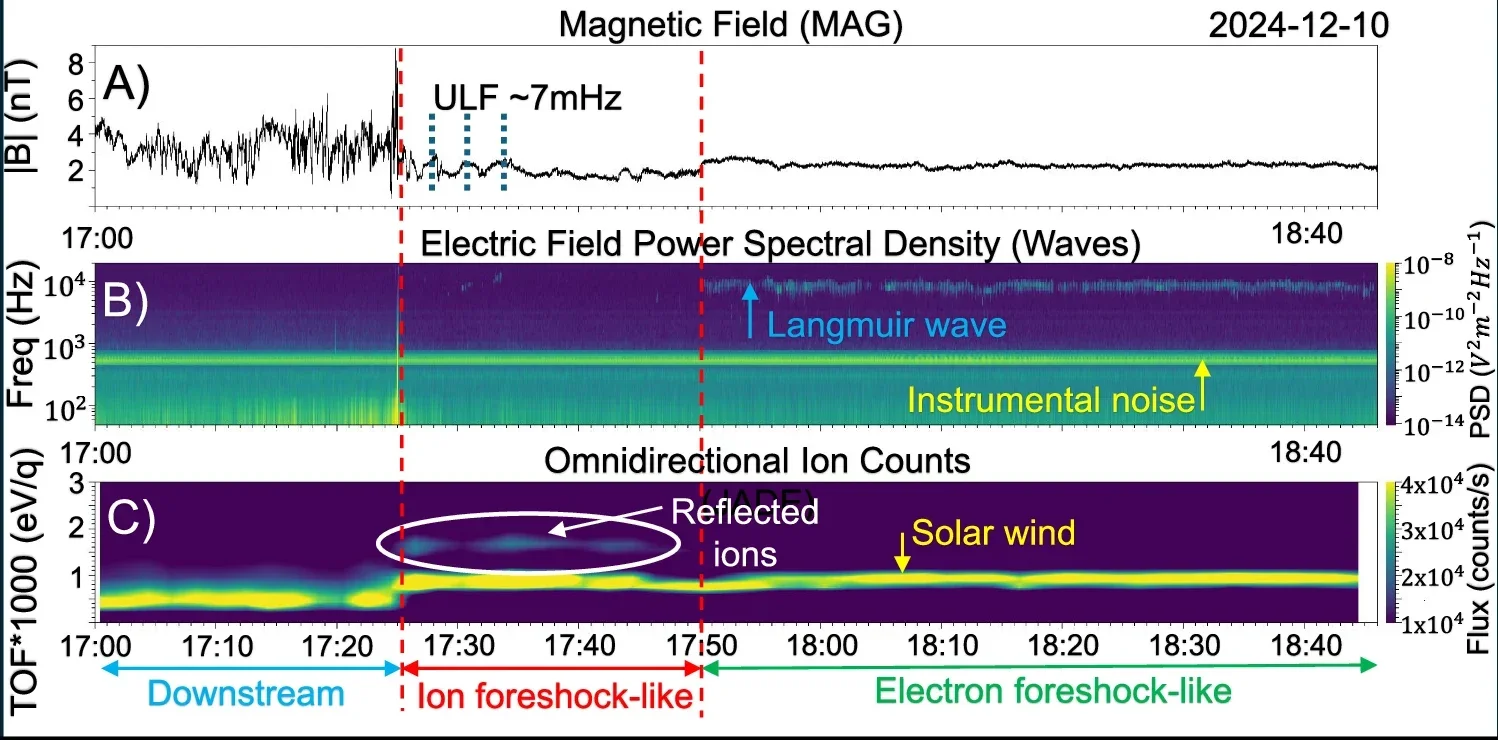
Juno detected several plasma-wave types familiar from Earth, including ion-acoustic waves, electrostatic solitary waves, Langmuir waves and activity associated with electron cyclotron drift instability, or ECDI.
The unusual part was their complexity.
During one interval, ion-acoustic waves centered near 5.61 kilohertz developed additional signals at approximately 11.13 and 16.68 kilohertz. Those correspond to the second and third harmonics of the fundamental frequency.
The waveform itself became distorted and flattened near its peaks, evidence that the wave was behaving nonlinearly rather than like a simple sinusoidal oscillation.
That matters because ion-acoustic waves can exchange energy with electrons. Multiple harmonics create additional resonances, potentially allowing the waves to interact with a broader range of particle velocities.
“It’s like generating a richer note of music by playing multiple chords with one strum of the guitar,” the researchers explained. More available frequencies can provide additional pathways for converting solar-wind energy into heat.
The team describes the result as the first direct observation of this type of ion-acoustic harmonic structure at a planetary bow shock.
An even denser series of frequencies appeared near the shock ramp.
Researchers detected approximately 18 spectral peaks separated by about 300 hertz, corresponding closely to multiples of the local electron cyclotron frequency. The pattern is characteristic of ECDI, an instability driven partly by relative motion between incoming electrons and ions reflected by the shock.
At Earth, spacecraft typically observe only a fraction of the possible ECDI harmonics. Jupiter’s richer pattern suggests that the instability may engage particles across more resonances and produce stronger electron heating.
Comparisons must be made carefully because the magnetic environment at Jupiter differs substantially from conditions near Earth. The researchers also could not calculate the total energy dissipated by the waves because Juno was not designed to make all of the measurements required for such a calculation.
Still, earlier studies indicate that ion and electron temperatures rise much more strongly across Jupiter’s bow shock than across Earth’s. The new wave observations provide a possible microscopic explanation for how some of that extra heating occurs.
Juno discovered another striking pattern during its second crossing: magnetic structures recurring approximately every 8.3 seconds.
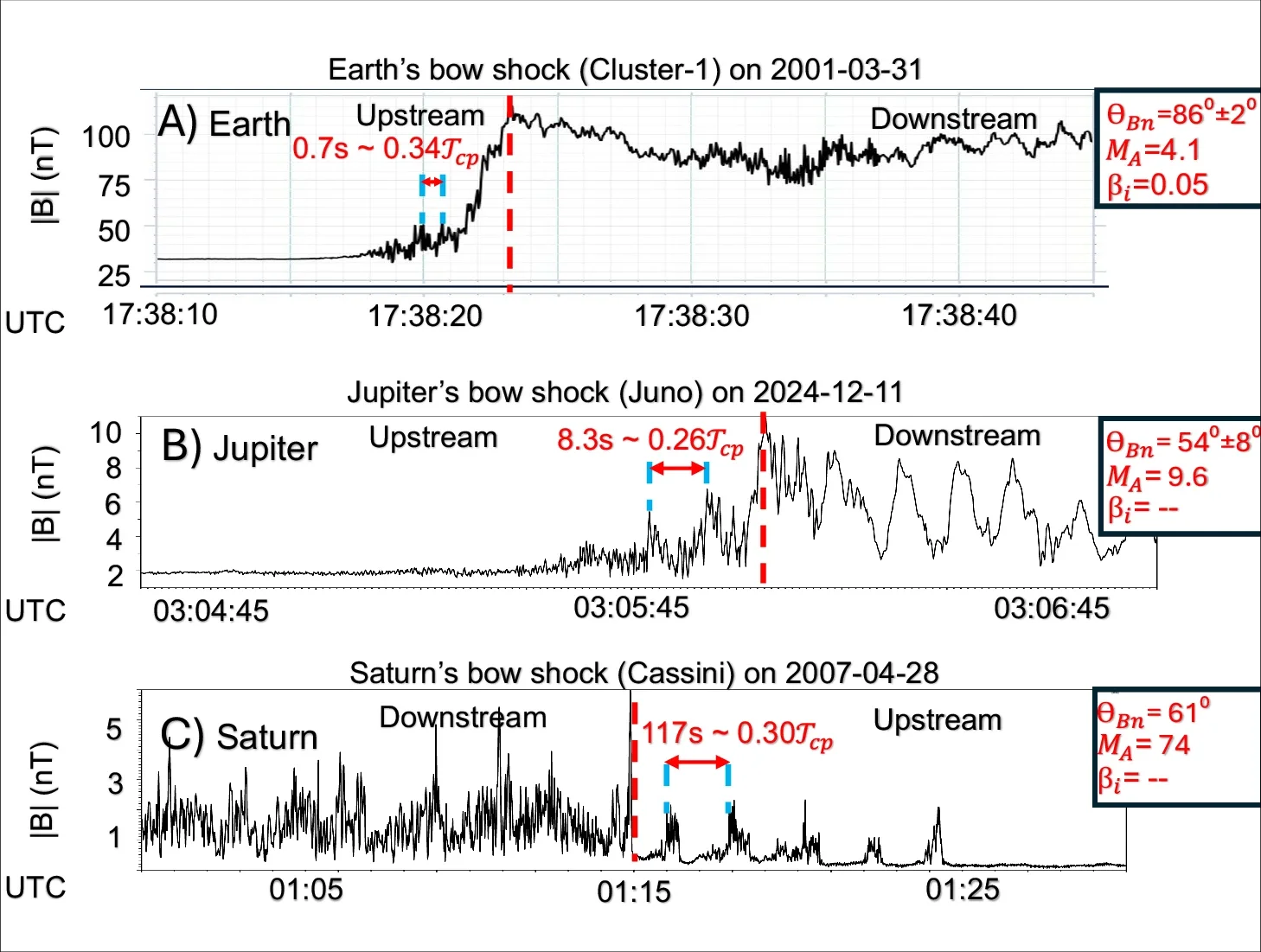
The timing equals roughly one-quarter of the local proton gyroperiod, the time required for a proton to complete one orbit around a magnetic-field line.
That regularity points toward shock self-reformation. In this process, reflected ions accumulate ahead of the existing shock, creating a new ramp that eventually replaces the previous one.
Researchers have detected related behavior around Earth and Saturn, but the Jovian signatures were especially pronounced. Jupiter’s higher Mach numbers and larger particle scales may allow the process to persist more clearly.
These repeated structures effectively spread the region where solar-wind energy can be converted into particle heating.
“Because even more powerful shocks occur around astrophysical objects such as supernova remnants, Jupiter’s bow shock offers a nearby natural laboratory for exploring and for understanding how nature converts enormous amounts of flow energy into heat and energetic particles,” Joseph said.
Juno cannot reproduce the violence of an exploding star. It can, however, let scientists place instruments directly inside a collisionless shock and watch the microscopic physics unfold.
That makes Jupiter much more than a giant planet. For shock physicists, it is an accessible test chamber for processes operating across the universe.
These resources explore the physics of planetary bow shocks, particle heating and shock reformation beyond the current study.
Relativistic electron acceleration at the bow shock of Jupiter and beyond: Juno observations revealed electrons accelerated to relativistic energies near Jupiter’s bow shock and connected the process with particle acceleration in larger astrophysical systems. (Nature, 2026)
Quasiperpendicular High Mach Number Shocks: Cassini observations provided evidence that powerful collisionless shocks can undergo cyclic self-reformation on timescales linked to ion motion. (Physical Review Letters, 2015)
Quantified energy dissipation rates in the terrestrial bow shock: 2. Waves and dissipation: Measurements at Earth showed that plasma waves can dominate energy dissipation across collisionless shock transitions. (Journal of Geophysical Research: Space Physics, 2014)
Fundamentals of collisionless shocks for astrophysical application, 1. Non-relativistic shocks: This comprehensive review explains how collisionless shocks heat plasma, accelerate particles and generate waves throughout space. (The Astronomy and Astrophysics Review, 2009)
Comparison of plasma wave measurements in the bow shocks at Earth, Jupiter, Saturn, Uranus and Neptune: This early comparative study showed how plasma-wave activity changes among planetary bow shocks across the Solar System. (Geophysical Research Letters, 1990)
Research findings are available online in the journal Nature Communications.
The original story “NASA’s Juno reveals how Jupiter’s giant magnetic shield absorbs the solar wind” is published in The Brighter Side of News.
Like these kind of feel good stories? Get The Brighter Side of News’ newsletter.
The post NASA’s Juno reveals how Jupiter’s giant magnetic shield absorbs the solar wind appeared first on The Brighter Side of News.


Leave a comment
You must be logged in to post a comment.