Neandertals passed down a version of the growth hormone receptor that still shapes some human bodies today. The genetic legacy appears to slightly increase adult muscle mass while also influencing jaw and tooth structure.
An international team led by Hugo Zeberg of Karolinska Institutet and Philipp Kanis of the Max Planck Institute for Evolutionary Anthropology identified two amino acid changes unique to the Neandertal form of the receptor.
Growth hormone helps control the growth of bones and muscles. The pituitary gland releases it into the bloodstream, where it binds to receptors on cell surfaces and relays growth signals inside them.
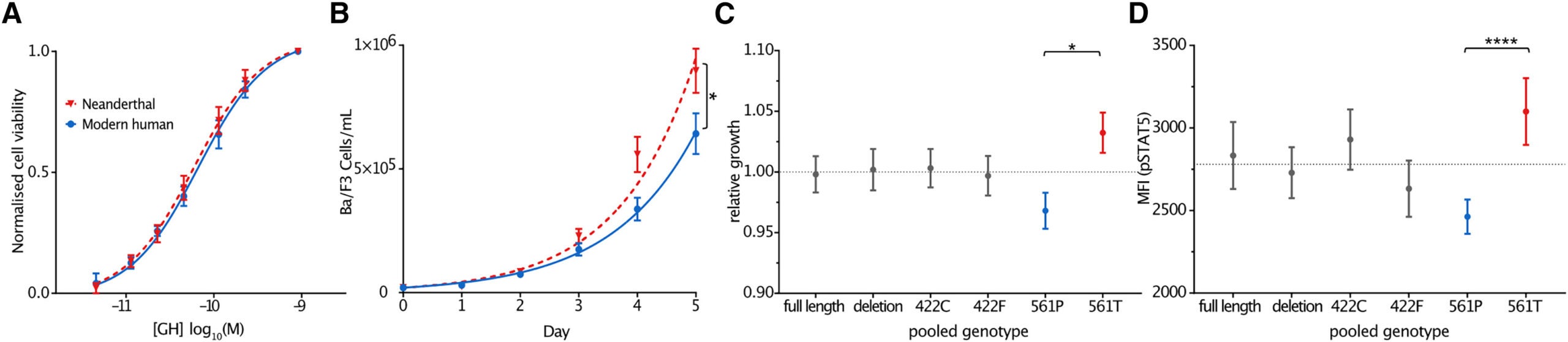
In laboratory experiments, cells carrying the Neandertal receptor reached numbers 39 percent higher after five days than cells carrying the more common modern human version.
The team examined two Neandertal-specific substitutions, known as C422F and P561T, along with a separate deletion in the receptor gene. The two substitutions always occur together in living carriers.
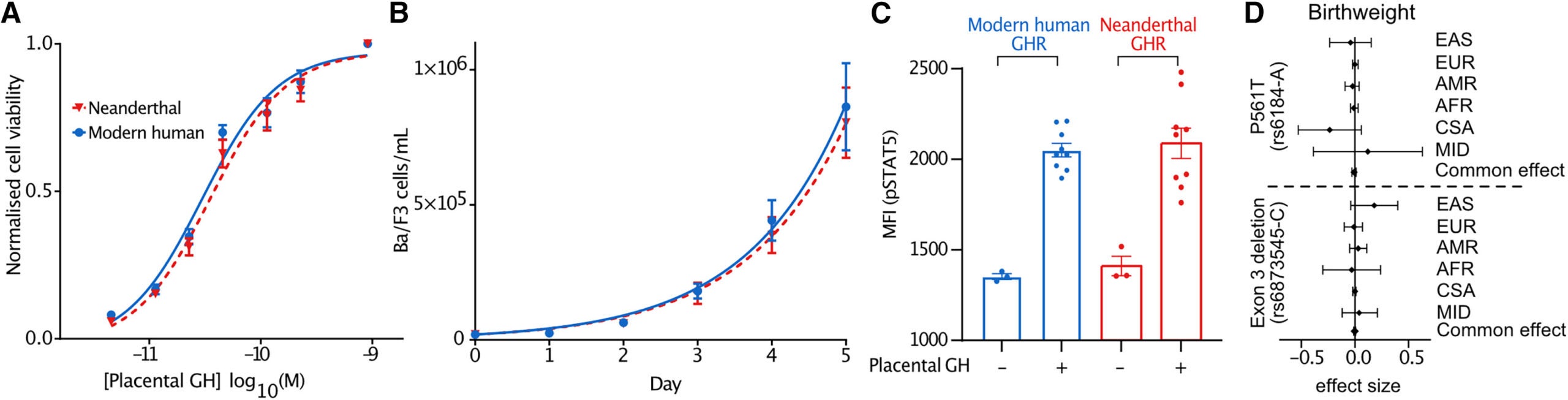
Both receptor forms bound growth hormone with similar affinity. The difference appeared after the hormone attached.
Cells carrying threonine at position 561 grew 6 percent faster and produced 22 percent more phosphorylated STAT5, a molecule involved in transmitting growth signals. The P561T substitution explained the increased cell growth. The other substitution and the gene deletion did not.
A slower phase of phosphorylation near the altered region may help prolong signaling, although the mechanism remains unresolved.
Modern humans likely acquired the receptor haplotype through interbreeding with Neandertals about 47,000 years ago.
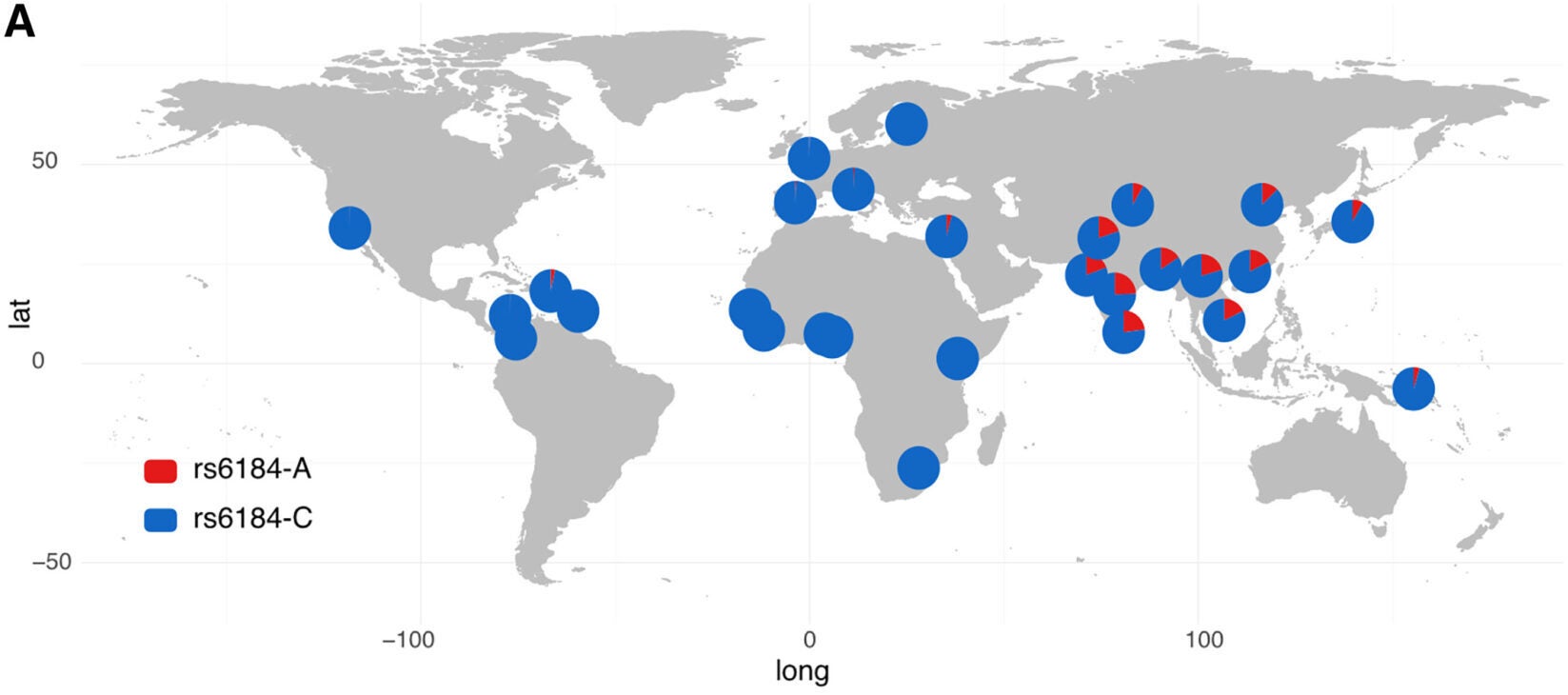
Today, the two substitutions occur at frequencies of about 0.5 percent in Europe, 2 percent in the Americas, 15 percent in East Asia and 20 percent in South Asia. In one Pakistani population, the frequency reaches 24 percent. The variants were absent from the sub-Saharan African genomes examined.
A review of 9,990 ancient genomes showed that regional frequencies remained broadly similar during the past 10,000 years. That pattern suggests no strong recent selection for or against the variants.
The haplotype is still more common in South Asia than most other known Neandertal-derived variants there. The authors said earlier positive selection is possible, but diet and physiology may influence its effects.
The team analyzed measurements from 1,134,174 adults across five biobanks. Adults carrying one copy of the Neandertal haplotype averaged 0.30 centimeters taller and 285 grams heavier than non-carriers.
Nearly all the added weight came from fat-free tissue. Carriers had about 150 grams more muscle in their arms and legs and 121 grams more fat-free trunk mass, for a combined increase of 271 grams.
The effects were modest. Height, weight and muscle mass depend on many genes, along with environmental and cultural factors.
“What struck me most was that two very different types of evidence told the same story,” Kanis said. “Cells grown in the laboratory responded more strongly, while data from more than a million people showed signs of the same effect in the body. It is rare to see laboratory and population evidence fit together so clearly.”
“As someone who does CrossFit, I was delighted to find Neandertal genetics and muscle mass coming together in the same study,” said co-author Miriam Berreiter. “But even a Neandertal growth hormone receptor is no substitute for training.”
The researchers examined 6,602 children from birth through age 11. They found no connection between the haplotype and body measurements during that period.
The adult differences may emerge during or after puberty, when growth hormone levels rise sharply. During puberty, those levels can reach about three times those seen in childhood.
However, the receptor variant does not produce a Neandertal body type by itself.
“It is fascinating that one genetic change inherited from Neandertals can still have an effect on the human body today,” Zeberg said. “But this is only one of many genetic influences on growth and body shape. It cannot explain the Neandertal body type on its own, and it certainly does not determine a person’s overall appearance.”
Carriers also showed subtle differences in the lower jaw and teeth. Earlier studies linked each copy of the haplotype to a 3.6-millimeter reduction in the height of the mandibular ramus, the upright rear section of the lower jaw.
MRI data from Japan supported that result. Men with two copies had a ramus about 2.4 millimeters shorter, while women with two copies had a reduction of 4.3 millimeters.
Two studies from India linked the haplotype to higher odds of overbite. A Colombian study reported a possible underbite pattern, but included only 11 carriers.
Studies of Japanese participants found shorter roots in several teeth. Those findings match a feature often seen in Neandertal remains, but both studies had small samples.
The team found no differences in brow ridges, forehead slope, jaw protrusion or the occipital bun at the back of the skull.
The findings connect a specific Neandertal genetic change to measurable effects in living people. They also offer a biological clue to parts of the stockier Neandertal build.
The work shows how laboratory experiments and large population datasets can test the effects of ancient DNA. It also narrows the stronger growth signal to one amino acid substitution within the receptor.
Further studies could examine growth hormone signaling during puberty and adulthood. Larger dental and cranial studies could clarify the weaker associations involving tooth roots, bite patterns and jaw shape.
The inherited DNA segment extends beyond the growth hormone receptor gene, so nearby genes could contribute to some observed traits. That limitation means the receptor cannot yet explain every association tied to the haplotype.
Research findings are available online in the journal Current Biology.
The original story “Neandertal DNA linked to more muscle mass in modern adults” is published in The Brighter Side of News.
Like these kind of feel good stories? Get The Brighter Side of News’ newsletter.
The post Neandertal DNA linked to more muscle mass in modern adults appeared first on The Brighter Side of News.


Leave a comment
You must be logged in to post a comment.