The enormous databases created by modern biology contain clues about cancer cells, infections, genetic mutations and other processes involved in disease. Finding those clues, however, can require researchers to download and reprocess vast amounts of sequencing data spread across thousands of experiments.
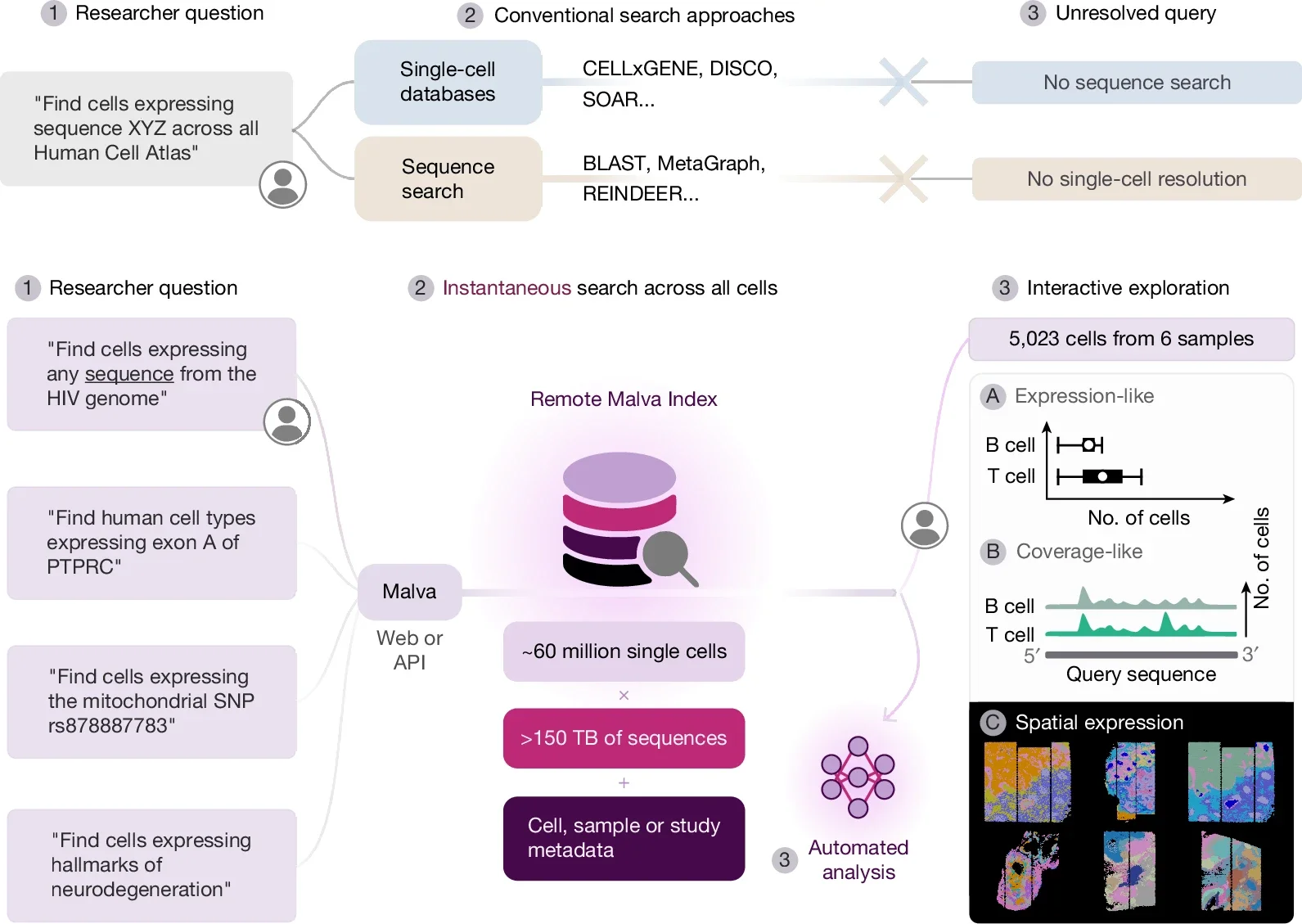
A new search platform called Malva is designed to make that process far faster. Instead of forcing scientists to retrieve enormous raw datasets and map them against a reference genome, Malva lets them search millions of individual cells directly using RNA sequence information.
Researchers at the Berlin Institute of Medical Systems Biology of the Max Delbrück Center describe the system in Nature. Daniel León-Periñán and Nikos Karaiskos are co-first authors of the work, with Nikolaus Rajewsky serving as senior author.
“Like Google did for the internet 30 years ago, Malva allows scientists and AI tools to search across millions of cells in seconds — without downloading huge files or needing a reference genome, and without deep computational expertise,” Rajewsky said.
Single-cell RNA sequencing has transformed researchers’ ability to study what individual cells are doing. Rather than averaging activity across an entire tissue sample, scientists can measure RNA within individual cells and identify differences among cell types, disease states and other biological conditions.
The success of those techniques has created another problem: scale. Single-cell and spatial transcriptomics now generate petabytes of sequence information from hundreds of millions of cells. Public repositories contain data from healthy tissue, diseases, model organisms, organoids and other biological systems.
Traditional portals typically organize these data around predefined genes. Sequencing reads are mapped to a reference genome, then summarized into gene-level counts. That approach works well for many questions, but much of the original sequence-level information becomes difficult to search.
A scientist interested in an unusual RNA sequence could instead return to the raw files. At the scale of modern cell atlases, however, that could mean downloading and reprocessing petabytes of data.
Malva takes a different approach. The system makes the underlying sequence information searchable without first requiring every query to be aligned against a reference genome.
Malva accepts several kinds of searches. Scientists can provide a nucleotide sequence, a gene identifier or even a natural-language request. The system then searches its index and returns cells containing matching sequences along with information about the cells and samples.
The possibilities go beyond asking whether a gene is active. Researchers can search for mutations, splice junctions, RNA isoforms, viral sequences, bacterial or fungal material, synthetic sequences and other features that may not appear in conventional gene-count databases.
“They can range from the very simple, like: ‘In what cell type is this particular gene expressed?’ to much more complex,” Karaiskos said.
RNA isoforms offer one example. A single gene can produce several RNA versions, but conventional gene-centered atlases can collapse those variants into one measurement. Searching directly by sequence allows Malva to distinguish among them.
“Having the flexibility to search by RNA sequence in Malva gives us the ability to answer questions from this data that were previously not answerable,” Karaiskos said.
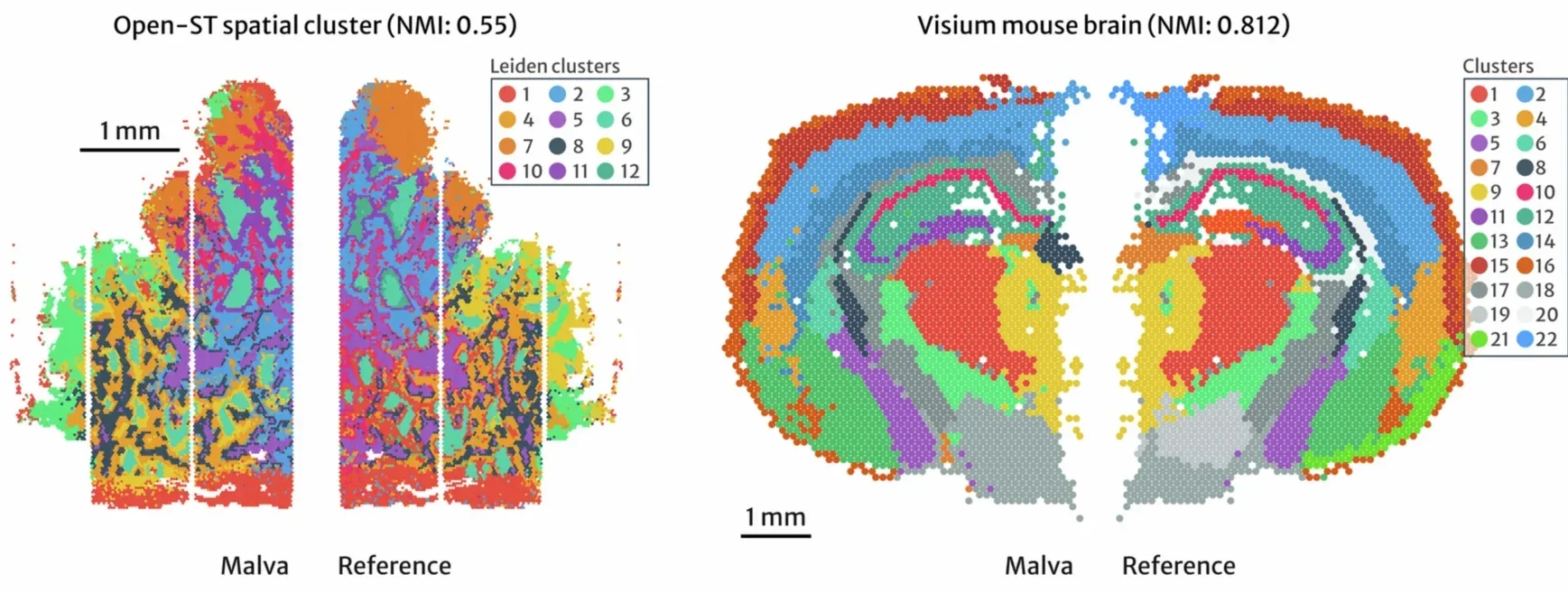
The platform can also search spatial transcriptomics data, allowing researchers to determine where particular RNA sequences appear within tissue sections.
The team built the Malva Index by processing more than 140 terabytes of publicly available single-cell and spatial transcriptomics data. At the stage described in the study, the human index contained more than 100 billion unique 24-nucleotide sequences from roughly 51 million cells representing 592 studies and 7,966 samples. About 10 million mouse cells were also included.
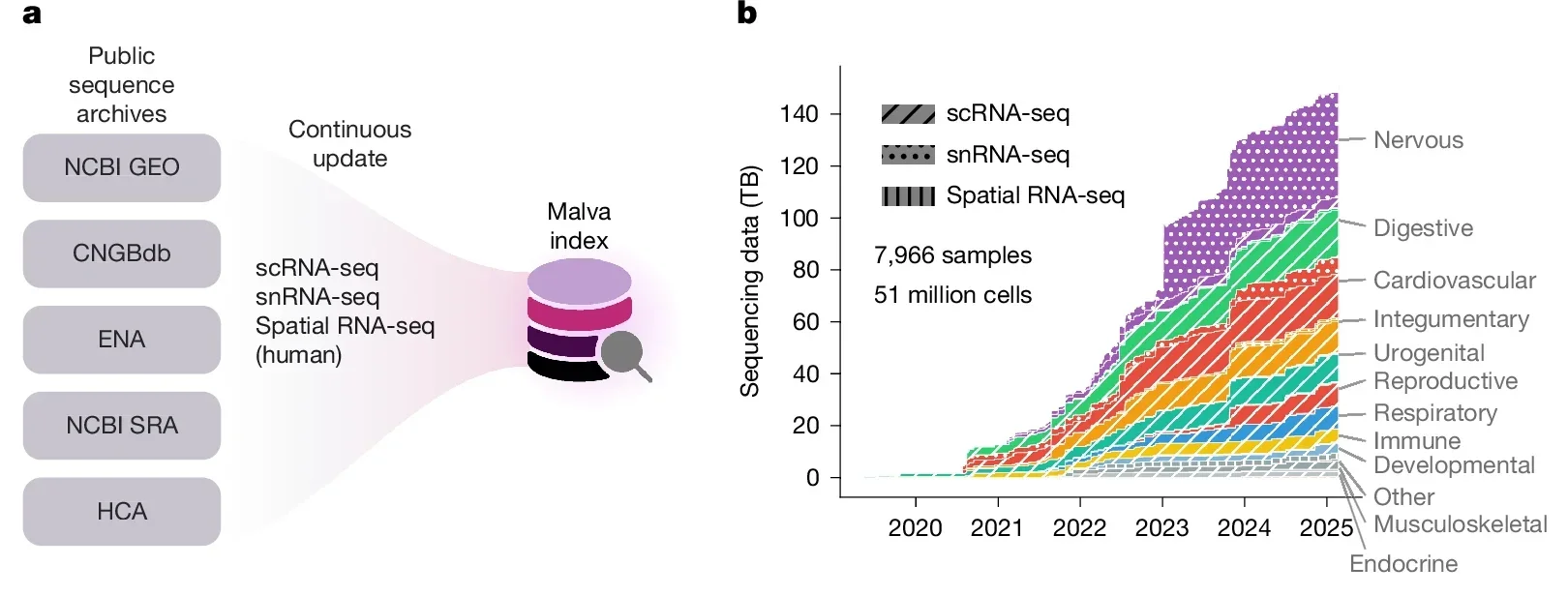
The platform collects data primarily from the Human Cell Atlas Data Portal and can incorporate information from repositories including the NCBI Sequence Read Archive, Gene Expression Omnibus, European Nucleotide Archive and CNGBdb.
Malva is designed to keep growing as more datasets become available. New information can be processed and added without rebuilding the entire resource.
Its search system divides sequencing reads into short segments called k-mers and records which cells contain them. In performance tests, a single k-mer search took about 70 milliseconds. Searching a 1,000-base transcript took about 0.9 seconds, while searching 1,000 transcripts took roughly one minute on a single CPU core.
The researchers found that Malva’s sequence measurements strongly correlated with conventional reference-based counts across different technologies, tissues and disease states. Cell-type signatures and spatial organization were also preserved.
The researchers tested the system on several biological problems. Malva detected viral, retroviral and laboratory contaminant sequences across its index, including expected signals from the sequencing control PhiX and Mycoplasma contamination.
It also recovered common human genetic variants at frequencies that closely tracked expected population patterns. In cancer datasets, Malva detected somatic mutations across 16 cancer types without requiring researchers to realign the underlying sequencing reads or run specialized mutation-calling software.
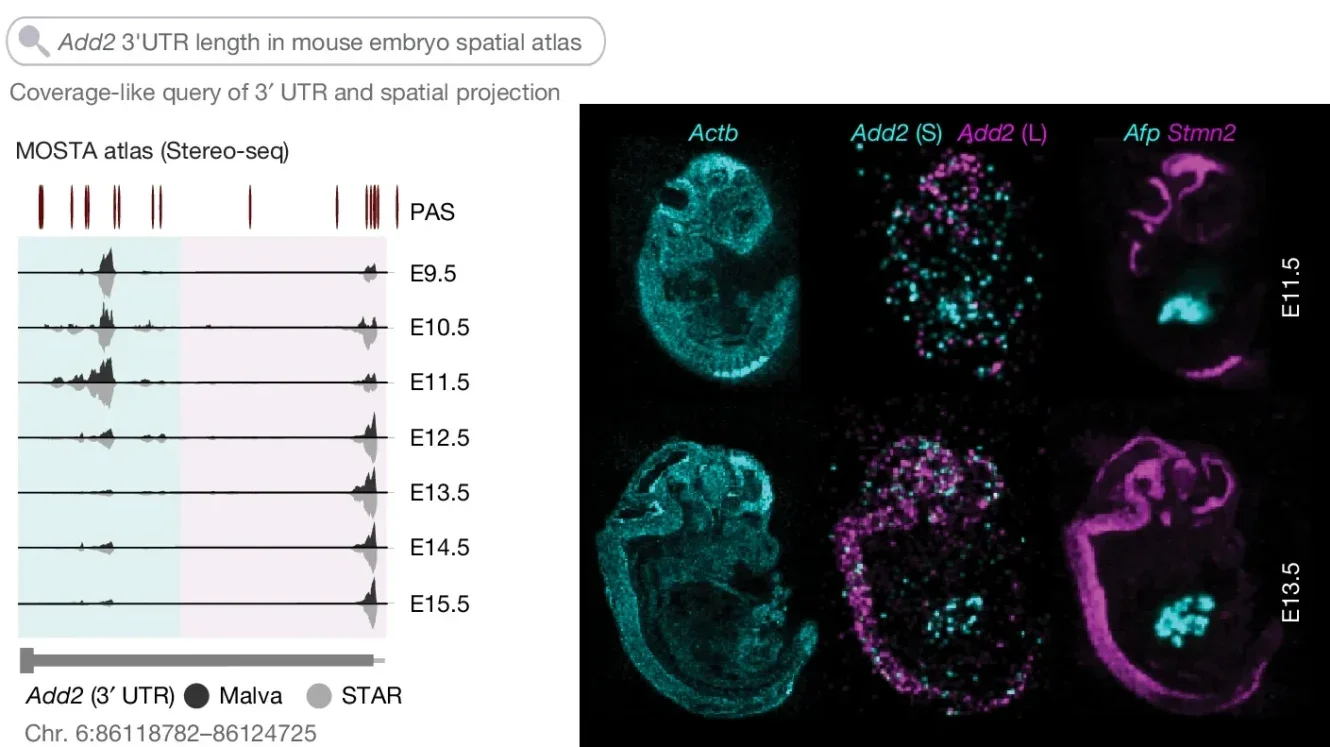
Another test focused on RNA isoforms. Malva recovered known differences in forms of the Ptprc gene among immune cell types and detected cell-specific patterns involving untranslated regions of RNA.
The platform also found CDR1as, a circular RNA highly expressed in the brain. Among cells testing positive for it, 95% were excitatory neurons.
Malva can go further than individual sequence searches. The team showed that it could group cells based on their sequence composition without relying on predefined genes. In one spatial tumor dataset, that approach revealed signals from human RNA as well as bacterial sequences associated with microbes found in the oral mucosa.
The researchers see another possible use for Malva as artificial intelligence becomes more common in biology. AI systems can analyze large collections of biological information, but they do not normally have a simple way to search the underlying experiments while generating an answer.
“Malva transforms static transcriptomic atlases into dynamic resources, which will further our understanding of RNA biology,” Rajewsky said. “It will also be potentially transformative in helping researchers understand how health slides into disease, or how and which cells respond to specific medical treatments.”
The system has limitations. Malva currently requires queries of at least 24 nucleotides and relies on exact sequence matching. It reports k-mer-derived pseudocounts rather than absolute molecule counts, so researchers may still need additional validation and analysis. Public datasets also remain uneven, with many relying on short reads, while spatial information can be incomplete.
Malva is currently available to academic scientists through its public interface and API. The researchers are also in the early stages of creating a company around the technology, and a patent is pending.
For now, the broader goal is to turn an expanding archive of cellular sequencing experiments into something scientists can interrogate almost as soon as a question arises.
These resources explore the rapidly expanding cell-atlas landscape, new ways to search millions of cells and emerging techniques for capturing RNA information that conventional gene-level analyses can miss.
The Human Cell Atlas from a cell census to a unified foundation model: This perspective examines how the Human Cell Atlas is evolving from a catalog of cell types into an integrated resource that combines molecular and spatial profiling with artificial intelligence and machine learning. (Nature, 2025)
A cell atlas foundation model for scalable search of similar human cells: Researchers developed a foundation-model approach for searching enormous single-cell collections for biologically similar cells, addressing a related challenge of making rapidly expanding cellular atlases easier to interrogate. (Nature, 2025)
Scalable single-cell total RNA sequencing unifies coding and noncoding transcriptomics: This work expands single-cell profiling beyond commonly captured RNA by developing a scalable approach that measures both coding and noncoding transcripts, highlighting the biological information that can remain outside traditional RNA atlases. (Nature Biotechnology, 2026)
SCOTCH: isoform-level characterization of gene expression through long-read single-cell RNA sequencing: SCOTCH uses long-read single-cell sequencing to study gene expression at the RNA-isoform level, addressing the same broader problem of distinguishing transcript variants that gene-level measurements can obscure. (Nature Communications, 2026)
Cell-type deconvolution methods for spatial transcriptomics: This review examines computational methods for identifying cell types within spatial transcriptomics data and explains the analytical challenges involved in linking molecular activity with its position inside tissues. (Nature Reviews Genetics, 2025)
Research findings are available online in the journal Nature.
The original story “New ‘Google-like’ search engine can scan millions of cells for hidden RNA clues in seconds” is published in The Brighter Side of News.
Like these kind of feel good stories? Get The Brighter Side of News’ newsletter.
The post New ‘Google-like’ search engine can scan millions of cells for hidden RNA clues in seconds appeared first on The Brighter Side of News.


Leave a comment
You must be logged in to post a comment.