A new generation of robots is beginning to take shape, one that moves, senses, and adapts more like living creatures. Scientists in Italy have developed a soft robotic arm inspired by the octopus, an animal known for its flexibility and remarkable control. The device can feel contact, judge pressure, and grasp objects on its own, even in complex underwater environments.
The research, led by Barbara Mazzolai at the Istituto Italiano di Tecnologia, marks a major step forward in soft robotics, a field that aims to build machines that interact more naturally with the world.
“We drew inspiration from the octopus to develop a robotic system in which perception and action are integrated and distributed throughout the body,” said Barbara Mazzolai, who directs the Bioinspired Soft Robotics laboratory.
The octopus stands apart in the animal world. Its arms contain no bones, yet they can twist, bend, and grip with precision. Each arm also processes information locally, allowing it to react quickly without relying fully on the brain.
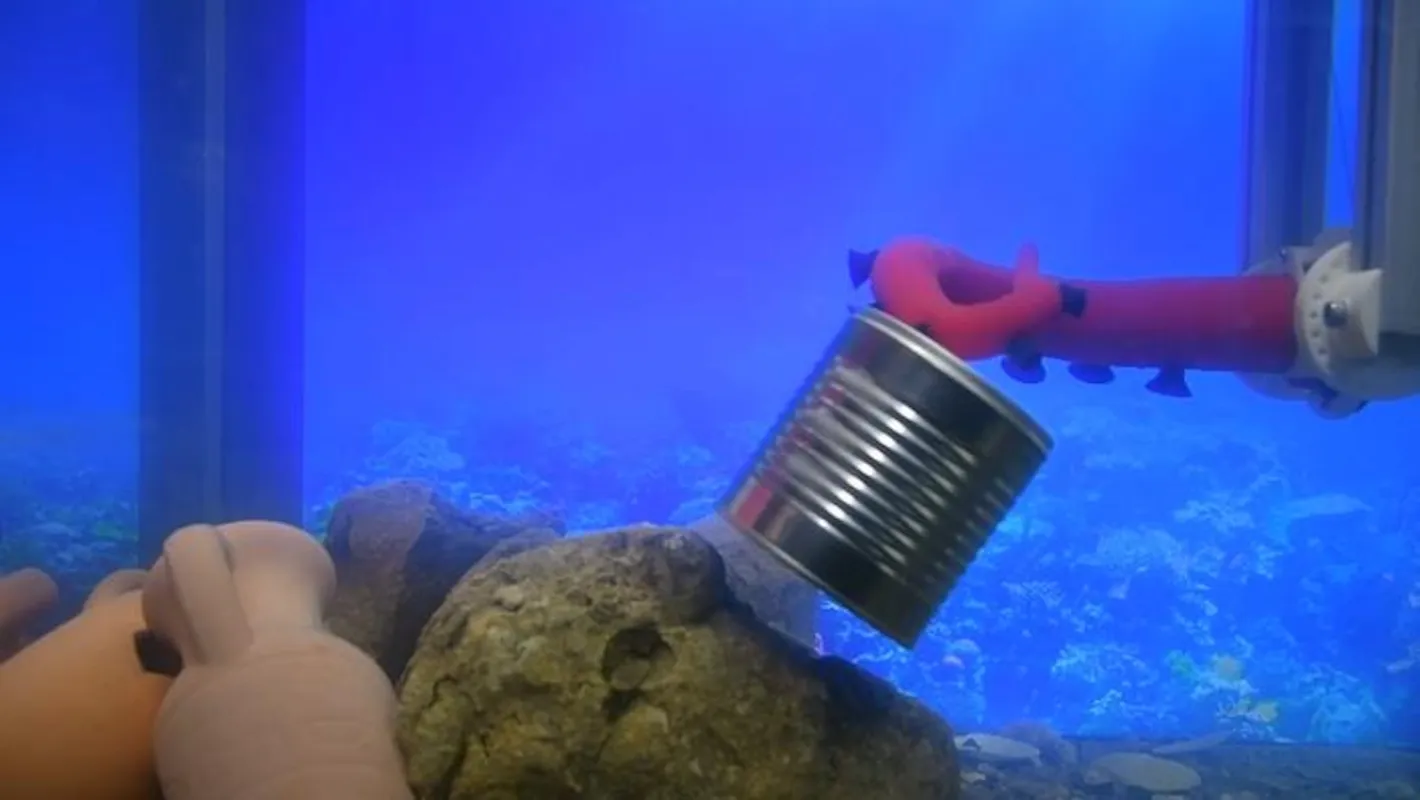
This ability to combine movement and sensing inspired researchers to rethink how robots should work. Traditional machines rely on rigid parts and central control systems. They perform well in factories but struggle in unpredictable environments.
Soft robotics offers a different approach. By using flexible materials and distributed sensing, these machines can adapt to their surroundings in real time.
The new robotic arm reflects this philosophy. It does not simply copy the shape of an octopus arm. It mirrors how the animal senses and responds to the world.
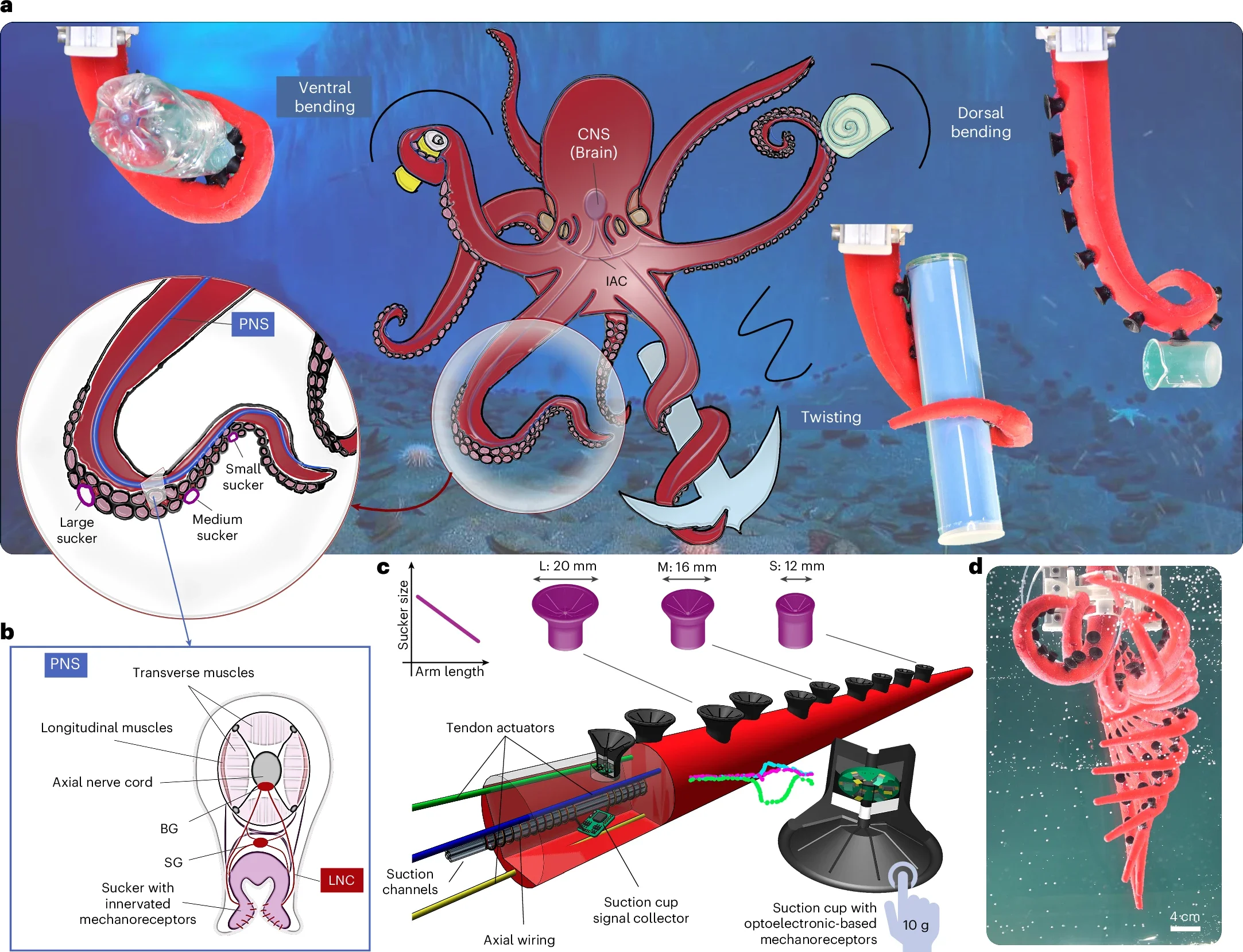
At the heart of the system are artificial suction cups made of soft silicone. These cups serve two roles at once. They help the robot grip objects, and they act as sensors that detect touch.
Each suction cup contains tiny optical components, including light-emitting diodes. When the cup presses against an object, its shape changes. This deformation alters how light reflects inside the structure.
The system measures these changes and translates them into information about force and direction. In this way, the robot can sense how strongly it is touching something and from which angle.
The sensors are highly sensitive. They can detect even very small forces, allowing the robot to handle delicate objects without damage. They also work in both air and water, making the system suitable for underwater use.
“By integrating sensors and signal processing directly into the suction cups, the arm reacts to contact in real time and precisely, without relying on centralized control,” said Emanuela Del Dottore, first author of the study.
The arm itself is built to move like its biological inspiration. It has a soft, tapered shape and contains internal cables that control motion. By pulling these cables in different ways, the arm can bend, twist, and wrap around objects.
This flexibility allows it to adjust its shape to match whatever it touches. Instead of forcing objects into a fixed grip, the arm adapts to them.
The system can also coordinate movement across the entire arm. While each suction cup reacts locally to contact, a higher-level control system ensures that the arm acts as a whole.
For example, if a cup detects an object, the arm may bend toward it. If multiple cups detect contact, the system may twist to improve its grip. These actions happen smoothly and quickly, without the need for detailed instructions.
One of the most important advances in this research is how the robot processes information. Instead of sending all data to a central controller, the system uses a decentralized approach.
Each suction cup makes simple decisions based on local signals. At the same time, a broader control system integrates this information to guide the arm’s overall movement.
This layered design allows the robot to respond quickly while still making coordinated decisions. It also reduces the need for constant communication between parts of the system, making the robot more efficient.
The approach mirrors the nervous system of the octopus, where much of the processing happens in the arms themselves.
The robotic arm was tested in both air and underwater settings. In these experiments, it successfully detected contact, measured forces, and grasped objects of different shapes.
Underwater tests were especially important. Many traditional robots struggle in these conditions due to pressure, movement, and limited visibility.
The soft arm performed well in these environments. It was able to explore, detect objects, and adjust its grip without external guidance.
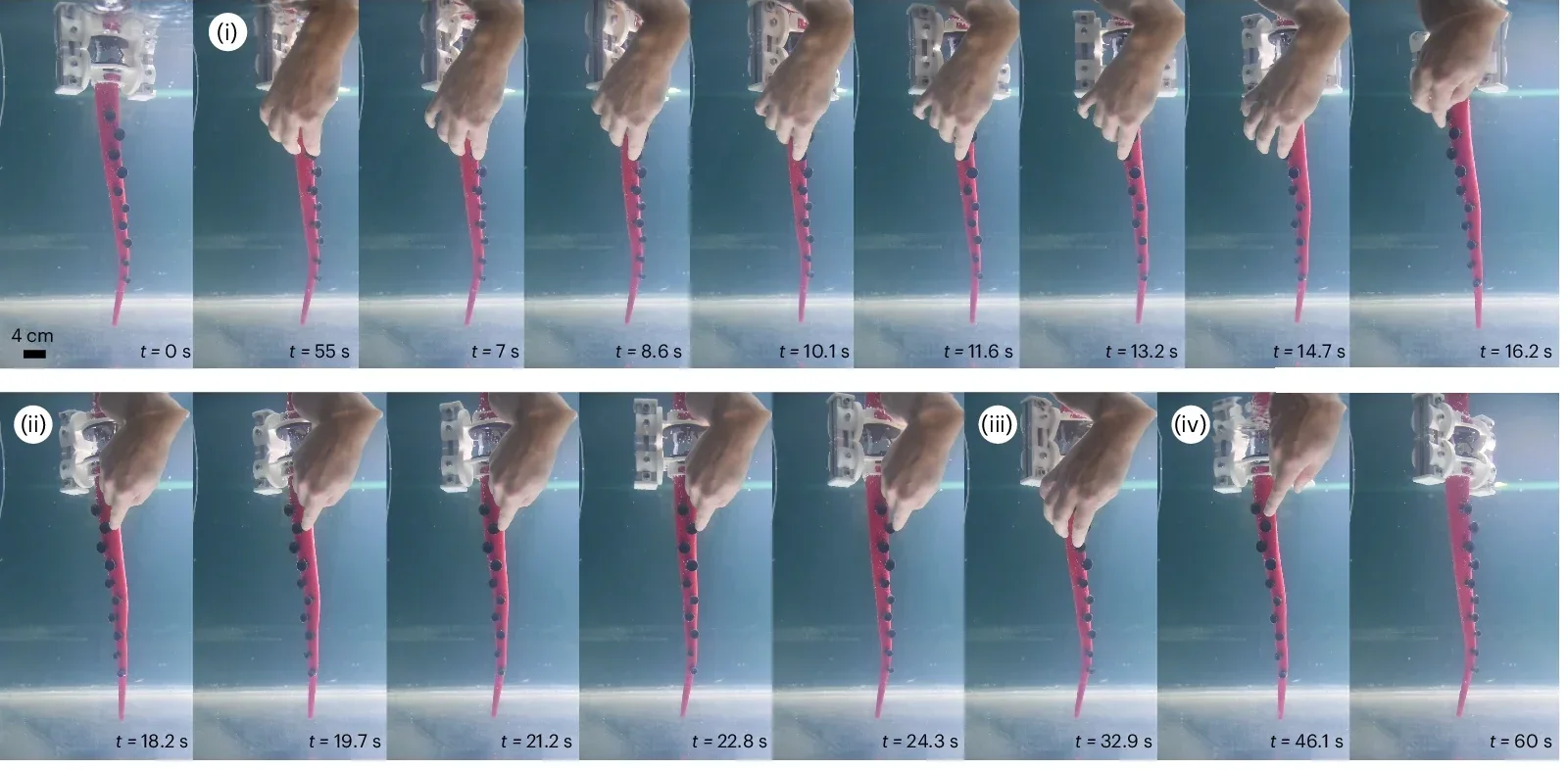
The system also proved to be durable. Its sensors remained accurate after repeated use, and its flexible structure allowed it to absorb impacts without damage.
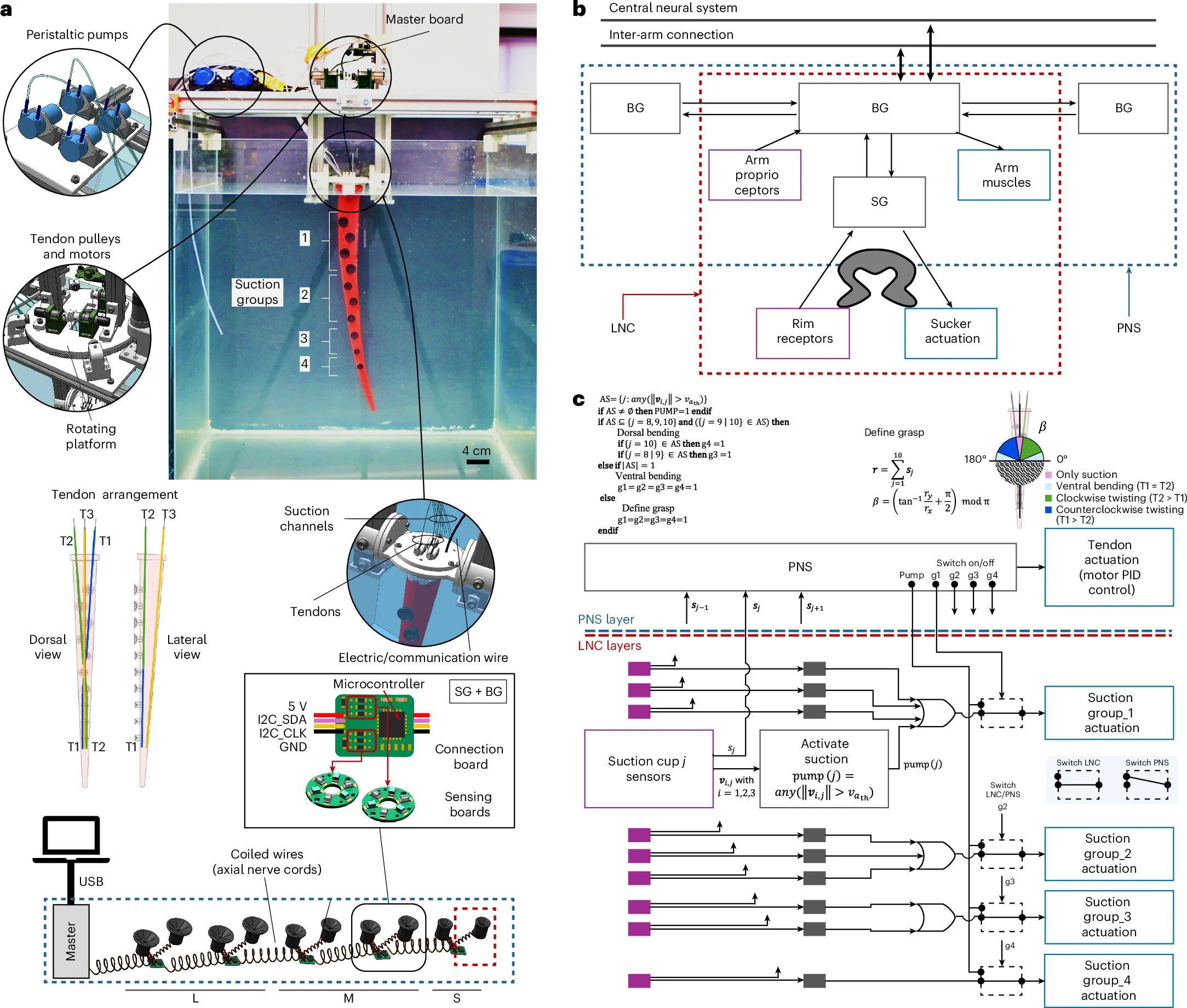
Another key feature of the design is its modularity. Researchers can adjust the number and placement of suction cups along the arm. This makes it possible to tailor the robot for specific tasks.
For example, an arm designed for delicate biological work may include more sensors for precise control. One built for industrial use may focus on strength and durability.
This flexibility makes the system suitable for a wide range of applications. It also allows researchers to continue improving the design over time.
The development of this robotic arm builds on earlier work by the research team. Previous studies focused on optimizing movement using minimal actuators and creating soft internal structures through 3D printing.
This latest advance brings those elements together with sensing and control. It represents a more complete step toward robots that can operate independently in real-world environments.
Potential uses for the technology are wide-ranging. In underwater settings, the arm could help study marine life or recover fragile artifacts. In industry, it could assist with inspection and maintenance in hard-to-reach places.
Its gentle touch also makes it suitable for handling sensitive materials, including biological samples.
The researchers plan to expand the system’s capabilities. Future versions may handle heavier loads and grasp a wider variety of objects. They may also incorporate additional sensors to improve perception.
The long-term goal is to create robots that can work safely alongside humans and adapt to changing conditions. By drawing inspiration from nature, scientists hope to build machines that are both powerful and flexible.
The octopus-inspired arm offers a clear example of this vision. It shows how combining biology and engineering can lead to new forms of intelligence in machines.
This research has the potential to reshape how robots are used in everyday life and specialized industries. By enabling machines to sense touch and respond instantly, it opens the door to safer and more precise interactions between robots and their environment.
In healthcare, soft robotic systems could assist in delicate procedures or handle sensitive biological materials without causing damage. In environmental science, they could help study fragile ecosystems, especially underwater, where traditional tools are too invasive.
Industrial applications are also significant. Robots capable of adapting to unpredictable conditions could perform maintenance in hazardous environments, reducing risks for human workers. Their ability to operate underwater may improve inspection of pipelines, ships, and offshore structures.
For robotics research, the study introduces a new design philosophy. Instead of relying on rigid structures and central control, future systems may use distributed sensing and decentralized decision-making. This approach could lead to machines that are more resilient, adaptable, and efficient.
Ultimately, the work demonstrates how lessons from nature can guide technological innovation. By understanding how living systems solve complex problems, engineers can create tools that better serve human needs while expanding the limits of what machines can do.
Research findings are available online in the journal Nature Machine Intelligence.
The original story “Octopus-inspired robot arm can feel and grasp like living creatures” is published in The Brighter Side of News.
Like these kind of feel good stories? Get The Brighter Side of News’ newsletter.
The post Octopus-inspired robot arm can feel and grasp like living creatures appeared first on The Brighter Side of News.

