A 245-foot wall of ancient Martian rock records a sky filled not with rain, but with molten droplets and pulverized dust thrown up by repeated asteroid impacts nearly 4 billion years ago.
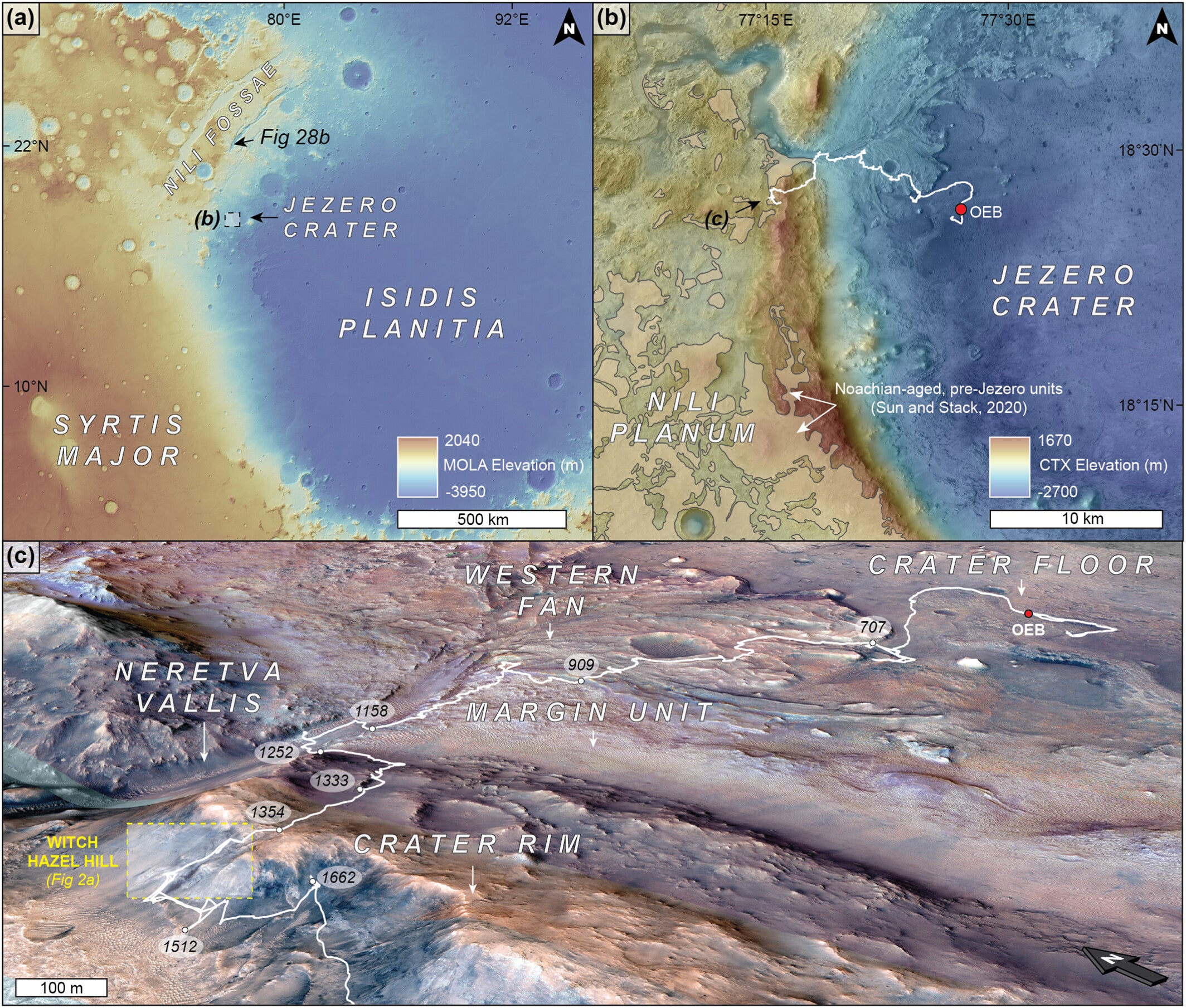
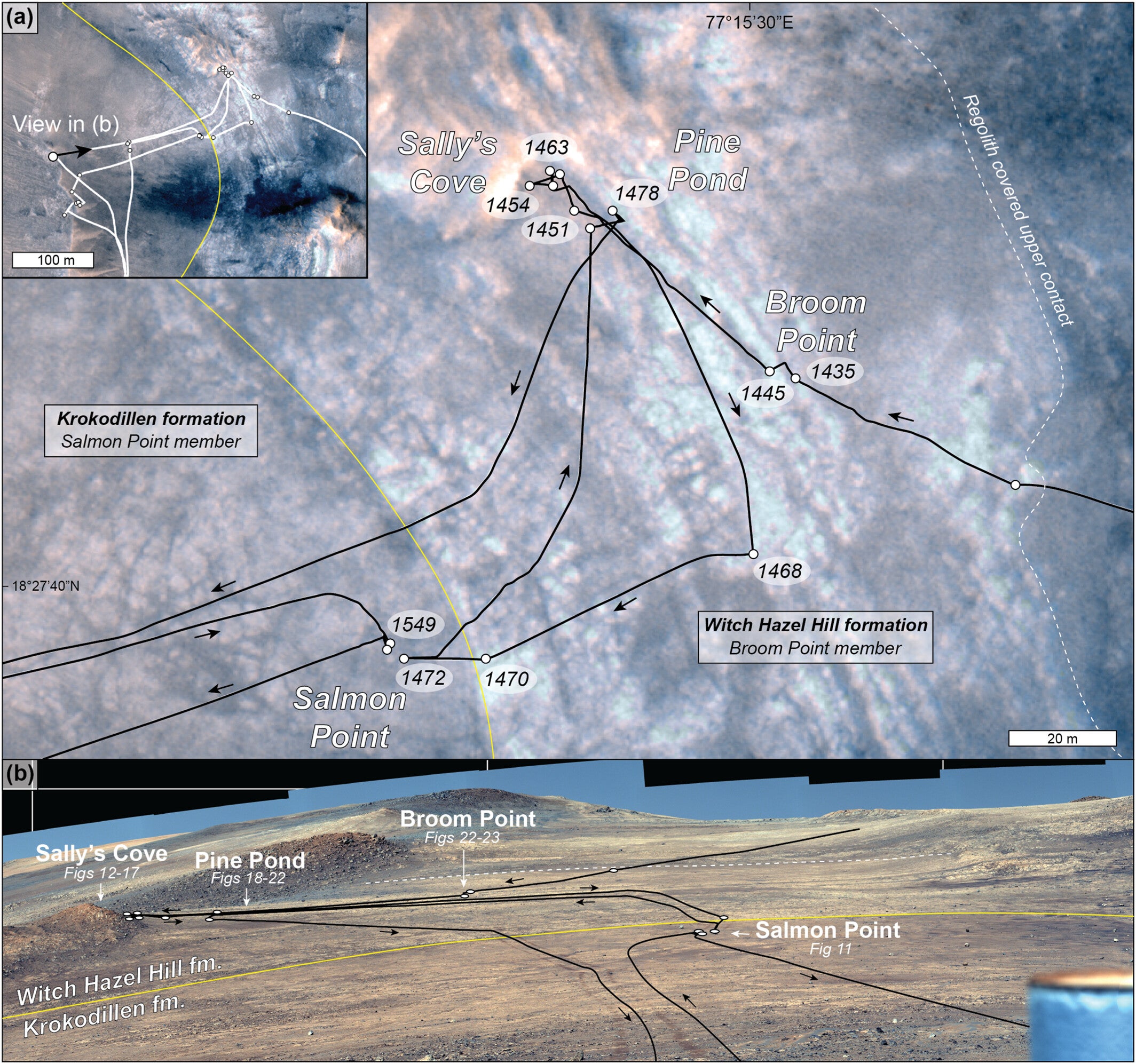
NASA’s Perseverance rover examined the layered bedrock after descending the western rim of Jezero Crater in early 2025. The sequence, called the Broom Point member, measures about 75 meters thick and is likely more than 3.9 billion years old.
The findings suggest repeated impacts built the formation long before Jezero Crater existed. The rocks rank among the oldest terrain ever studied directly by a Mars rover.
The exploration took Perseverance into a chapter of Martian history that predates the crater and differs sharply from the younger rocks inside it. Because Mars does not recycle its crust through plate tectonics, much of that early record remains available for direct examination.
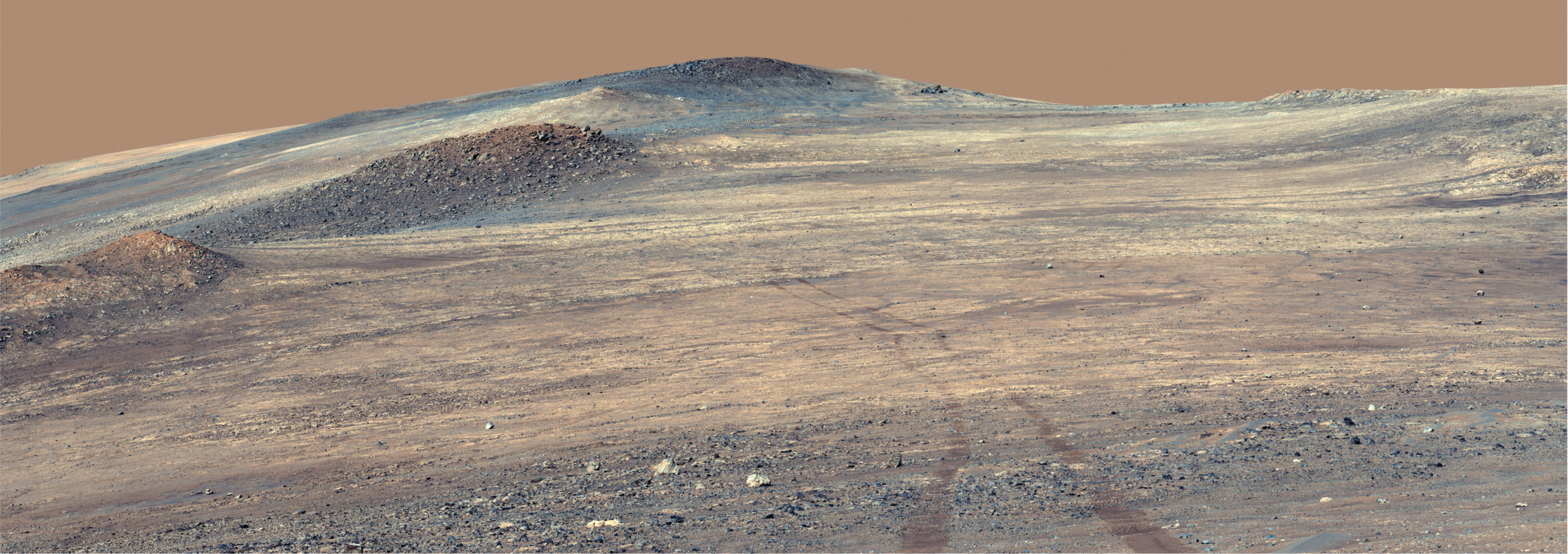
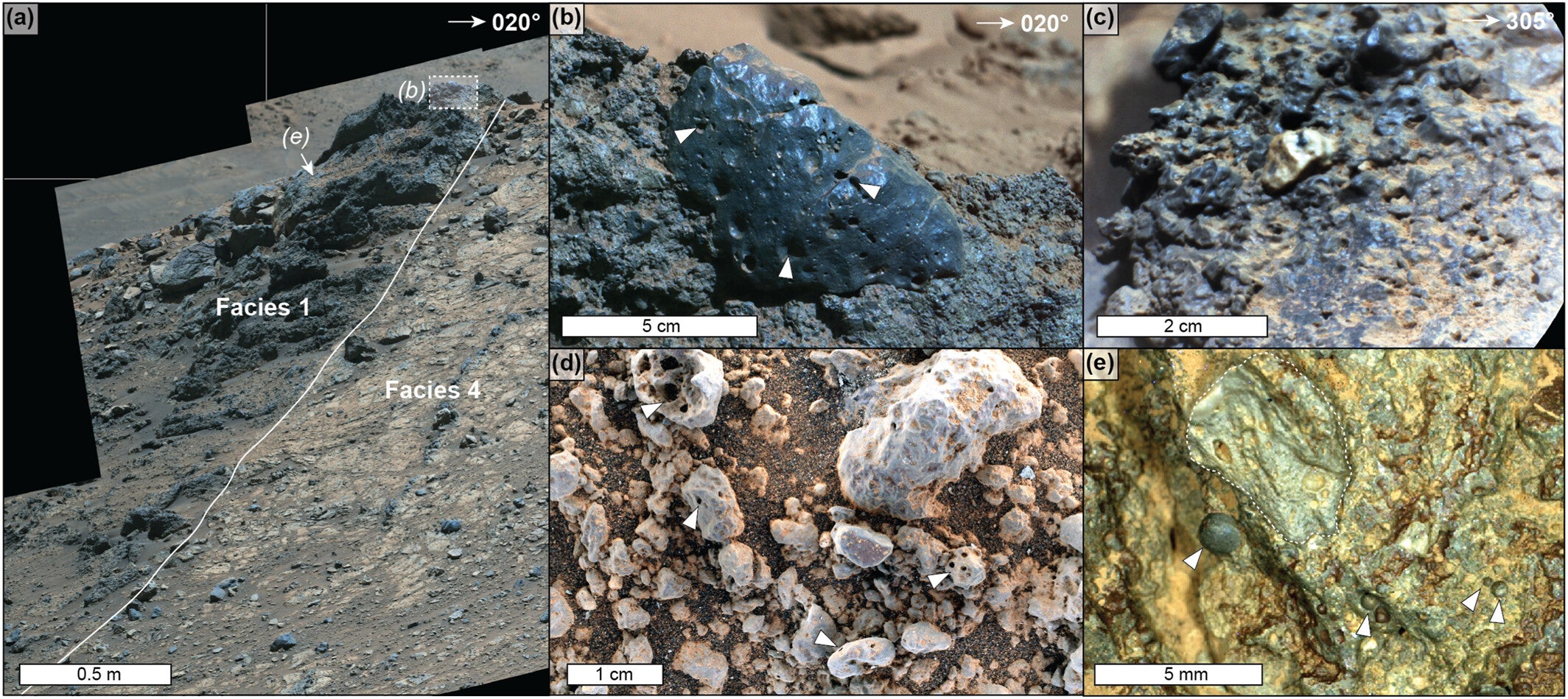
Perseverance’s instruments identified six distinct rock types within the formation. They include breccias, which contain angular rock fragments, and fine-grained layers made from pulverized dust.
Fragments inside the breccias contain cavities left by gas bubbles. Those cavities indicate the material was once molten.
The rover also detected tiny, dark, glassy beads throughout the layers. Volcanoes can produce similar droplets, but the beads appeared in unusually high numbers. Their abundance pointed instead to asteroid impacts.
Some of the largest beads rival material produced by the Chicxulub impact on Earth, which is associated with the extinction of the dinosaurs.
The repeated sequence of breccias, dusty layers, and glassy particles indicates that the region endured more than one impact event. Debris from different collisions accumulated in the same area over time.
“The different rock layers are a record of variable-sized impacts occurring at different distances from where this rock sequence was accumulating,” said Alex Jones, a doctoral student in planetary geology at Imperial College London and the paper’s lead author.
“Some large impacts took place very far away, some small impacts nearby. Their debris all ended up landing here, constructing this thick section of rock.”
Several layers resemble fast, ground-hugging debris flows. On Earth, similar fluid-like surges can form when molten rock strikes water or ice, which rapidly turns to steam.
That resemblance suggests water or ice may have interacted with impact debris while the Broom Point layers formed. The evidence does not establish exactly how much water or ice was present.
Fine material likely settled from clouds of pulverized rock after energetic events. Coarser fragments may have moved in dense flows across the surface.
Together, the layers preserve alternating episodes of violent movement and quieter fallout.
Some deposits also appear to have deformed while still soft. Folded or disrupted layers indicate that new material accumulated before earlier deposits had fully hardened.
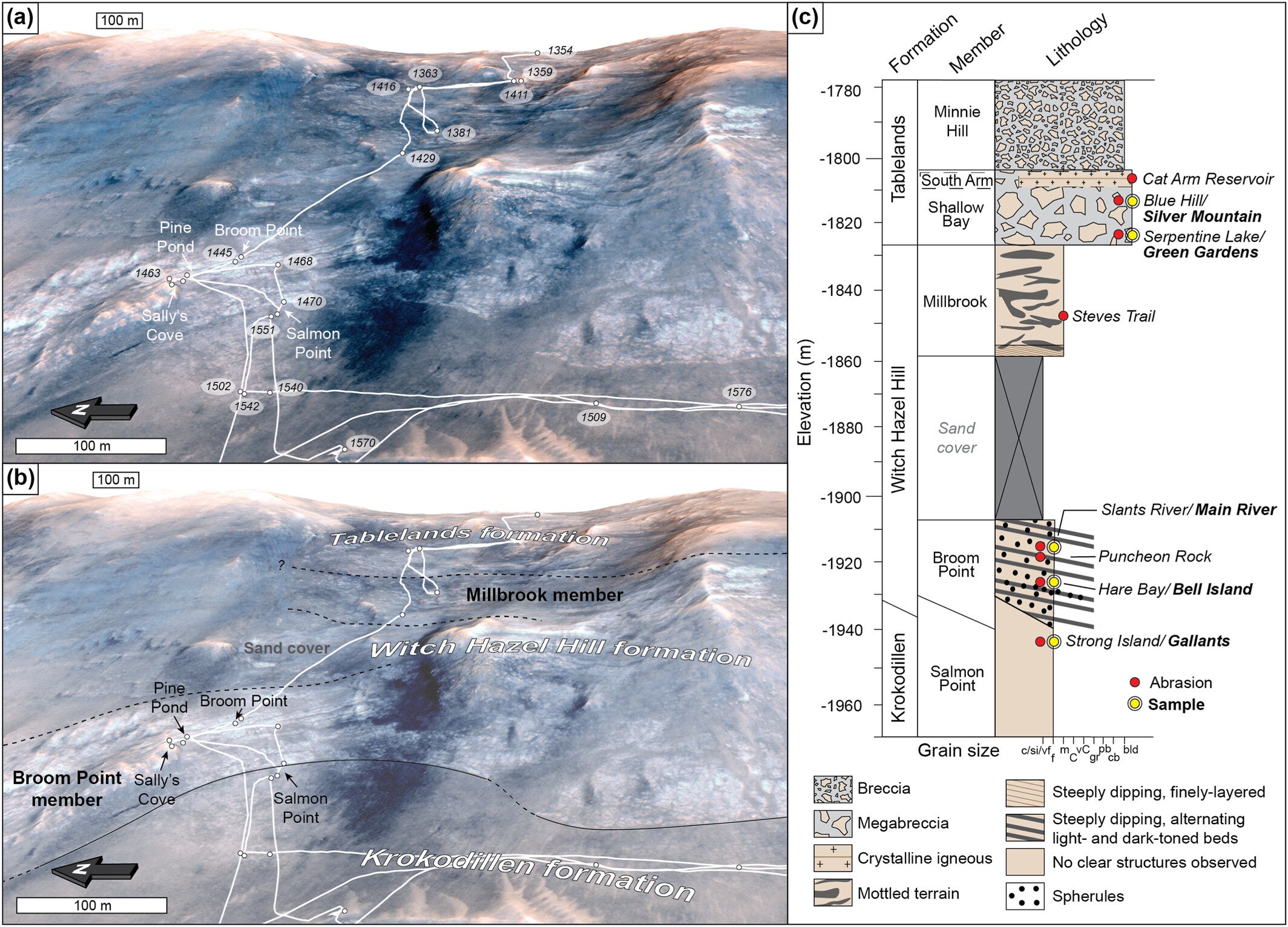
Many Broom Point layers now tilt at angles greater than 80 degrees. The Jezero impact alone could not have produced such steeply angled beds.
Scientists instead suspect two major collisions reshaped the landscape in sequence.
The first created Isidis Basin, a roughly 1,200-mile-wide, or 1,900-kilometer-wide, impact basin. That collision likely overturned and tilted rock layers that had originally formed on a flatter surface.
A later asteroid struck the already disturbed terrain and created Jezero Crater, which measures about 28 miles, or 45 kilometers, across. The second impact fractured and uplifted the tilted rocks.
That process exposed formations that had remained buried for billions of years.
Mars preserves this record because it lacks the plate tectonics that continually recycle Earth’s crust. On Earth, the oldest geological record has been broken, deformed, and erased.
“Because Mars lacks plate tectonics to recycle its crust, this ancient record remains intact, giving us a rare glimpse into a geological time period that doesn’t exist on our own planet,” said Ken Farley, Perseverance deputy project scientist at Caltech in Pasadena, California.
Perseverance collected two core samples from the ancient sequence, named “Bell Island” and “Main River.”
A future mission could return those samples to Earth. Laboratory analysis could then determine when the layers formed and how often impacts struck early Mars.
Those dates could also offer clues about the young Earth. Both planets experienced the early history of the solar system, but Earth’s active geology destroyed much of its corresponding impact record.
“During this violent era, it wasn’t rain or snow falling from the sky, but an almost constant barrage of molten rock droplets and pulverized dust kicked up by asteroid impacts,” Jones said.
“If we can pin down the ages of these layers, it would be like reading a cosmic weather report from 4 billion years ago.”
The Broom Point sequence gives planetary scientists a rare, ordered record of repeated impacts rather than evidence from one isolated crater.
By comparing the layers, researchers can study how debris changed with impact size, distance, and local conditions. The possible involvement of water or ice may also help explain how hot debris moved and settled across early Mars.
Returned samples could anchor those observations to precise ages. That would allow scientists to place individual events within the early history of Mars and compare them with the period when the young Earth also endured heavy bombardment.
The work also shows why Jezero’s rim matters beyond the crater itself. Its rocks preserve events that occurred before Jezero formed, extending Perseverance’s investigation into an older chapter of Martian history.
Each additional measurement may help reconstruct how repeated impacts built, tilted, fractured, and exposed some of the oldest crust yet examined on another planet.
Research findings are available online in the journal AGU.
The original story “Perseverance found a 245-foot Martian rock wall formed by asteroid impacts nearly 4 billion years ago” is published in The Brighter Side of News.
Like these kind of feel good stories? Get The Brighter Side of News’ newsletter.
The post Perseverance found a 245-foot Martian rock wall formed by asteroid impacts nearly 4 billion years ago appeared first on The Brighter Side of News.


Leave a comment
You must be logged in to post a comment.