Two qubits sat half a meter apart, with no direct link between them. Yet correlated microwave photons pushed them into a shared quantum state, offering a new route to entanglement without constant intervention.
Physicists at the Institute of Science and Technology Austria, or ISTA, have demonstrated the first autonomous form of distributed entanglement based on a correlated “quantum bath.” Their experiment confirms a prediction made more than 20 years ago and appears in Physical Review X.
Distributed entanglement connects quantum bits across separate locations. It could support larger quantum processors and networks that move quantum information between distant modules.
Most existing approaches require carefully timed control pulses, repeated measurements or post-selection. The ISTA method instead uses the qubits’ environment as the entangling mechanism.
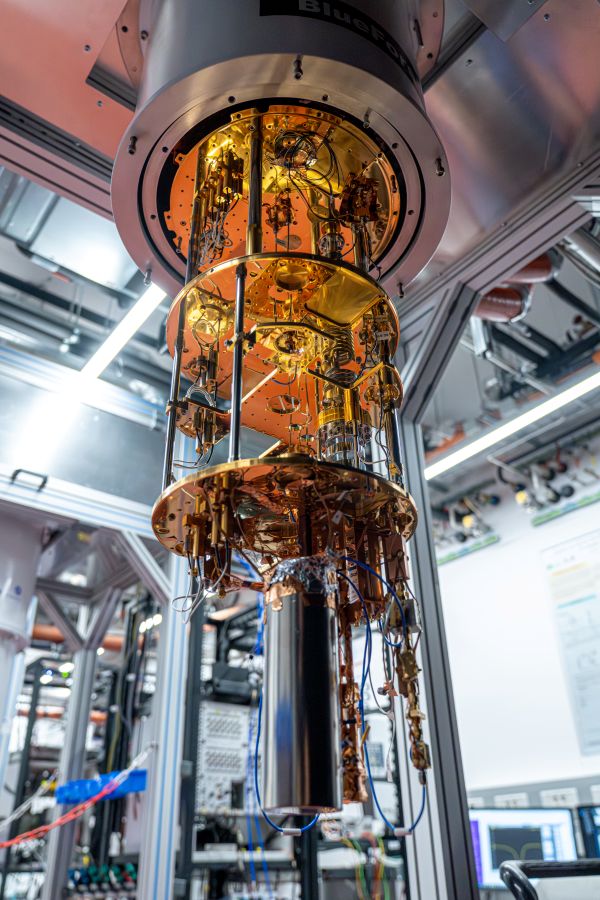
“In this work, we aimed to overcome this mismatch between the readily available and the practically useful forms of entanglement,” said PhD student Alejandro Andrés-Juanes to The Brighter Side of News. “By stabilizing the entangled states remotely, our approach is fully autonomous and requires no active control or measurement.”
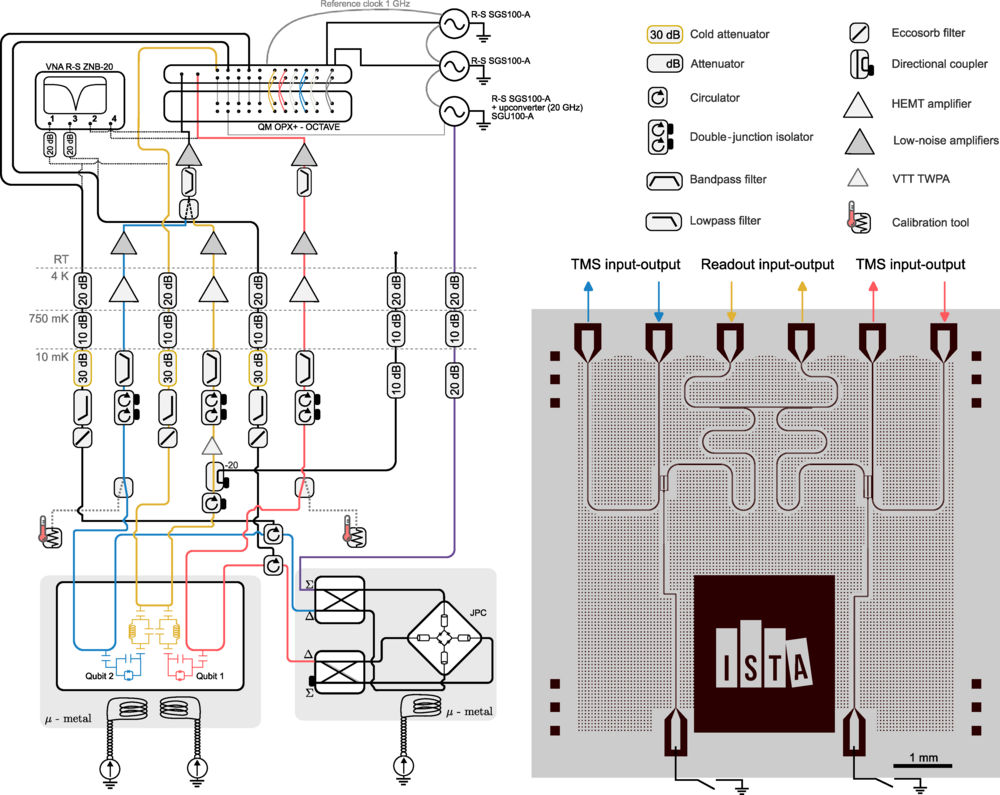
The experiment used two transmon qubits, a common type of superconducting quantum bit. Each received microwave photons from a shared source called a Josephson parametric converter.
That source generated correlated photons in a two-mode squeezed state. Such states carry continuous-variable entanglement, where measurable properties vary across a range rather than taking only fixed values.
Quantum computers, however, usually work with discrete-variable systems. Their qubits are measured as one of two outcomes, commonly described as 0 or 1.
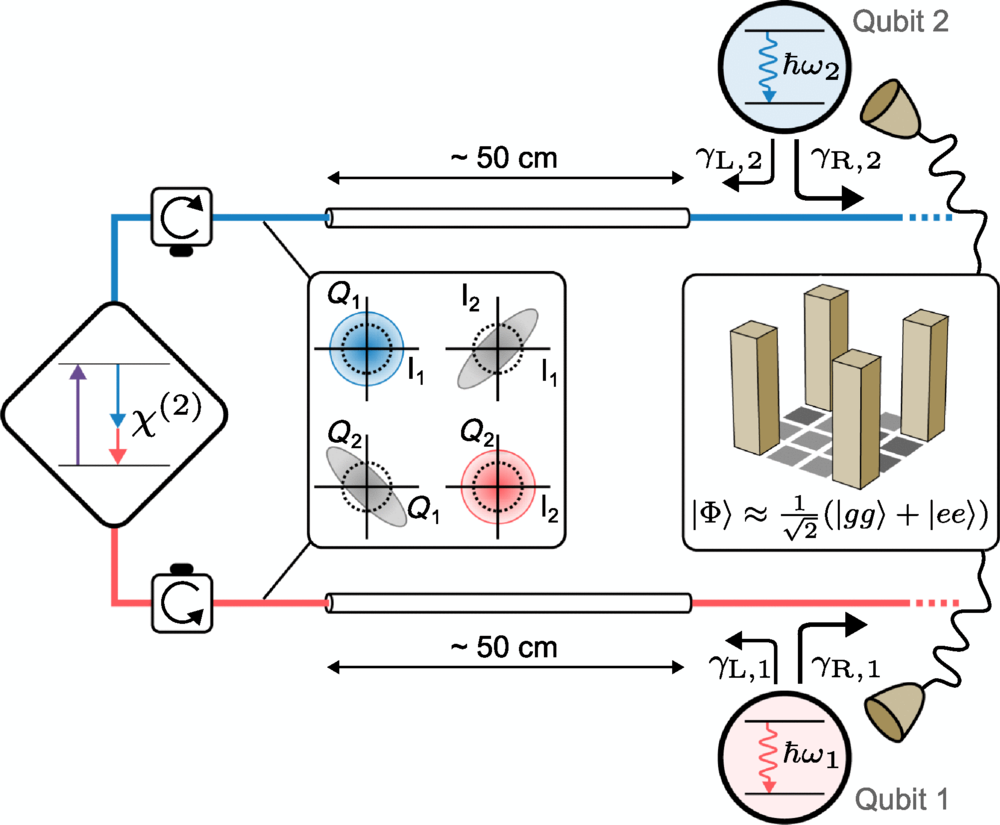
The challenge was to transfer entanglement from the continuous photon fields into the separated qubits. The photon source acted as a reservoir that continuously drove both qubits toward an entangled steady state.
“In our method, the quantum bath—meaning the qubits’ environment—is the source of entanglement. It creates a new ground state through a continuous stream of correlated photons,” said professor Johannes Fink.
“This way, the entangled qubit state is stabilized, even beyond the qubits’ own ‘lifetime’, and remains always available as a resource for further quantum processing. This makes the approach conceptually significant.”
The state formed autonomously through a nonlocal interference effect. Photon absorption and emission processes at the two qubits canceled in a way that left one entangled state stable.
The two qubits were isolated from direct interaction and placed on a second chip. Each sat 50 centimeters from the photon source, connected through coaxial cable.
The researchers sent a two-microsecond pump pulse into the source. The pulse exceeded the individual qubits’ relaxation times, allowing the shared environment to drive them toward a steady state.
Measurements showed that the qubits developed coherent correlations tied to the phase of the photon source. The team then used quantum tomography to reconstruct their joint state.
Tomography combines measurements taken along different bases. The researchers used 25 measurement settings and readout pulses lasting 20 to 80 nanoseconds.
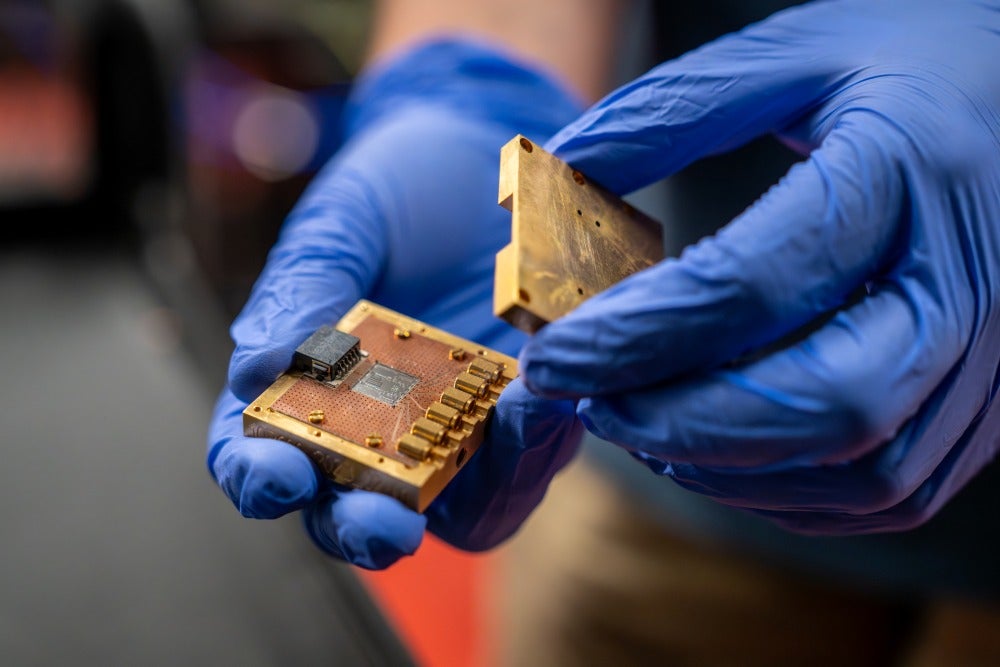
“Qubits can be in a superposition of states, but all these states collapse when we measure them, leaving us with a 0 or 1 state,” Andrés-Juanes said.
The reconstructed state reached a concurrence of 0.10, with an uncertainty of 0.01. Concurrence measures two-qubit entanglement, with higher values indicating stronger correlations.
The state formed in about 300 nanoseconds and remained stable for up to 10 microseconds. That was almost 100 times longer than the stabilization period.
Unlike short-lived entanglement events, the steady state remained available until needed. That could reduce the timing demands placed on future quantum processors.
The experiment transferred about 10 percent of the photon bath’s available entanglement into the qubits. The result matched the team’s theoretical model.
Several design constraints reduced the transfer. The waveguides carried photons in both directions, allowing the qubits to emit into uncorrelated modes. Transmission losses and uneven decay rates also weakened the final state.
Under the bidirectional design, the maximum predicted concurrence remained below 0.26. A one-sided or unidirectional system could preserve a purer state and produce much stronger entanglement.
“Our method currently transfers about 10% of the bath’s available entanglement,” Andrés-Juanes said.
Approaches using active control remain more efficient. The new method’s value lies in its autonomy, continuous availability and potential to serve several nodes from one broadband photon source.
The team also changed the qubit frequencies to test the operating range. Entanglement followed a bandwidth of 44 megahertz, close to the photon source’s measured 46-megahertz bandwidth.
That agreement showed that qubit measurements could reveal properties of the traveling microwave field itself.
The team also used the qubits to verify entanglement in the microwave photon source. Conventional microwave measurements amplify weak signals before detecting them at room temperature.
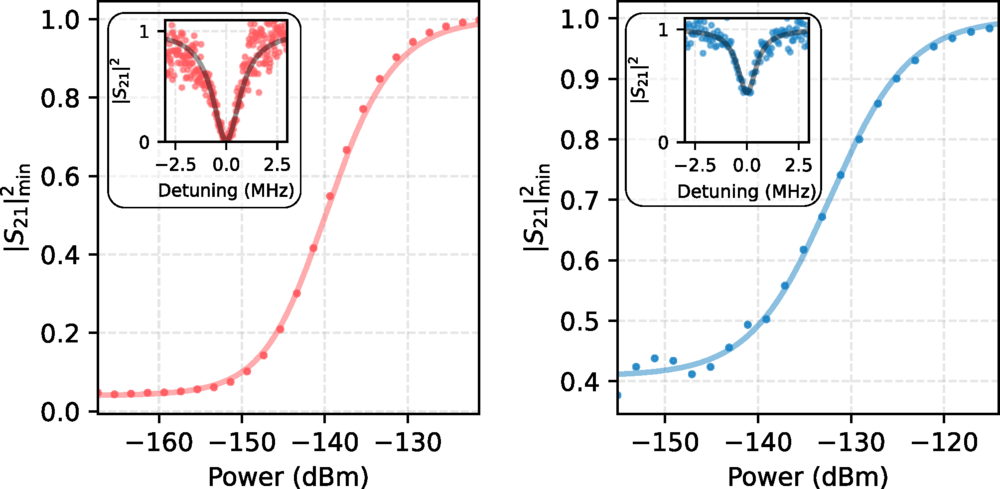
That process requires careful calibration and noise subtraction. Amplifiers can add noise, respond differently across frequencies and drift over time.
The qubits provided another option. At low photon numbers, they acted as direct detectors of photon populations and correlations without requiring the same calibration process.
Their measurements agreed with conventional detection in the weak-signal range. They also confirmed that the two microwave fields were entangled.
The team described this as the first calibration-free verification of a two-mode squeezed state at microwave frequencies.
The prototype offers a possible foundation for distributing entanglement across modular quantum processors with less active control. One broadband source could serve several qubit pairs in parallel, with the generation rate limited by its bandwidth.
The method could also connect systems operating at different frequencies. Correlated optical and microwave photons could help link superconducting processors with optical networks that transmit information through fiber.
The device remains a proof of concept. Stronger transfer will require lower-loss transmission, directional waveguides, better-matched qubit decay rates and improved photon sources.
Still, the experiment demonstrates that dissipation does not always destroy quantum information. When deliberately engineered, the surrounding environment can create and preserve correlations needed for fault-tolerant processors, quantum networks and other distributed quantum technologies.
Research findings are available online in the journal Physical Review X.
The original story “Quantum bath keeps distant qubits entangled without human control” is published in The Brighter Side of News.
Like these kind of feel good stories? Get The Brighter Side of News’ newsletter.
The post Quantum bath keeps distant qubits entangled without human control appeared first on The Brighter Side of News.

