A tiny silica bead, just 100 nanometers across, sits suspended in a vacuum and vibrates under the grip of laser light. Those vibrations might sound like a small detail, but in this case they are the heart of a new kind of laser, one that works not with light particles, but with particles of mechanical motion.
Researchers at the University of Rochester and Rochester Institute of Technology have built what they describe as a squeezed phonon laser, a system that gives unusually tight control over phonons, the quantum units of vibration or sound. Their results, reported in Nature Communications, push phonon lasers into new territory by combining laser-like coherence with reduced noise in a levitated nanoparticle system.
That matters because noise is a constant problem in precision measurement. Even ordinary lasers, which look steady to the eye, are never perfectly calm. Their output fluctuates, and those fluctuations can blur a signal. The same basic problem affects phonon lasers.
“While a laser looks to the naked eye like a steady beam, there’s actually a lot of fluctuation, which causes noise when you’re using lasers for measurement,” said Nick Vamivakas, the Marie C. Wilson and Joseph C. Wilson Professor of Optical Physics at the University of Rochester’s Institute of Optics. “By pushing and pulling on a phonon laser with light in the right way, we can reduce that phonon laser fluctuation significantly.”
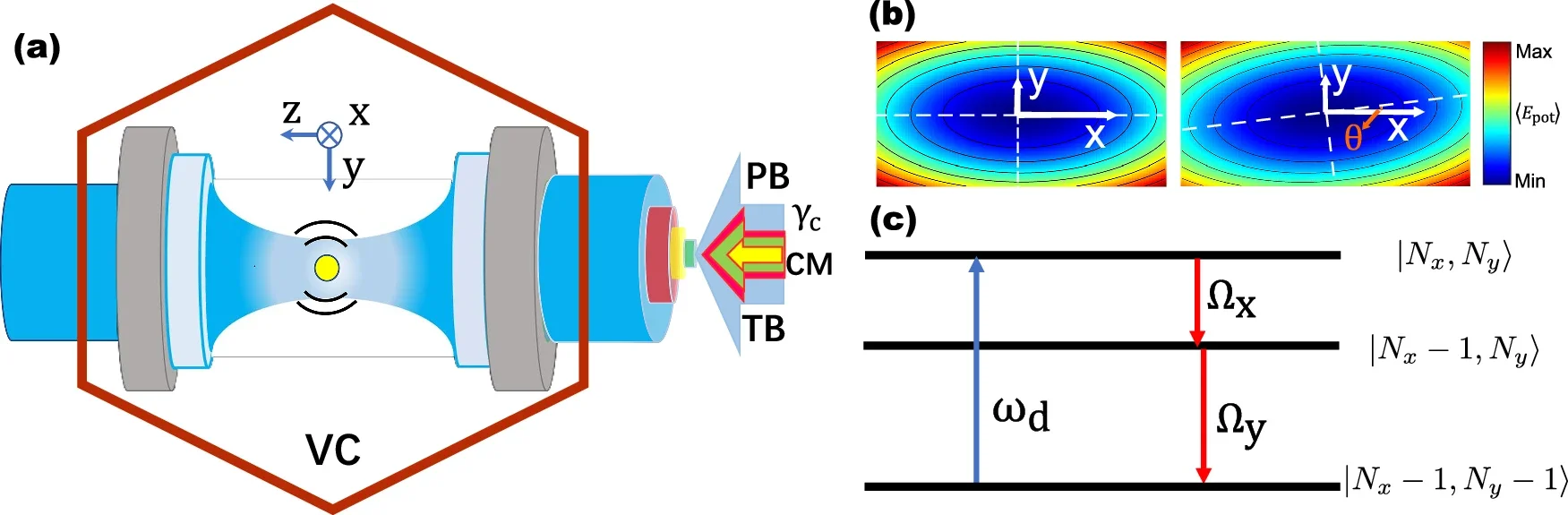
His group had already shown in 2019 that phonons could be trapped and levitated with an optical tweezer in vacuum. The new work goes further by suppressing part of the thermal noise built into the system itself.
Conventional lasers organize photons into a coherent stream. This device instead organizes two mechanical vibration modes of a trapped nanoparticle. The particle is held in place by a tightly focused 150 milliwatt laser beam with a wavelength of 1064 nanometers, inside a chamber pumped down to 1 × 10⁻⁵ mbar. At that pressure, gas molecules interfere much less with the particle’s motion.
Because the trapping beam is linearly polarized, the optical potential is not perfectly symmetric. That gives the nanoparticle two distinct transverse vibration modes, one in the x direction and one in the y direction. In the experiment, those modes oscillated at about 115 kilohertz and 130 kilohertz.
The team coupled those two modes by periodically rotating the trapping potential. When the driving frequency matched the sum of the two oscillation frequencies, the system began generating correlated phonons through a down-conversion process. In simple terms, one driving input fed energy into both vibrational modes at once.
On its own, though, that kind of parametric driving creates a problem. Push the system too hard and the oscillation amplitude runs away, making the particle unstable enough to escape the trap. To prevent that, the researchers used nonlinear parametric cooling. That cooling balanced the drive and allowed the motion to settle into a stable oscillation.
The result was a clear transition. Before coupling, both vibration modes behaved like thermal states. Their motion looked like ordinary Brownian noise. Once the coupling was turned on strongly enough, both modes crossed a threshold and began acting like coherent laser modes instead.
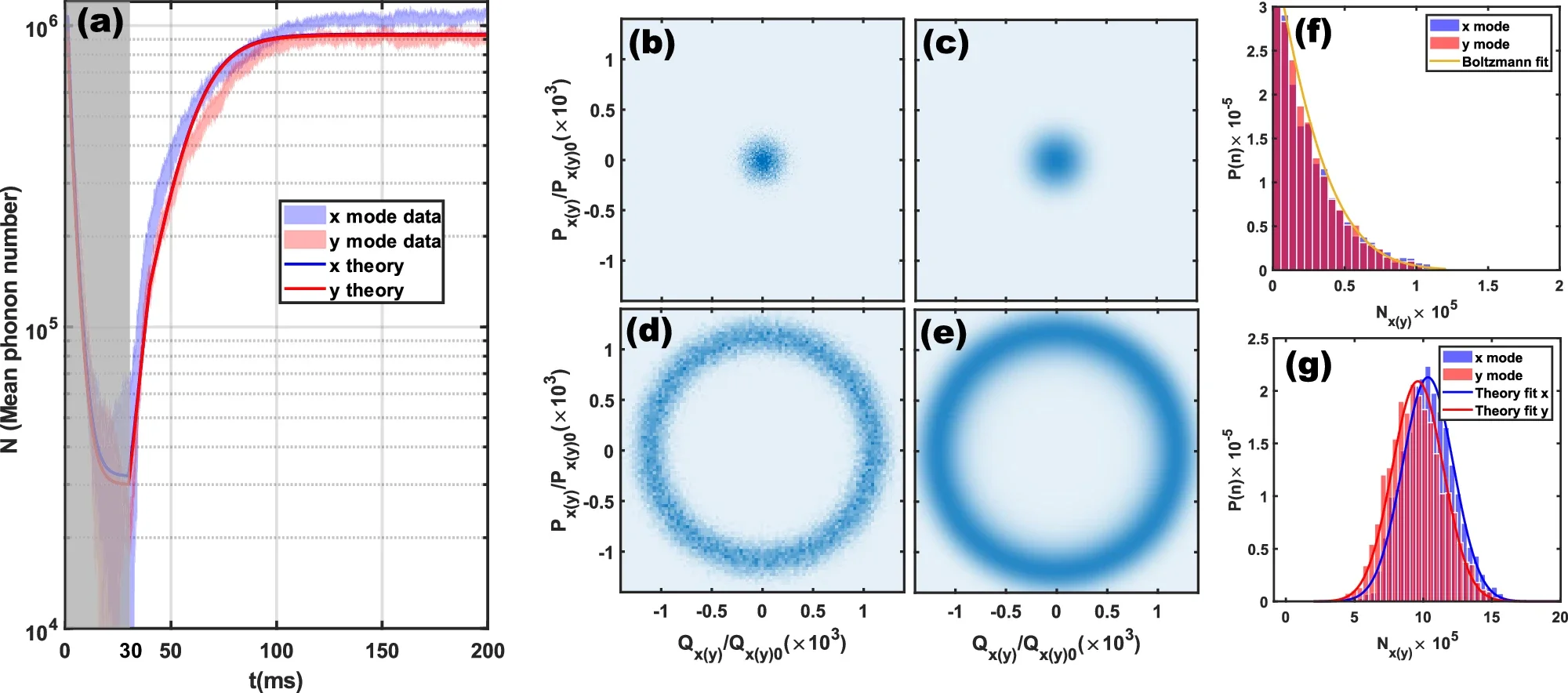
That transition showed up in several ways. The mean phonon number rose and then stabilized. The phase-space distributions changed from disks centered at the origin to annular shapes associated with phase-diffused coherent states. The phonon number distribution also shifted, indicating that the system had moved from a thermal regime into one with laser-like coherence.
The researchers measured a normalized second-order phonon autocorrelation function to track that shift. As the coupling strength increased, the value moved from about 1.8 toward 1. A value near 2 is associated with thermal behavior, while a value near 1 marks coherent behavior.
In other words, the system stopped looking like random thermal motion and started looking like a phonon laser.
This was not just a repeat of earlier single-mode work. The team said their two-mode version does not rely on linear amplification feedback to create gain. Instead, the gain comes from modulation of the coupling between the two modes themselves. That distinction is part of what makes the new device interesting.
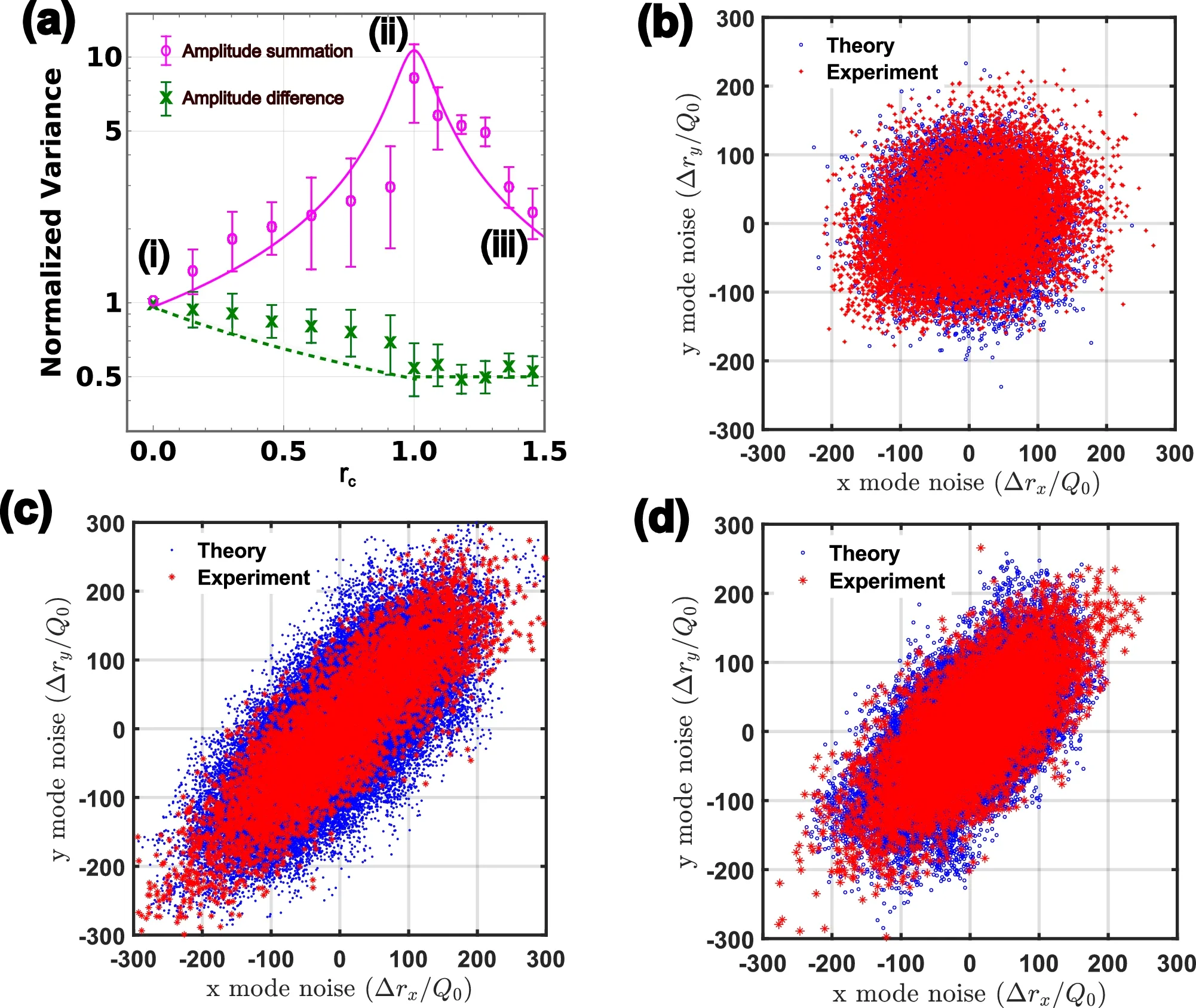
The other major advance is squeezing. In optical physics, squeezing means reducing fluctuations in one measurable quantity below its ordinary limit, usually at the cost of increasing fluctuations elsewhere. Here, the researchers observed thermomechanical two-mode squeezing in a levitated nanoparticle system for the first time.
They found that when the two modes were coupled, their fluctuations became linked. The fluctuation in the difference between their amplitudes dropped, while the fluctuation in their summed amplitudes increased. Near the threshold, this squeezing effect was strongest. One measured squeezing ratio reached 15.8 ± 0.8 near threshold, then fell to 5.2 ± 0.6 above threshold.
That combination is the core claim of the paper. Above threshold, the device behaves like a laser, narrow in linewidth and coherent, while also retaining reduced noise in the correlated motion of the two modes. The authors describe it as a bright source of coherent and classically correlated phonons.
The researchers are careful about where this work stands. They note that their result is classical, not yet a demonstration of quantum entanglement. They also describe it as a first step toward an eventual quantum realization rather than a finished quantum technology.
That restraint matters. Phonon control has long attracted interest because it could support sensitive measurements and, eventually, quantum information applications. But this experiment stops short of claiming that full quantum regime.
Even so, the work points to several uses. Vamivakas said reducing thermal noise could allow more accurate acceleration measurements than methods based on photon lasers or radio-frequency waves. He also said the system could help researchers measure gravity and other forces with high precision.
That opens the door to ideas such as navigation systems that do not depend on satellites. Scientists have imagined quantum compasses as harder-to-jam alternatives to GPS, and the team sees phonon lasers as a possible ingredient in that kind of future hardware.
This work gives researchers a new way to build low-noise mechanical signals at the nanoscale. That could improve force sensing, acceleration measurements, and studies of gravity.
It may also help expand levitated optomechanics, where trapped particles act as testbeds for questions in thermodynamics and quantum physics.
For now, the system is a classical device, but it offers a more stable and controllable platform for future experiments that aim to reach the quantum regime.
Research findings are available online in the journal Nature Communications.
The original story “Quantum researchers created a new kind of laser built from sound” is published in The Brighter Side of News.
Like these kind of feel good stories? Get The Brighter Side of News’ newsletter.
The post Quantum researchers created a new kind of laser built from sound appeared first on The Brighter Side of News.

