A black hole may have been hurled from its galaxy at nearly 1,000 kilometers per second, leaving a narrow, star-forming trail more than 200,000 light-years long behind it.
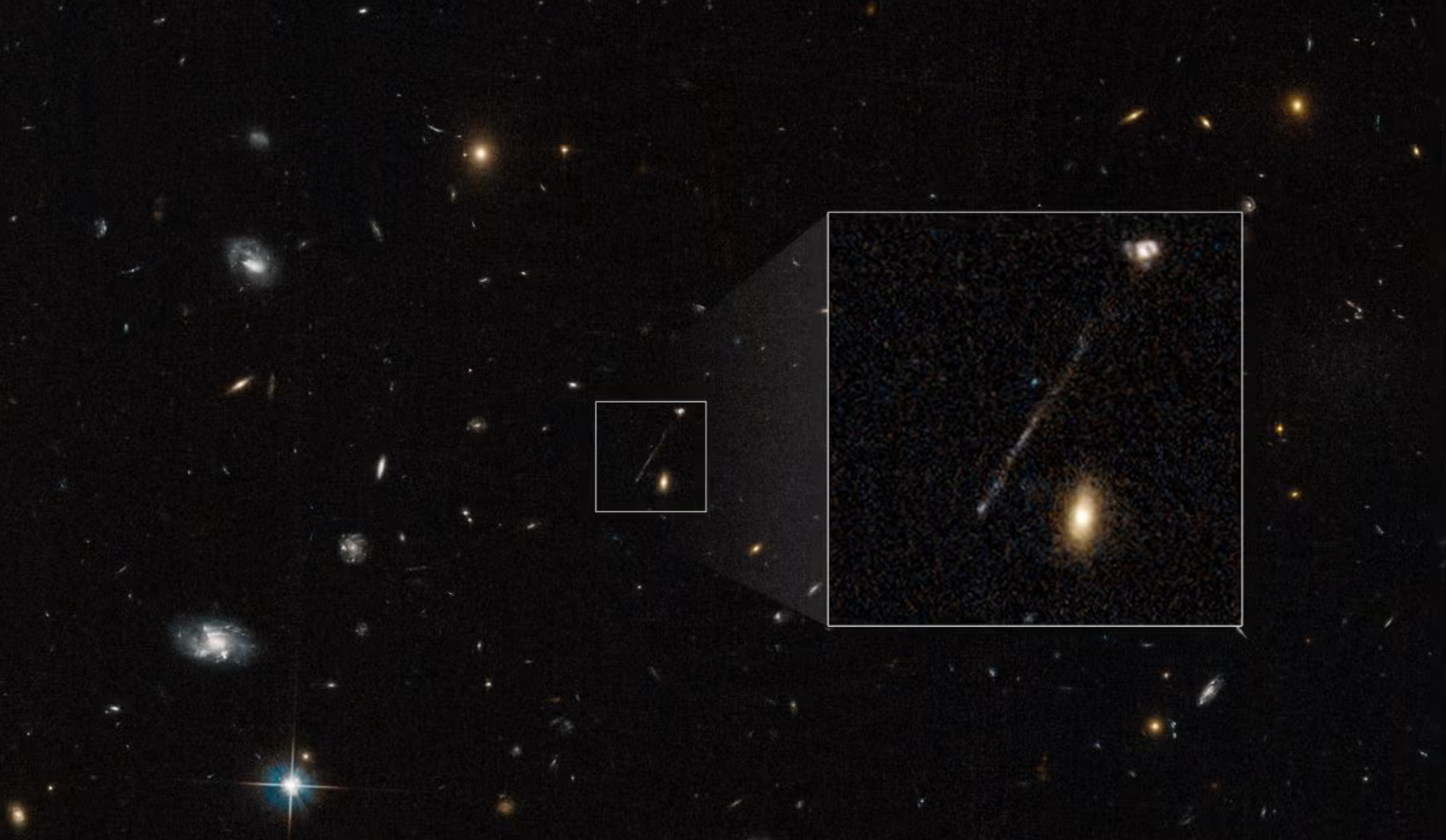
The object, known as RBH-1, sits at the leading edge of a striking linear feature first noticed in Hubble Space Telescope images in September 2022. The structure extends about 62 kiloparsecs, or roughly 202,000 light-years, from a compact galaxy called GX, around 7.5 billion light-years from Earth.
At the tip is an unresolved point source with no detectable stellar continuum. Behind it lies a wake only about 1 kiloparsec wide, filled with young stars and shocked gas. Follow-up observations with the James Webb Space Telescope strengthened the case that the object is a runaway supermassive black hole moving through the circumgalactic medium.
Now a team from UC Santa Barbara and the University of Texas at Austin has worked backward from that motion to reconstruct the merger that may have launched it. Their findings, published in Physical Review Letters, point to an unusually violent collision between two rapidly spinning, misaligned supermassive black holes.
When two black holes merge, they release gravitational waves as they distort spacetime. If the merger is sufficiently uneven, those waves can carry momentum away asymmetrically. The newly formed black hole then recoils in the opposite direction.
Tejaswi Venumadhav, an associate professor in UC Santa Barbara’s Department of Physics, compared the process to “the recoil of a fired cannon.”
But ordinary mergers could not explain RBH-1’s apparent speed.
The researchers tested hundreds of thousands of possible black-hole pairings, varying mass ratios, spin rates and spin orientations. Nonspinning black holes generated kicks no larger than about 180 kilometers per second. Even aligned or antialigned spinning systems generally topped out around 200 to 300 kilometers per second.
RBH-1 appears to be moving at about 954 kilometers per second, with an uncertainty range of roughly 828 to 1,064 kilometers per second.
“The two black holes had to be spinning fast,” said lead author Tousif Islam, a postdoctoral scholar at UC Santa Barbara’s Kavli Institute for Theoretical Physics. “And their spins had to be misaligned.”
![We show merger scenarios incapable of producing the RBH-1 runaway velocity of 954^{+110}_{-126} km s^{-1} (vertical shaded gray region). These include nonspinning SMBH mergers, nonprecessing SMBH mergers, and precessing SMBH mergers with mass ratios q ∈ [5, 20].](https://www.thebrighterside.news/uploads/2026/08/black-hole-3.png)
That misalignment means the black holes were precessing, with their spin axes tilted relative to the orbital plane.
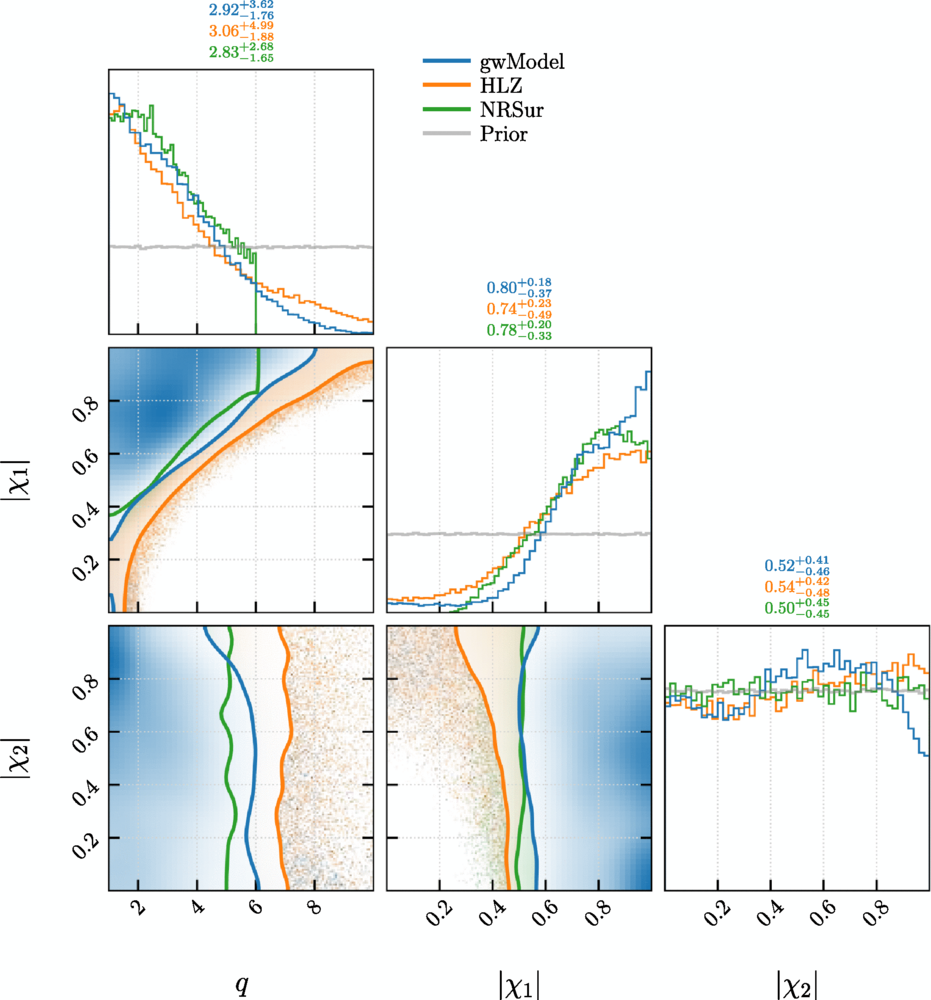
Across three recoil models, the characteristic mass ratio was about 3-to-1, with the larger black hole likely no more than six or seven times the mass of the smaller one.
The heavier black hole also appears to have been spinning rapidly. Depending on the model, its dimensionless spin was centered around 0.75 to 0.80, where 1 represents the maximum allowed by general relativity.
“I was initially surprised by how extreme this sounds,” Venumadhav said, “but then I realized it probably had to be the case in order to have produced the dramatic feature visible in telescopes.”
The smaller black hole’s spin remains much less constrained. The final runaway black hole likely retained substantial spin, while the merger preserved about 97% of the binary’s initial mass.
Those conclusions depend on interpreting RBH-1 as a recoiling supermassive black hole. Alternative explanations include a bulgeless edge-on galaxy or a tidal feature. However, those ideas struggle to reproduce the missing stellar continuum at the tip, the extreme velocity and the required energy input.
JWST spectroscopy added another clue. The apex shows a sharp velocity jump of about 600 kilometers per second, consistent with a bow shock. Gas downstream follows a smooth velocity gradient, while emission-line ratios point to fast radiative shocks.
A simple shock-compression model reproduces the observations with an object moving at about 954 kilometers per second. That speed implies an ejection roughly 70 million years ago.
If two supermassive black holes met more than 7.5 billion years ago, their host galaxies likely had to merge first.
Using the inferred black-hole mass ratio and relations between black-hole mass and galaxy bulge mass, the researchers estimate the two progenitor galaxies were probably within about a factor of four in mass. That places the event in the major or near-major merger regime.
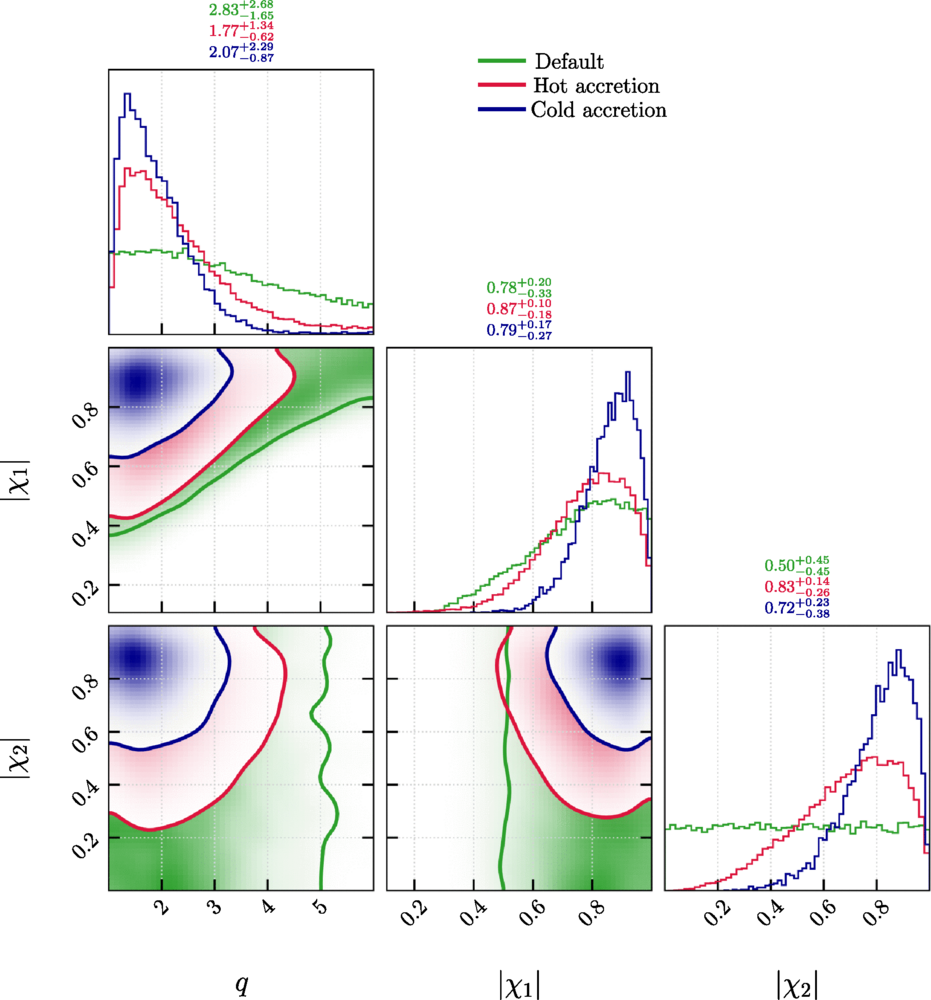
The geometry of the black-hole spins offers another clue. Strong precession requires spin-orbit misalignment, which the team argues fits a dynamically complicated, gas-rich environment better than a purely collisionless merger.
At least one progenitor black hole also appears to have had a high spin, which is more naturally associated with prolonged gas accretion.
![Similar to Fig. 2, but showing the inferred spin angles between the progenitor SMBH spins and the orbital angular momentum: θ₁(= cos⁻¹[L̂ × Ŝ₁]), θ₂, and the effective precession parameter χₚ [Eq. (1)], obtained using the recoil-kick models HLZ and NRSur.](https://www.thebrighterside.news/uploads/2026/08/black-hole-5.png)
There is a tension, however. Coherent gas accretion can align black-hole spins with the orbital axis, reducing the recoil. The researchers suggest the spin magnitudes may have been established earlier, inside the two separate galaxies, while the final spin orientations developed later during the shorter circumbinary phase.
Warped or torn disks, thick accretion flows, or alignment timescales comparable to the merger timescale could preserve enough misalignment to produce the observed kick.
RBH-1 offers astronomers a possible preview of the supermassive black-hole mergers that future gravitational-wave missions may detect directly.
Ground-based observatories such as LIGO and Virgo detect mergers involving much smaller black holes. Supermassive black-hole collisions radiate at far lower frequencies.
The planned Laser Interferometer Space Antenna, or LISA, is designed to target that regime. For a system like the one that may have created RBH-1, the researchers estimate a characteristic LISA signal-to-noise ratio of about 1,000.
“This connects what telescopes see to what LISA will hear,” Venumadhav said.
JWST could also help determine whether RBH-1 is unique or part of a larger population. General relativity predicts that roughly 5% to 10% of these mergers should produce large recoil kicks.
“Before, we did not have the technology,” Islam said. “Now that we have JWST, this is hopefully the first of many such observations.”
Finding more runaway black holes could help astronomers test how often massive black holes merge with strong spin misalignment, how their host galaxies assemble, and what kinds of systems LISA may eventually detect.
These resources explore how gravitational-wave recoil can eject supermassive black holes, how gas and spin shape massive mergers, and how future observatories could detect these events.
A confirmed recoiling supermassive black hole in a powerful quasar
Detailed spectroscopy of quasar 3C 186 provides strong evidence that its displaced supermassive black hole received a gravitational-wave recoil kick after a merger, offering an important comparison with other runaway black hole candidates. (arXiv, 2025)
Accretion, Jets, and Recoil in Merging Supermassive Binary Black Holes
A three-dimensional relativistic simulation follows two misaligned, accreting supermassive black holes through merger and finds that the remnant can receive a recoil exceeding 1,000 kilometers per second while retaining surrounding gas. (arXiv, 2025)
Accretion-mediated spin–eccentricity correlations in LISA massive black hole binaries
This work examines how gas accretion can shape the spins and orbital eccentricities of massive black hole binaries, showing how LISA measurements could help distinguish different environments and merger histories. (Monthly Notices of the Royal Astronomical Society, 2024)
Systematics in tests of general relativity using LISA massive black hole binaries
Researchers show that surrounding gas and orbital eccentricity can leave measurable signatures in gravitational waves from massive black hole binaries, underscoring the importance of accurately modeling their environments when interpreting LISA observations. (Monthly Notices of the Royal Astronomical Society, 2024)
Waveform modelling for the Laser Interferometer Space Antenna
This LISA Consortium review surveys the gravitational-wave models needed to interpret sources including massive black hole mergers at cosmological distances and outlines the theoretical challenges that must be solved before LISA observations begin. (Living Reviews in Relativity, 2025)
Research findings are available online in the journal Physical Review Letters.
The original story “Runaway supermassive black hole may be the result of a violent cosmic collision” is published in The Brighter Side of News.
Like these kind of feel good stories? Get The Brighter Side of News’ newsletter.
The post Runaway supermassive black hole may be the result of a violent cosmic collision appeared first on The Brighter Side of News.


Leave a comment
You must be logged in to post a comment.