A few millimeters separated recovery from severe decline in tanks of bleached coral. Fragments touching healthy genetic clones regained their beneficial algae and resumed growth. Fragments held nearby without contact largely succumbed to invasive algae and tissue loss.
The laboratory findings, published in Science Advances, reveal a route to rapid recovery after bleaching. Stanford University researchers found that about a week of contact could provide enough algae for recovery to continue independently. The results identify a biological mechanism, rather than a method already demonstrated to restore natural reefs.
Danny Collins, an oceans doctoral student at the Stanford Doerr School of Sustainability, led the study with colleagues including Steve Palumbi. Their experiments involved small fragments of the branching coral Pocillopora damicornis. Successful recovery required a healthy donor genetically matching the bleached recipient, a major constraint on wider use.
Corals are animals that host microscopic algae within their tissues. These partners, known as symbionts, supply much of the coral’s nutrition through photosynthesis. Heat stress can disrupt that relationship, leaving pale tissue after large numbers of algae disappear.
Bleaching does not necessarily mean a coral has died. However, losing its partners leaves the animal vulnerable to starvation and external algae growing over its surface. Recovery can occur after heat stress subsides, but natural recolonization often takes months.
Healthy corals release some symbionts into the environment, and bleached corals can sometimes acquire them from surrounding water. Yet environmental concentrations are much lower than those inside coral tissue. The Stanford team investigated whether direct contact could bypass that limited supply.
The question followed a chance observation in Palumbi’s laboratory. A healthy fragment and a bleached fragment from the same colony had fallen together in a tank. Color returned where they touched, prompting experiments on whether that contact could help restart recovery.
The initial comparison used ten pairs, each containing one healthy fragment and one bleached fragment of the same genotype. Five pairs touched, while five remained approximately five to seven millimeters apart. Bleached recipients were initially only about one to one-and-a-half centimeters long.
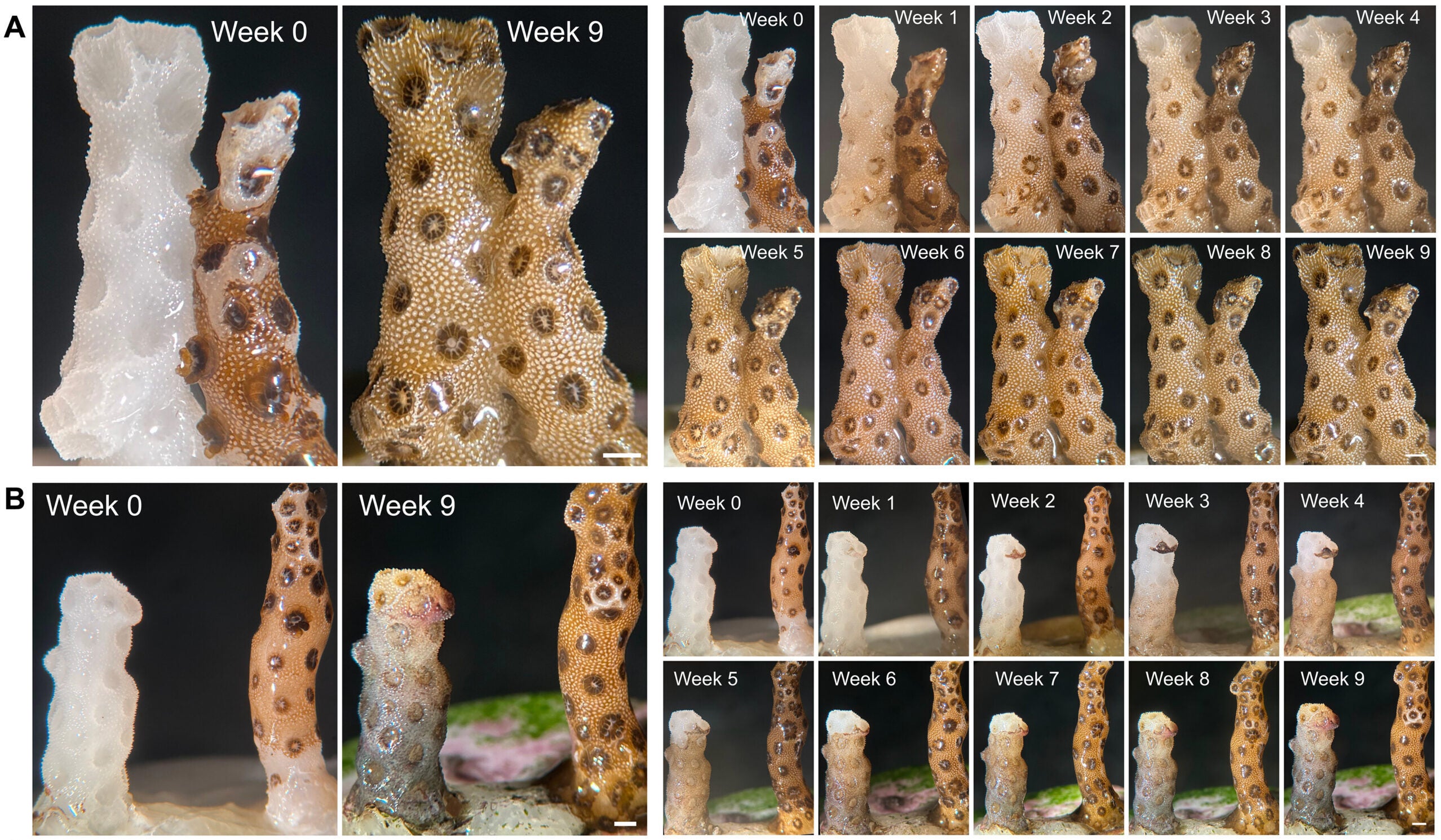
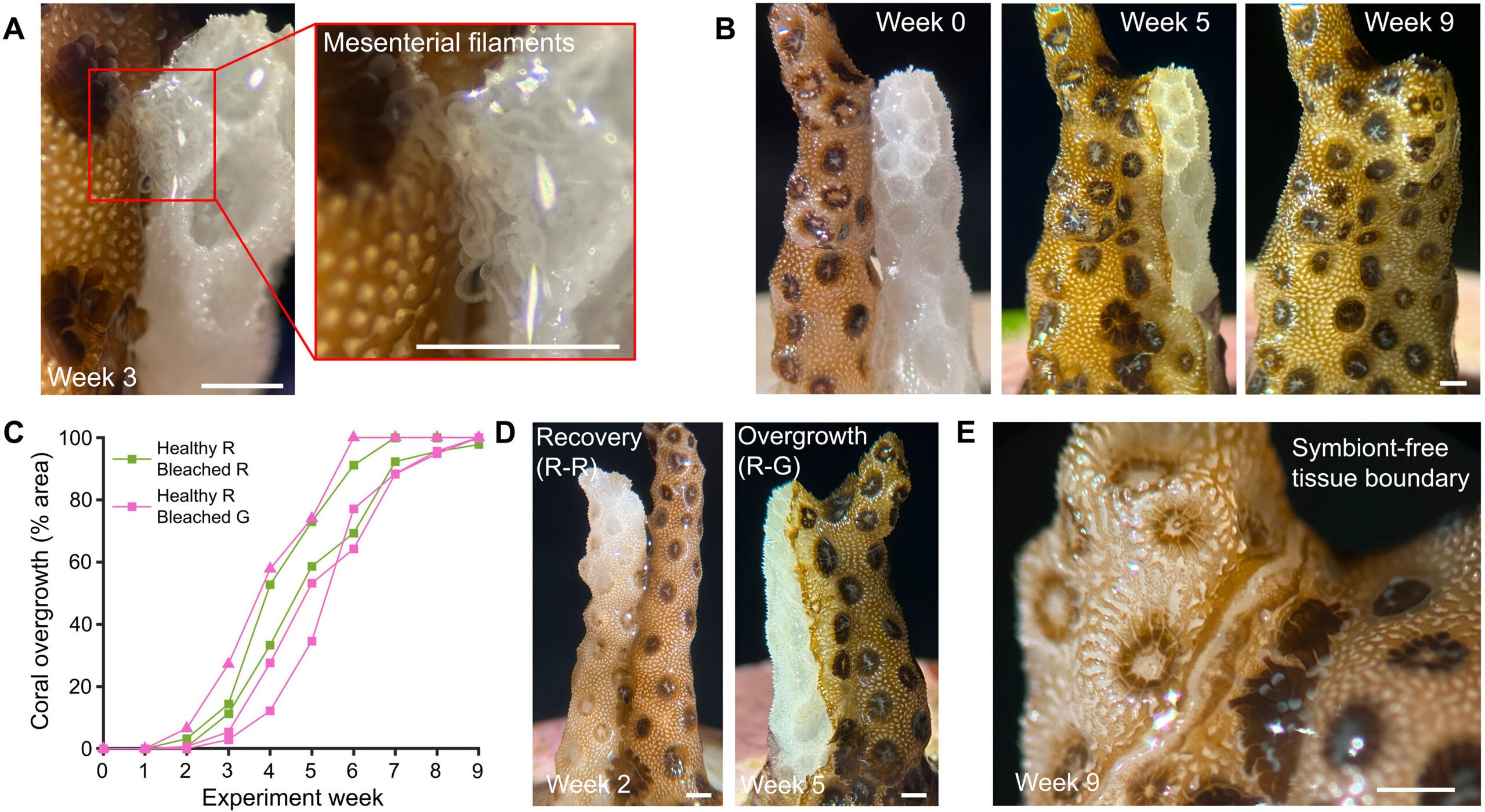
All five touching fragments achieved complete polyp recovery by eight weeks, with one reaching that point after four weeks. Their pigmentation approached that of healthy fragments, and new polyps subsequently appeared. At twenty weeks, previously bleached recipients showed substantial growth and new branches.
The separated controls followed a much poorer course. By nine weeks, two were fully overgrown by algae and had died. The remaining three had algal coverage across at least 87% of their surfaces, despite limited recovery near some branch tips.
Experiments with larger fragments produced similar patterns, and matching fragments from a second genotype also recovered. That repeatability strengthens the observation within the tested system. It does not establish how reliably other coral species, larger colonies or different symbiont communities would respond.
Researchers next separated pairs after contact lasting from one day to three weeks. All recipients kept in contact for at least a week, plus one receiving five days of contact, achieved full polyp recovery within seven weeks. Shorter exposures sometimes transferred algae but did not reliably prevent later overgrowth.
This separation experiment helped distinguish continued delivery from growth inside the recipient. Once the fragments were apart, newly introduced symbionts could keep multiplying without further transfer through fused tissue. Their continued recovery indicated that this internal replication drove much of the later improvement.
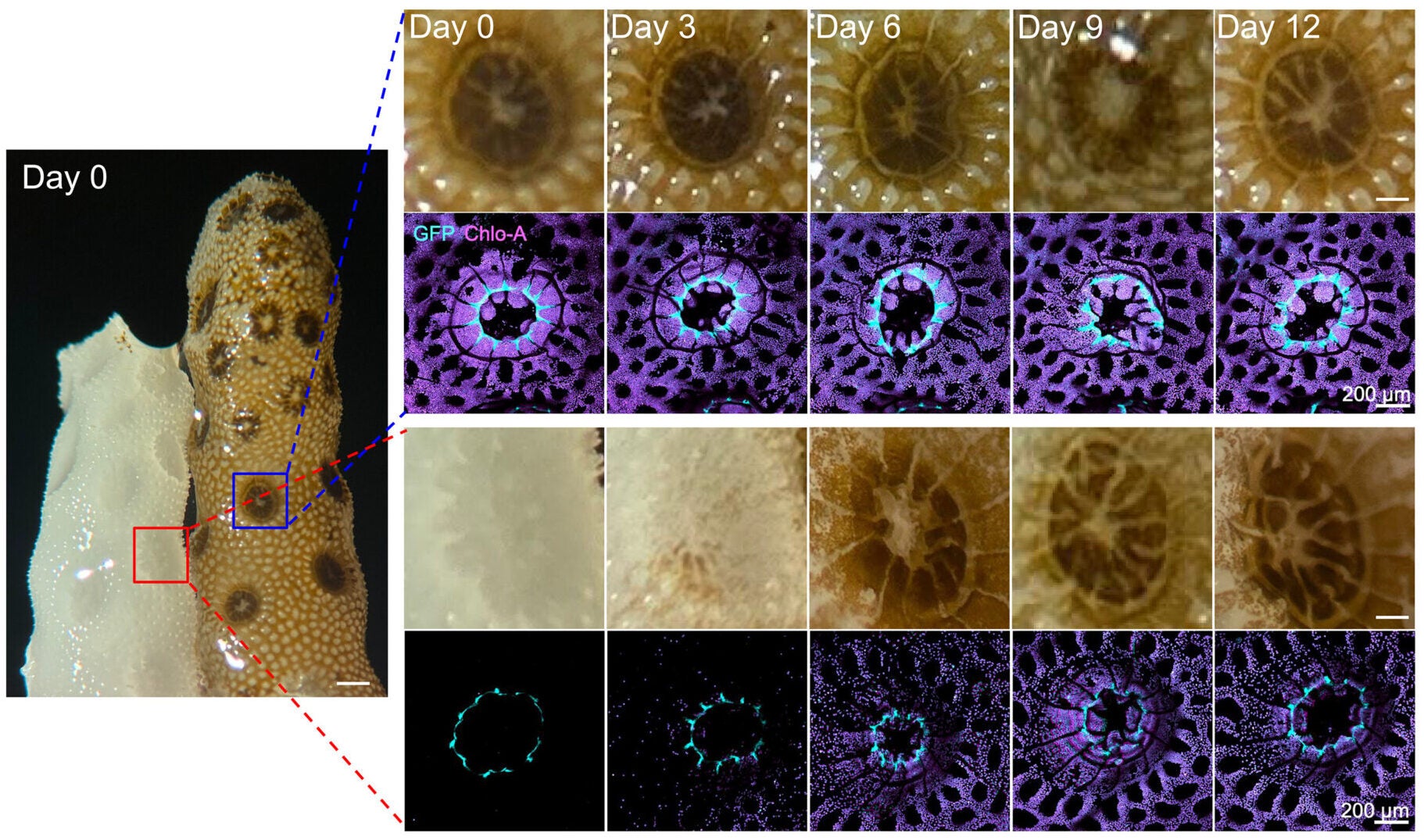
Confocal microscopy showed how depleted the bleached tissue had become. Healthy polyps averaged more than 6,700 symbiont cells per square millimeter, compared with about seven in bleached polyps. The bleached fragments had therefore lost approximately 99.9% to 100% of their symbionts.
Algae appeared in recipient polyps within three days, followed by rapid increases. During the second six-day observation period, symbiont populations doubled approximately every four days. That was fast compared with several published field-recovery examples, although the study did not establish a universal recovery rate for corals.
Recolonization began at localized contact points before spreading through the recipient. Depending on where transfer started, recovery progressed downward from a tip, upward from a base or in both directions. This pattern suggested a physical connection between the fragments.
When researchers pulled matching fragments apart, they found corresponding tissue tears at the transfer sites. Those paired tears supported the formation of fused tissue bridges. Rapid mass transfer began approximately 36 to 60 hours after contact, around the time those connections formed.
The observations also suggested that the coral’s internal transport network helped distribute symbionts. However, the exact cellular mechanism remains unresolved, including whether algae traveled inside host cells or independently. Nutrient transfer may also have supported recovery, but its contribution needs further investigation.
Genetic compatibility changed the outcome dramatically. When healthy and bleached fragments came from different genotypes, they deployed stinging filaments and failed to achieve fragment-wide recovery. Healthy coral overgrew weakened neighbors instead, showing why placing arbitrary corals together could cause harm rather than help.
The experiments used one species and two genotypes, with small numbers in individual treatment groups. Researchers still need to test broader biological diversity and realistic field conditions. They also do not know how far recovery could spread through a full-sized colony from a limited contact area. Feeding conditions and the processes controlling symbiont multiplication are additional questions, since laboratory fragments may differ substantially from colonies on reefs.
Maintaining a healthy genetic duplicate of every bleached colony would be impractical across entire reefs. The study therefore points toward further questions about delivering beneficial algae efficiently, rather than a ready-to-deploy rescue program. Large-batch delivery or improved environmental uptake remain possibilities to investigate.
The findings also do not demonstrate protection during continuing extreme heat or resistance to future bleaching. Recovery and heat tolerance are related but different challenges. Any intervention would need evaluation alongside the conditions that caused the original loss of symbionts.
“While bleached corals may be dying, they are not dead yet,” Collins said. The experiments show that severely depleted fragments can retain considerable capacity to recover when beneficial partners return quickly. Turning that capacity into practical reef restoration will depend on overcoming compatibility, delivery and scale.
These resources explore the biology of bleaching and other approaches under investigation for protecting corals.
Selective breeding enhances coral heat tolerance to marine heatwaves: Tests whether selecting heat-tolerant parents can improve the performance of adult coral offspring. (Nature Communications, 2024)
Heat-evolved microalgal symbionts increase coral bleaching tolerance: Investigates whether laboratory-evolved algal partners can improve coral responses to heat stress. (Science Advances, 2020)
Coral microbiome manipulation elicits metabolic and genetic restructuring to mitigate heat stress and evade mortality: Examines bacterial treatments as another way to influence coral health and survival under heat stress. (Science Advances, 2021)
Breeding and Selecting Corals Resilient to Global Warming: Reviews the opportunities and limitations of using coral variation and breeding in conservation. (Annual Review of Animal Biosciences, 2024)
What is coral bleaching?: Explains the relationship between coral animals, their algal partners and environmental stress. (NOAA, 2026)
Research findings are available online in the journal Science Advances.
The original story “Scientists discover a way to reverse coral bleaching, one of the ocean’s biggest environmental threats” is published in The Brighter Side of News.
Like these kind of feel good stories? Get The Brighter Side of News’ newsletter.
The post Scientists discover a way to reverse coral bleaching, one of the ocean’s biggest environmental threats appeared first on The Brighter Side of News.


Leave a comment
You must be logged in to post a comment.