A monkey-like foot may not have stopped the ancestor of humans and chimpanzees from climbing straight up tree trunks. New field measurements show wild sooty mangabeys can bend their midfeet almost as much as chimpanzees flex their ankles.
Humans and chimpanzees split from that shared ancestor about 6 million to 7 million years ago, leaving a long-running debate over how it moved through forests.
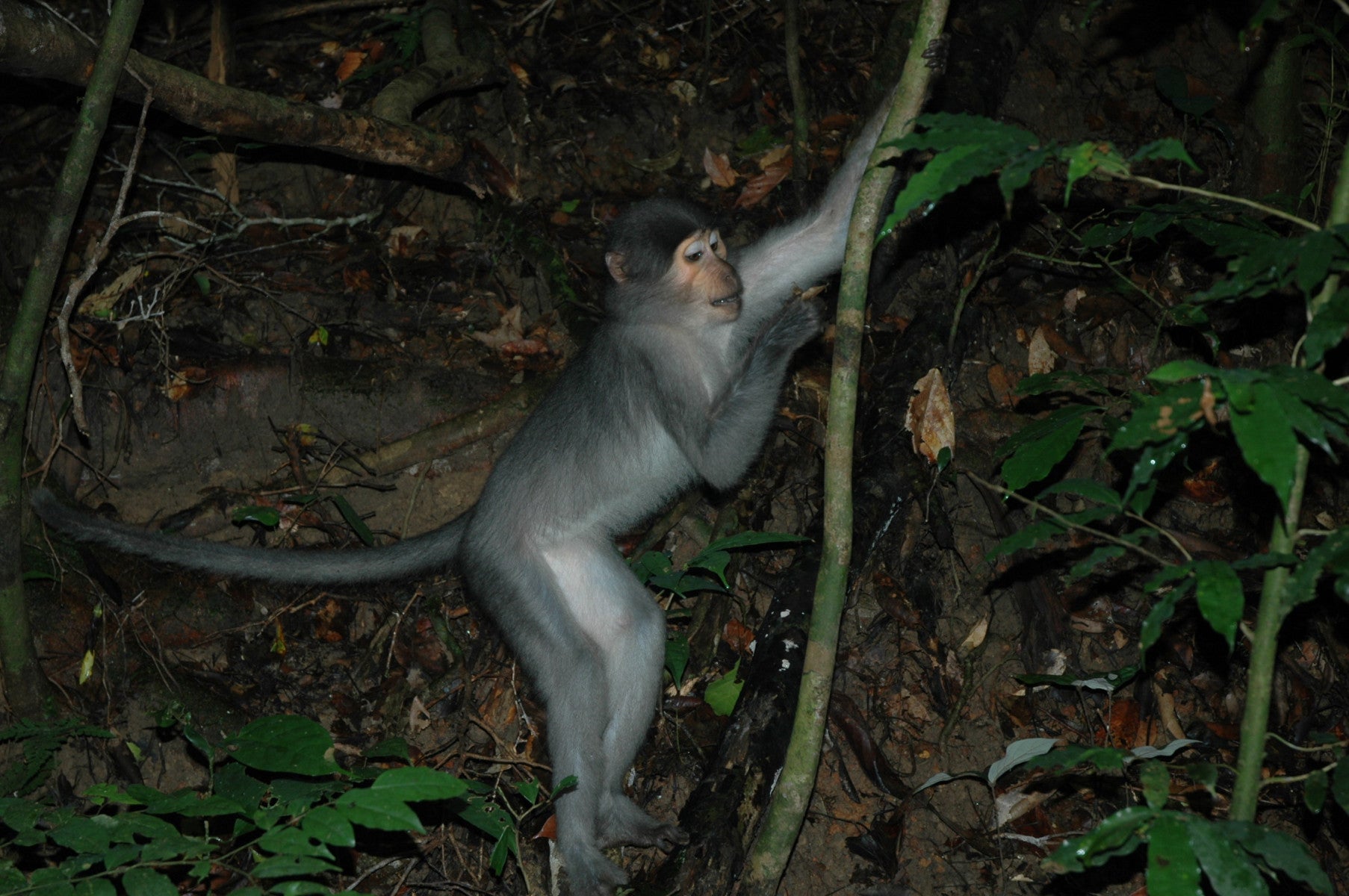
The research comes from scientists at The Ohio State University. The team studied sooty mangabeys in Ivory Coast, whose feet lack chimpanzees’ highly flexible ankles.
“People are making behavioral inferences from fossils, and some say a monkey can’t vertically climb as well as an ape can,” said first study author Luke Fannin, assistant professor of anthropology at Ohio State. “We’re saying there’s a functional equivalence here. So you can’t rule out vertical climbing just because something doesn’t have a chimpanzee-like foot.”
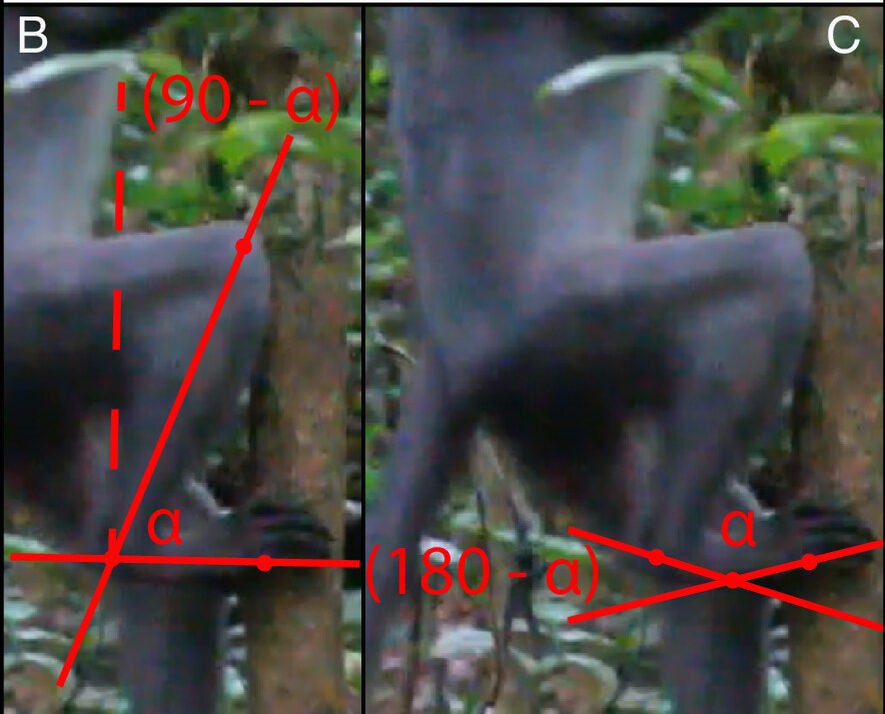
Chimpanzees can flex their ankles upward to about 45 degrees while climbing trees. Most human ankles flex only about 20 degrees. That movement pulls the body closer to a trunk, reducing forces that could pitch the climber backward.
Sooty mangabeys do not have the expanded ankle joint that supports such movement in African apes. Yet video recorded in the Taï Forest showed the monkeys reaching similar angles in a different part of the foot.
Fannin filmed mangabeys at the Taï Forest Monkey Project field station, which is co-directed by W. Scott McGraw, professor and chair of anthropology at Ohio State. The footage allowed measurements of ankle and midfoot movement during climbs.
“The great thing about having the video is that it allows us to capture exactly what the monkey is doing in a high-resolution manner. So we can actually say how the joint is loaded. Before, we had hunches, but in this way, it’s far more precise,” McGraw said.
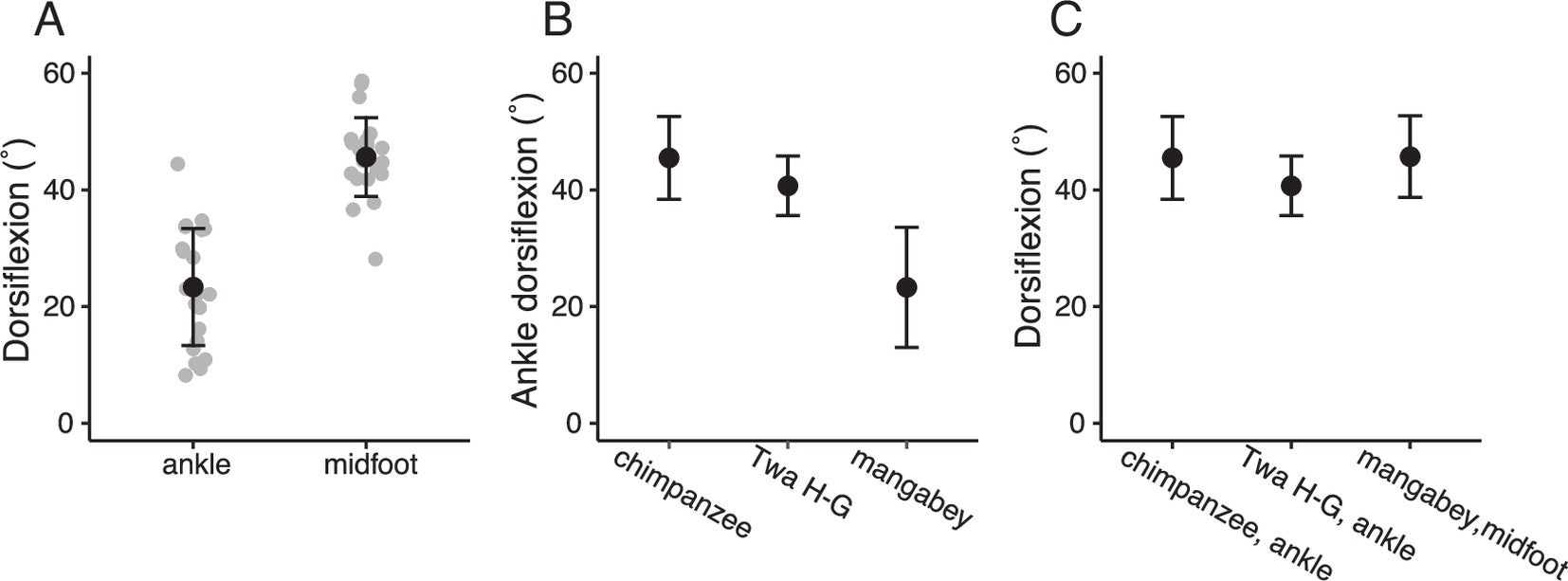
Mangabeys averaged 45.7 degrees of maximum midfoot flexion during climbs, versus 23.3 degrees at the ankle, about 65 percent more.
Their ankle flexion was also far below that measured in chimpanzees and climbing Twa hunter-gatherers. Chimpanzees averaged 45.5 degrees of maximum ankle flexion, while Twa climbers averaged 40.7 degrees.
Yet mangabey midfoot movement nearly matched chimpanzee ankle movement and was about 12 percent higher than the Twa measurement. Chimpanzees and mangabeys also held comparable positions relative to the tree.
The result matters because paleoanthropologists have proposed competing versions of the last common ancestor’s foot.
One model gives that ancestor an African ape-like foot suited to ground movement and climbing. Another points to monkey-like fossil traits and more above-branch movement.
Those models have treated vertical climbing differently. In the ape-like scenario, trunk climbing plays an important role in moving between the ground and trees. In the monkey-like scenario, some researchers have viewed that behavior as less compatible with the proposed foot structure.
The new measurements weaken that distinction. Mangabeys gain similar climbing benefits without a chimpanzee-like ankle.
“What’s neat about this paper is it adds clarity, but it also makes the broader picture more fuzzy,” McGraw said. “Because this notion that you have to have a foot like an advanced ape to vertically climb, which is a difficult task, is not true. You’ve got a bunch of monkeys that aren’t extinct – and which can be filmed – that are very competent at performing a biomechanically challenging behavior right now in a forest in West Africa.
“The videos that Luke made in Taï are particularly important because they provide some of the first kinematic documentation of a locomotor behavior in a monkey that has largely been unrecognized or underappreciated.”
The researchers stress that the findings do not identify whether the last common ancestor had a monkey-like or ape-like foot. Instead, they show that either form could have supported safe vertical climbing.
The findings also affect how scientists interpret early hominin fossils.
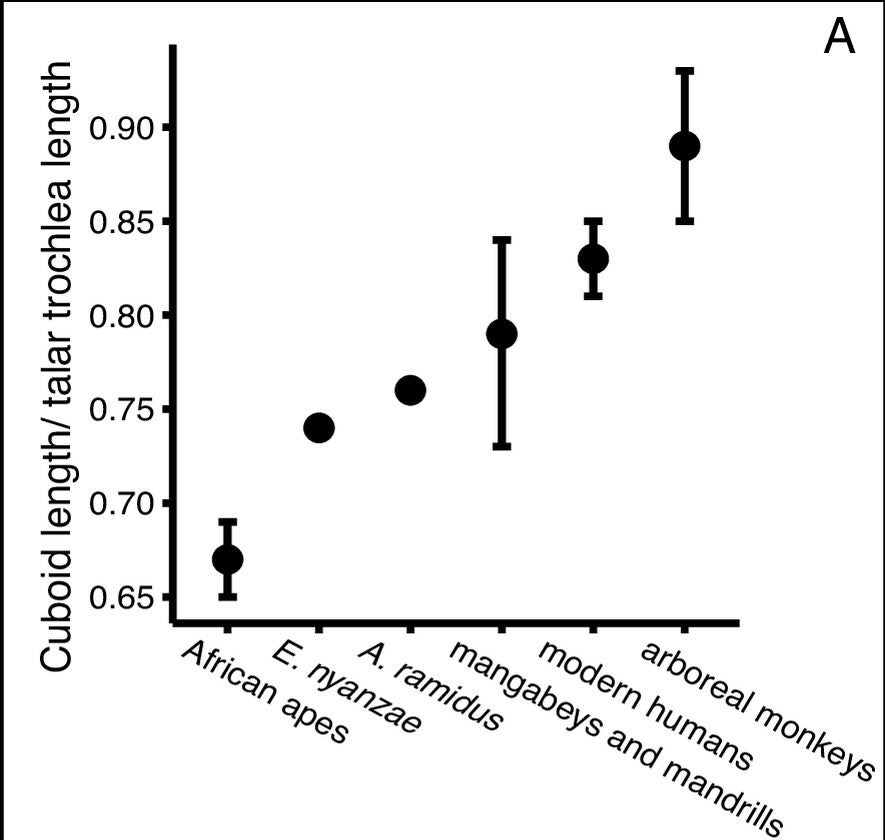
Most Plio-Pleistocene australopith ankles lacked the expanded shape associated with extreme chimpanzee-like ankle flexion. That anatomy has been linked to more frequent striding on two legs and less use of chimpanzee-style ankle movement during climbs.
But some Australopithecus species had foot bones suggesting greater midfoot flexibility than modern humans. Australopithecus deyiremeda, dating to about 3.5 million years ago, had a relatively short fourth metatarsal base. Australopithecus sediba, from about 2 million years ago, had a strongly convex base in the same bone.
Earlier researchers proposed that such mobility could help climbing. Mangabey measurements support that possibility by showing another route to effective vertical movement.
Some hunter-gatherers and human foragers also climb vertically despite lacking ape-like ankle bones. Their ability is thought to depend on flexible ligaments, tendons and muscles.
“Arboreality is fundamental to understanding primates – including ourselves – because it has shaped our body to a large degree: hands and feet, wrists and ankles, nails instead of claws, etc.,” McGraw said.
The work gives paleoanthropologists a broader framework for reading fossil feet. A monkey-like foot shape may not justify ruling out vertical climbing when reconstructing the behavior of extinct primates or early human relatives.
It also shows why living primates can sharpen interpretations of fossil anatomy. Video-based measurements reveal how different joints can produce similar climbing performance, even when the underlying bones look quite different.
That leaves the identity and anatomy of the human-chimpanzee last common ancestor unresolved. The study narrows one assumption rather than settling the larger debate.
“Regardless of where you’re starting from, which we don’t know yet, vertical climbing is universal and the anatomy is going to perform that behavior. So I think that to get at the question of a monkey-like or ape-like last common ancestor, we need more fossils,” Fannin said.
These resources examine fossil feet and ankles, primate climbing mechanics and competing reconstructions of how the earliest members of the human lineage moved through trees and on the ground.
Analysis of the 4.4-million-year-old Ardipithecus ramidus ankle found similarities with chimpanzees and gorillas associated with vertical climbing, adding important evidence to the debate over whether the human-chimpanzee ancestor had African ape-like locomotor adaptations. (Communications Biology, 2025)
New finds shed light on diet and locomotion in Australopithecus deyiremeda
New fossils strengthen the assignment of a distinctive partial foot to Australopithecus deyiremeda and indicate that substantial tree use persisted in this roughly 3.5-million-year-old hominin despite adaptations connected with bipedal movement. (Nature, 2025)
Reappraising the palaeobiology of Australopithecus
This broad review reassesses Australopithecus anatomy, locomotion and evolutionary diversity, highlighting evidence that different species combined terrestrial bipedalism with varying degrees of continued arboreal behavior. (Nature, 2023)
Researchers compared human and chimpanzee anatomy and joint mechanics during bipedal walking, providing a functional framework for understanding which locomotor traits distinguish humans from our closest living relatives. (Journal of Human Evolution, 2022)
Analysis of Ardipithecus ramidus hand proportions supports an ancestor adapted for climbing and suspension, contributing another line of fossil evidence to competing reconstructions of locomotion before habitual human bipedalism emerged. (Science Advances, 2021)
Research findings are available online in the journal PNAS.
The original story “Wild monkeys challenge a long-held assumption about the common ancestor of humans and chimpanzees” is published in The Brighter Side of News.
Like these kind of feel good stories? Get The Brighter Side of News’ newsletter.
The post Wild monkeys challenge a long-held assumption about the common ancestor of humans and chimpanzees appeared first on The Brighter Side of News.


Leave a comment
You must be logged in to post a comment.