An atom trapped between mirrors can behave like a tiny engine, absorbing energy from light and releasing it again. The difficult part is deciding which escaping photons count as wasted heat and which still carry energy that can perform useful work.
Physicists at the University of Basel have developed a theoretical framework that connects the fully quantum description of such a system with its simpler semiclassical limit. Their results suggest that treating all outgoing light as heat can distort the thermodynamics of cavity quantum-electrodynamics systems.
The distinction matters because modern quantum devices often operate far from equilibrium. Energy flows through them continuously, while their currents fluctuate because of ordinary noise and genuinely quantum effects.
Postdoc Marcelo Janovitch and colleagues studied an atom inside a cavity formed by two mirrors. A laser pumps photons into the cavity, while some light escapes through the partially reflecting mirrors.

“Our calculations regard the concrete physical model of an atom that is placed in a cavity between two mirrors, where it can absorb and emit light particles”, says postdoc Marcelo Janovitch.
The setup is a driven-dissipative system, meaning it receives energy while simultaneously losing energy to its surroundings. “This is a textbook example of a so-called driven-dissipative system that continuously receives energy and simultaneously loses it to the environment”, says the researcher.
In thermodynamic terms, the atom can act like a miniature heat engine, or a “light engine.” But that creates a bookkeeping problem. A conventional approach treats photons leaving the cavity as a heat current, so their energy contributes to entropy production.
A newer input-output approach makes a different distinction. It treats the coherent part of the outgoing light as worklike energy because that radiation could, in principle, power another quantum system. Only fluctuations in the field are counted as heat-producing output.
The Basel team tested which description survives when the system approaches the semiclassical limit. There, the atom still has discrete quantum energy levels, but the cavity light behaves like a classical electromagnetic wave.
“Treating the light classically makes it much easier to define which part of the energy can be used to perform work and which part is disordered heat”, says Janovitch.
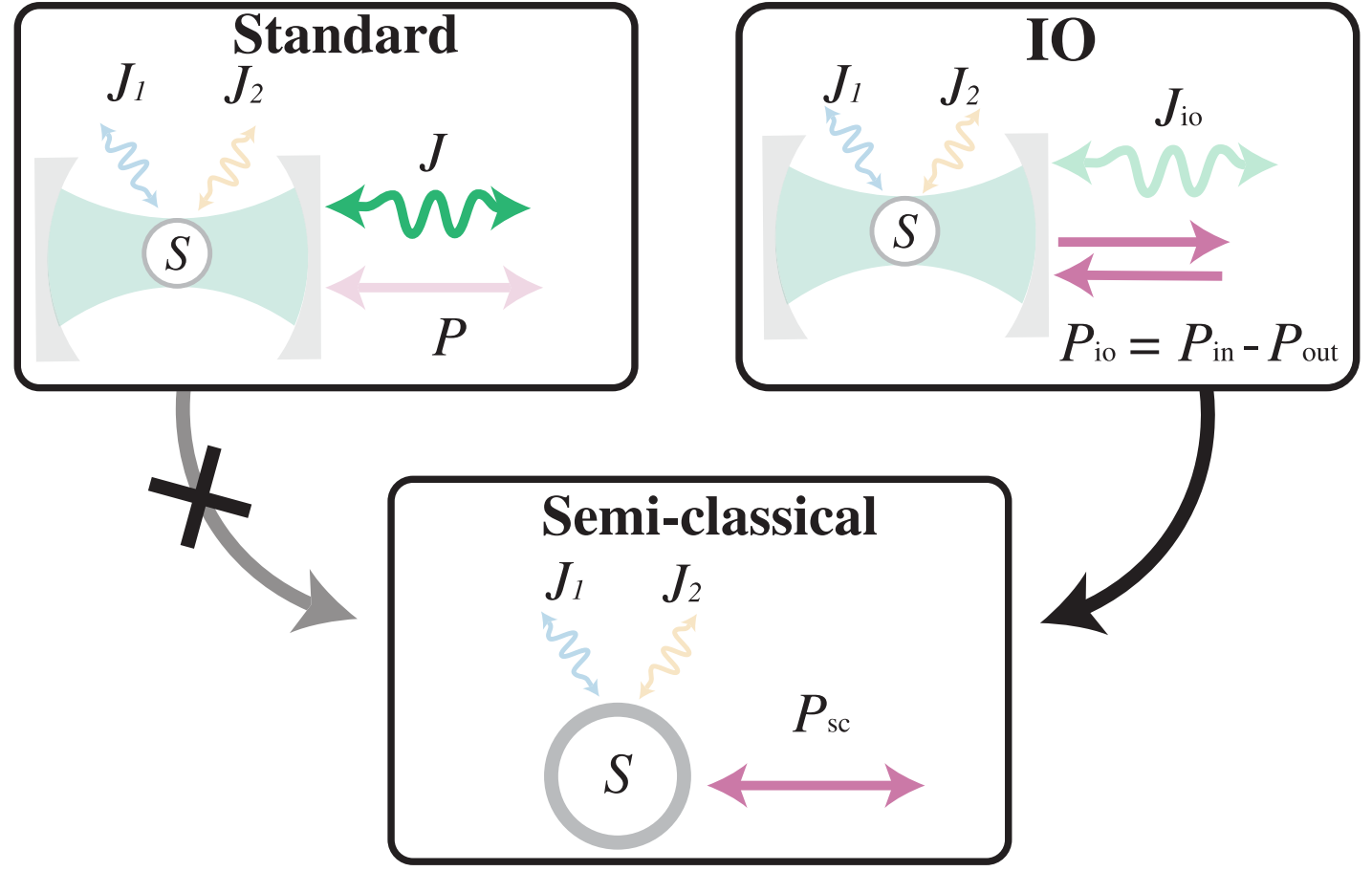
To reach that regime mathematically, the researchers considered a cavity with a large coherent field while reducing the atom-light coupling relative to the cavity decay rate. The product of the coupling and coherent field strength stays fixed.
Under those conditions, quantum fluctuations around the dominant light field become weak. The cavity acts as an externally controlled drive on the atom rather than as a strongly backacting quantum system.
That limiting model has a clear thermodynamic structure. Power comes from the coherent drive, while dissipative processes acting directly on the quantum system contribute to entropy production. The cavity field itself contributes no heat current.
The input-output framework reproduces that behavior. In the semiclassical, long-time limit, its power becomes the semiclassical power, its cavity heat current goes to zero, and its entropy production matches the semiclassical result.
The standard framework does not. It keeps assigning an entropy-producing heat current to the cavity field. That contribution grows with the square of the coherent cavity amplitude and causes calculated entropy production to diverge in the semiclassical limit.
The distinction becomes especially important for thermodynamic uncertainty relations, or TURs. These relations connect current fluctuations with entropy production in systems operating away from equilibrium.
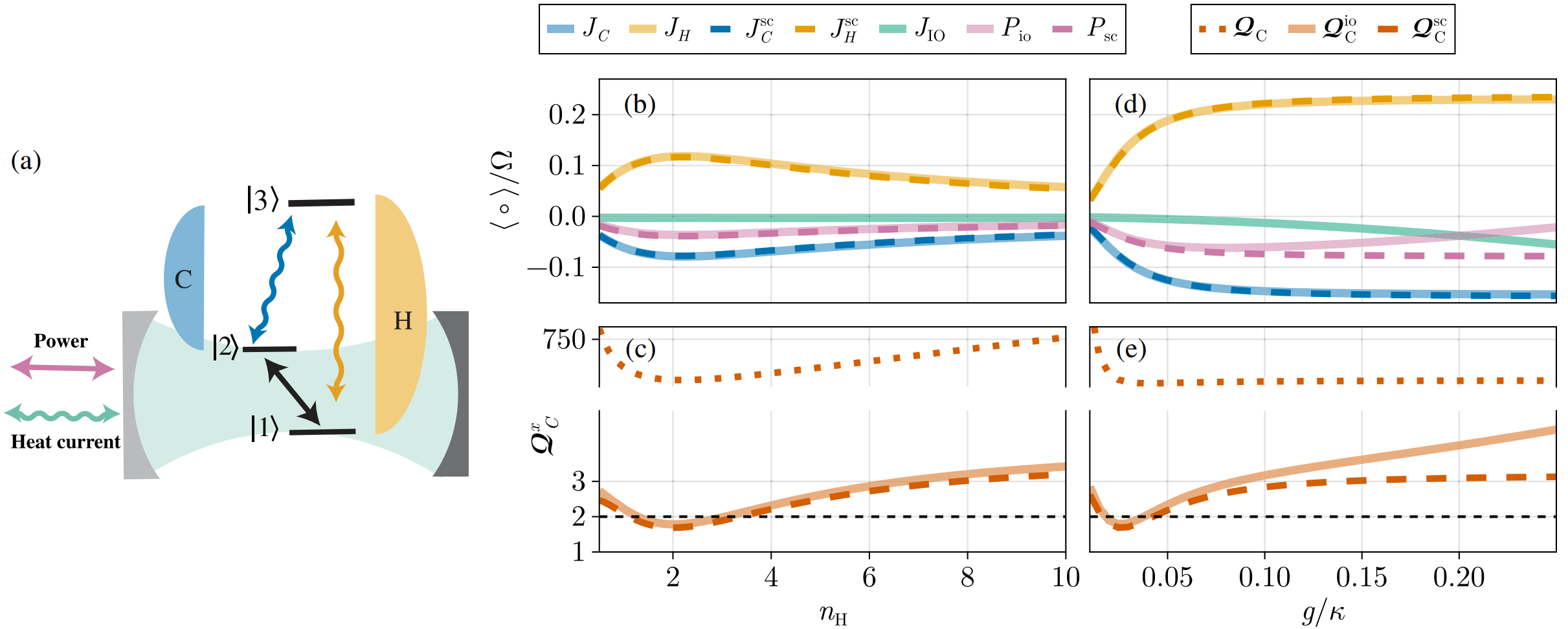
For classical Markovian dynamics, a commonly used thermodynamic uncertainty quantity has a lower bound of 2. Quantum coherence can suppress fluctuations enough to violate that bound, although such violations depend strongly on the system.
If entropy production is overestimated, the violation can disappear from the calculation even when quantum effects are present.
The researchers demonstrated this with a cavity-embedded three-level maser, a three-level atom coupled to a cavity and hot and cold thermal baths. Its semiclassical version can violate the classical TUR because quantum coherence suppresses fluctuations in the cold heat current.
Using the input-output framework, the fully quantum cavity model preserved that behavior. Its thermodynamic uncertainty fell below 2 in the appropriate regime and approached the semiclassical result.
The standard framework produced a sharply different picture. Its calculated uncertainty differed from the semiclassical value by orders of magnitude and never crossed below the classical bound. It also predicted power with the wrong sign and orders-of-magnitude larger magnitude in the tested regime, making the maser appear to stop functioning as a heat engine.
The agreement has limits. As atom-cavity coupling increases, the system moves away from the semiclassical regime and quantum fluctuations of the cavity field become increasingly important.
The treatment also rests on assumptions used in quantum Markovian master equations and quantum white-noise input fields. These include weak system-bath coupling, a flat bath spectrum and the rotating-wave approximation.
The authors state that the framework applies beyond the three-level maser, including cavity systems with multiphoton interactions and multiple driven-dissipative cavity modes.
The work gives physicists a more consistent way to separate useful energy from entropy-producing heat in cavity-based quantum machines. That distinction can determine whether a device’s nonclassical behavior is visible in thermodynamic measurements.
Reduced fluctuations can also become a resource rather than merely a source of noise. The researchers note that particular low-fluctuation states of light could support especially precise measurements in quantum metrology.
The next challenge lies beyond the semiclassical regime, where cavity-field fluctuations become essential and no independent classical benchmark may exist. The authors identify strong-coupling systems, including regimes involving photon blockade, bright states and dissipative phase transitions, as promising places to investigate further TUR violations.
They also point to a technical problem still to be solved: developing full-counting-statistics methods for coherent power and cavity heat currents within the input-output framework. Such tools could help determine whether thermodynamic uncertainty relations can be formulated directly for worklike observables.
These resources explore how heat, work, entropy, coherence and fluctuations behave in quantum machines, providing broader theoretical and experimental context for cavity-based quantum thermodynamics.
Thermodynamic Framework for Coherently Driven Systems
This work develops the input-output thermodynamic framework central to distinguishing useful coherent light from heat, showing that accessible outgoing light changes how work and entropy production should be defined in driven quantum systems. (Physical Review Letters, 2025)
Thermodynamic uncertainty relation of a quantum mechanically coupled two-qubit system
This study examines how quantum coherence, coupling and correlations alter thermodynamic uncertainty relations, finding regimes where quantum systems can suppress current fluctuations below the conventional classical bound. (Physical Review Research, 2025)
A unified framework for classical and quantum uncertainty relations using stochastic representations
The authors develop a common framework for uncertainty relations in classical and open quantum systems, including quantum bounds that become tighter when genuinely quantum effects play an important role. (Communications Physics, 2025)
Probing coherent quantum thermodynamics using a trapped ion
This experiment uses a trapped ion to directly identify quantum-coherent corrections to classical work-fluctuation relations, demonstrating how coherence can leave measurable thermodynamic signatures in a controlled quantum system. (Nature Communications, 2024)
Researchers experimentally realized a quantum Otto heat engine using a superconducting qubit and a tunable thermal reservoir, measuring positive work output and efficiency and providing a recent test bed for quantum thermodynamic theory. (Nature Communications, 2026)
Research findings are available online in the journal Physical Review Letters.
The original story “Quantum coherence links quantum engines with classical thermodynamics” is published in The Brighter Side of News.
Like these kind of feel good stories? Get The Brighter Side of News’ newsletter.
The post Quantum coherence links quantum engines with classical thermodynamics appeared first on The Brighter Side of News.


Leave a comment
You must be logged in to post a comment.